
 Deutsch
 Español
 Français
 Italiano
 Magyar
 Polski
 Slovenčina
 Čeština
Loyalty members spend 38-50% more than non-members and visit more frequently, yet most small businesses are still running the same basic stamp card they launched years ago. The gap between a simple rewards program and a true subscription loyalty model is significant, and understanding that gap can change how you retain customers and grow revenue. This article walks you through what subscription loyalty actually means, why it works better than traditional rewards for many SMBs, and how to build and optimize a program that keeps your best customers coming back consistently.
Key Takeaways
| Point | Details |
|---|---|
| Loyalty membership boosts spend | Customers in loyalty programs spend up to 50% more and visit more often. |
| Subscription loyalty delivers outsized ROI | Automating and piloting subscription loyalty can yield 340-500% ROI in the first year for SMBs. |
| Paid programs filter superfans | Paid subscription models attract highly committed customers, while free models appeal broadly but may attract discount seekers. |
| Start small, iterate with data | Launching a pilot and analyzing results helps optimize your loyalty program for greater impact. |
| Commitment creates lasting community | Subscription loyalty builds emotional commitment, fostering a loyal customer base beyond simple sales. |
What is subscription loyalty—and how does it differ from basic rewards?
Before you can decide whether subscription loyalty is right for your business, you need to know what sets it apart. Understanding the loyalty program basics is the right starting point, but subscription loyalty takes those foundations further in a specific direction.
Traditional loyalty programs give customers points, stamps, or cashback every time they make a purchase. The rewards accumulate over time, and customers redeem them when they hit a threshold. There is nothing wrong with this approach. It encourages repeat visits and gives customers a reason to choose you over a competitor. But it is largely transactional. The customer earns, the customer redeems, and that is the end of the relationship until their next visit.
Subscription loyalty programs work differently. Customers pay a recurring fee, often monthly or annually, to become members of an exclusive tier. In return, they receive benefits that are available to them immediately and consistently, such as fixed discounts on every purchase, priority access, exclusive products, or a set number of free items per month. The customer has already made a financial commitment to you, which changes their behavior significantly.
Loyalty members spend 38-50% more than non-members and visit more frequently. When that loyalty is locked in through a subscription model, the spending advantage compounds because the customer has a vested interest in using the benefits they paid for.
The behavioral difference is striking. In a traditional program, customers earn rewards passively and may forget about them entirely. In a subscription model, customers actively seek out your business because they want to justify the membership fee they already paid. This psychological driver, called the “sunk cost effect,” works in your favor.
Here is a quick comparison of the two models:
| Feature | Traditional loyalty | Subscription loyalty |
|---|---|---|
| Customer cost | Free to join | Paid recurring fee |
| Reward timing | Earned over time | Available immediately |
| Customer commitment | Low | High |
| Visit frequency impact | Moderate | Strong |
| Revenue predictability | Variable | Consistent |
| Risk of churn | Higher | Lower |
Key differences that matter for your business:
- Subscription loyalty creates predictable recurring revenue in addition to purchase revenue
- Paid members tend to spend more per visit because they want to maximize value
- Exclusivity and loyalty are closely linked; when customers feel like VIPs, they develop stronger emotional connections to your brand
- Traditional programs reward past behavior; subscription programs motivate future behavior from day one
The exclusivity factor should not be underestimated. When customers pay for access to a special tier, they associate your business with prestige and value. That perception drives both retention and word-of-mouth referrals, which are two of the most powerful growth levers available to small businesses.
The business case: Why SMBs benefit from subscription loyalty
You might assume subscription loyalty is only for large retailers with massive customer bases. The reality is that smaller businesses often see stronger results because their customer relationships are more personal and their programs can be more tailored.
The numbers tell a compelling story. Automating a subscription loyalty program can deliver 340-500% ROI in year one for small businesses, particularly when you combine smart targeting with automated communications. That kind of return is achievable because the program works around the clock without requiring your manual attention.

Here is why subscription loyalty specifically benefits SMBs:
| Benefit | Impact on SMB |
|---|---|
| Predictable revenue | Membership fees stabilize cash flow |
| Higher purchase frequency | Subscribed members visit up to 2x more often |
| Increased average spend | Members spend more per visit to maximize value |
| Lower marketing costs | Retained customers cost less than acquiring new ones |
| Better customer data | Subscription programs capture richer behavioral data |
To put it into practice, here are the steps most successful SMBs follow when piloting a subscription loyalty program:
- Identify your top 20% of customers. These are the people who already visit frequently and spend above average. They are your most likely early subscribers.
- Define what benefits you can offer sustainably. Think about discounts, exclusive access, free items, or priority service. Make sure the value is real and consistent.
- Set a price point that filters for commitment. The fee should be meaningful enough to attract serious customers but accessible enough not to create a barrier for your target audience.
- Launch with a small pilot group. Invite your best existing customers first. Gather feedback before opening the program broadly.
- Automate the member experience. Set up automated welcome messages, benefit reminders, and renewal notifications so the program runs smoothly without manual effort.
- Track key metrics from week one. Monitor visit frequency, average spend per member, and renewal rates to understand what is working.
Pro Tip: Start your subscription loyalty pilot with no more than 50 to 100 customers. A smaller group gives you real data without overwhelming your operations, and it lets you refine the benefits and messaging before scaling. Many SMBs find that their pilot group generates enthusiastic referrals organically, which accelerates broader adoption.
Automation is critical to making this work without burning out your team. When you use software for subscription loyalty that handles communications, renewals, and reporting automatically, you free yourself to focus on delivering the actual customer experience. The program becomes a system that runs itself while you run your business.
Paid vs. free subscription loyalty: Filtering profitable superfans
Once you understand why subscription loyalty works, the next decision is whether to charge for it or offer it free. Both models have genuine advantages, and the right choice depends on your specific business goals and customer profile.
Paid subscription loyalty requires customers to pay a fee, monthly, quarterly, or annually, to access exclusive benefits. The most important effect of a paid model is filtering. When customers hand over money to join, they are demonstrating real commitment. They are not casual visitors looking for a freebie. Paid subscription loyalty filters superfans, builds commitment, and reduces the risk of attracting customers who only engage when there is a deep discount on offer. Amazon Prime is the most cited large-scale example, but cafes, gyms, and specialty retailers use the same principle at a local level with excellent results.
Free subscription loyalty lowers the barrier to entry and appeals to a much broader audience. More customers join, which gives you a larger dataset and more touchpoints. The risk is that free members have made no financial commitment. Some will engage deeply; others will sign up, claim a welcome offer, and disappear. Without a cost filter, you may end up with a program that delivers discounts to people who were going to buy from you anyway, without meaningfully increasing their spend or visit frequency.
Key considerations when choosing your model:
- Your average transaction value: Paid models work better when your product or service has a higher price point because the member fee feels proportionate
- Your existing customer loyalty: If you already have a strong community of regulars, paid tiers reward them and deepen the relationship
- Your cash flow goals: Paid subscriptions generate recurring revenue immediately; free programs generate revenue only through purchases
- Your competitive environment: If competitors already offer free loyalty, a paid tier with genuinely superior benefits can differentiate you
| Factor | Paid model | Free model |
|---|---|---|
| Customer commitment | High | Low to moderate |
| Barrier to entry | Higher | None |
| Revenue predictability | Strong | Weak |
| Risk of discount-seekers | Low | Higher |
| Program reach | Narrower | Broader |
Pro Tip: Consider launching both tiers. A free tier keeps casual customers engaged and builds your base, while a paid premium tier filters for your most valuable superfans. This two-tier approach is common among businesses that want reach and depth at the same time. Studying top loyalty app examples shows that many successful SMBs run exactly this kind of layered structure.
The paid model is not about excluding customers. It is about giving your best customers a way to signal their commitment and be rewarded accordingly. When you frame it that way, the program becomes a privilege rather than a paywall.
Practical steps: Building and optimizing a subscription loyalty program
Knowing why subscription loyalty works is one thing. Knowing how to build it is another. This section gives you a structured path from planning to optimization, with specific actions at each stage.
Planning stage
Start by defining your objective clearly. Are you trying to increase visit frequency among existing customers, raise average transaction value, or both? Your objective determines which benefits you include and how you price the membership. Segment your customer base using your existing purchase data. If you do not have clean data yet, start collecting it now. Even basic information about visit frequency and average spend is enough to identify your target subscriber group.
Launch stage
- Choose a platform that supports subscription management, automated communications, and real-time reporting without requiring a point-of-sale integration.
- Build your welcome sequence. Every new subscriber should receive an automated message immediately after joining that explains their benefits clearly and tells them exactly how to use them.
- Set up automated benefit reminders. If a member has not visited in 21 days, send a push notification or email reminding them what they are missing.
- Create an onboarding promo for the first 30 days. A special offer in the first month drives early engagement and gets members into the habit of using their benefits.
- Invite your pilot group and monitor closely. Watch for friction points where members are confused about how to redeem benefits.
- Collect feedback at the 30-day mark. Ask subscribers what they value most and what they would change.
Optimization stage
This is where most programs either improve dramatically or stall. Use automating loyalty emails to trigger personalized messages based on member behavior, not just calendar dates. If a member always visits on Tuesdays, schedule their benefit reminder for Monday evening. Small personalizations like this increase redemption rates significantly.
Key metrics to monitor every month:
- Subscriber renewal rate: This is your most important indicator of program health
- Average spend per subscriber vs. non-subscriber: This shows you the actual revenue impact
- Visit frequency change: Are subscribers visiting more often than they did before joining?
- Benefit redemption rate: Low redemption may mean benefits are too complicated or not valuable enough
Pro Tip: The fastest win for most SMBs is setting up a simple automated email or push notification sequence using loyalty tools for SMBs that reminds subscribers about unused benefits just before the month resets. This single automation typically drives a measurable lift in visit frequency within the first 60 days.
The key to long-term optimization is treating your program as a living system. Review your data monthly, adjust benefits based on what subscribers actually use, and retire anything that generates cost without driving behavior.
The overlooked secret: Commitment creates community, not just sales
Most guides on loyalty programs focus entirely on the transactional side: how much members spend, how often they visit, and what the ROI looks like on paper. These numbers matter, but they miss what actually drives them.
When a customer pays to be part of your loyalty program, they are not just buying benefits. They are joining something. They are making a statement about which businesses they identify with. That shift from transactional customer to committed community member is where the real compounding effect begins.
Retention consistently outperforms acquisition in cost and long-term value, but the businesses that get the highest returns do not just retain customers. They build a group of people who feel connected to the brand and bring others with them. Referral rates among paid subscription members are significantly higher than among casual loyalty users because committed members want others to share what they have discovered.
This is what most programs miss. Emotional commitment amplifies every other metric. When you look at loyalty program case studies from successful SMBs, the ones that sustain growth over years are almost always the ones where subscribers feel like insiders, not just recipients of discounts. Build that feeling intentionally, and your program becomes something people talk about.
Take your next step with subscription loyalty solutions
If this article has shown you the potential of subscription loyalty for your business, the next step is finding the right tools to make it real.
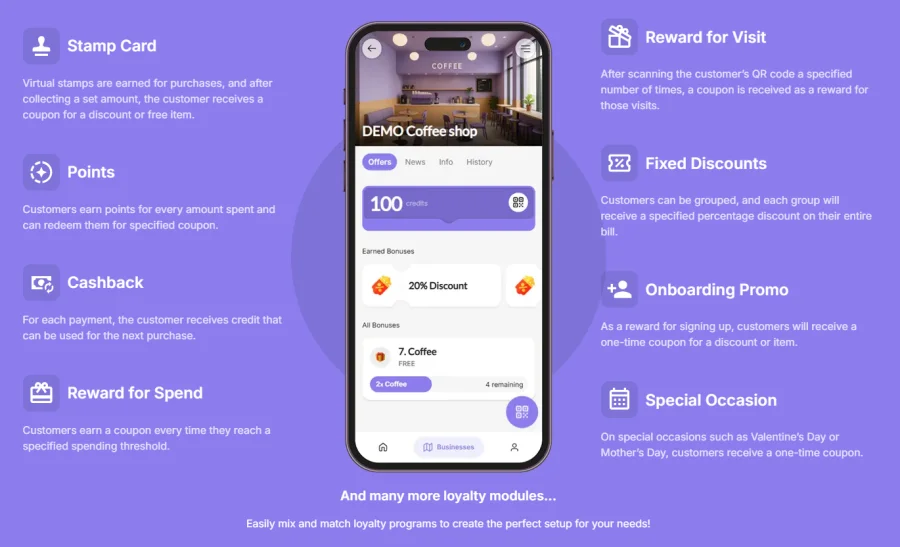
BonusQR is built specifically to help SMBs like yours launch and manage subscription loyalty programs without complexity or heavy setup. You can explore the full set of system features, including automated campaigns, real-time analytics, push notifications, and flexible reward structures. Whether you run a service business or a retail shop, subscription loyalty for services offers tailored options that fit your model. Ready to see what is possible? Start with BonusQR and get your program running faster than you might expect.
Frequently asked questions
How does a subscription loyalty program improve customer retention?
Subscription loyalty programs increase visit frequency and spending by incentivizing ongoing engagement and commitment. Because loyalty members visit more frequently and spend significantly more than non-members, the subscription structure amplifies these effects by locking in that commitment upfront.
What is the typical return on investment (ROI) for SMBs launching subscription loyalty?
SMBs can achieve 340-500% ROI in the first year by automating and piloting subscription loyalty programs strategically. The key is combining a well-defined pilot group with automated communications that minimize manual workload.
Should my business choose a paid or free subscription loyalty model?
Paid models attract committed superfans, while free models appeal widely but risk attracting discount-seekers; your choice depends on your goals and customer profile. A paid model filters for commitment and generates recurring revenue, while a free model builds a broader base more quickly.
How do I start building a subscription loyalty program for my SMB?
Begin by targeting your best existing customers, set clear objectives, launch a small pilot, and use automation tools to streamline processes from day one. Automating your pilot program ensures you capture accurate data without adding operational burden to your team.