
 Deutsch
 Español
 Français
 Italiano
 Magyar
 Polski
 Slovenčina
 Čeština
Loyalty card stamps are a classic for a reason: they work. This simple concept rewards regulars for their repeat business, giving them a tangible reason to come back. For a small business-whether a coffee shop, salon, or retail store-this method is a powerful, low-cost way to build genuine relationships and turn one-time visitors into loyal fans.
But are traditional paper stamps still the best way? Or is there a smarter, simpler, and more secure approach? This guide will walk you through everything you need to know.
Why Loyalty Card Stamps Are a Must-Have for Small Businesses
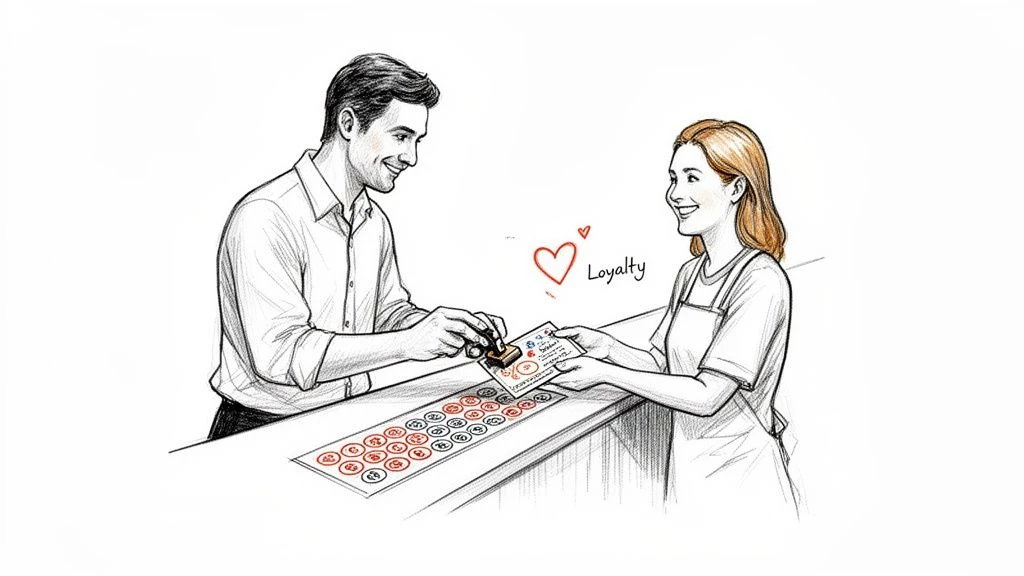
Running a small business is tough. You're not just competing on price or product; you're competing for attention. A loyalty program is your secret weapon to stay top-of-mind and give customers a compelling reason to choose you, every single time.
It’s a simple strategy with a huge payoff: reward loyalty, and you get more loyalty in return.
The Psychology Behind Collecting Stamps
A stamp card is more than just a piece of paper; it’s a mini-game. Each stamp taps into our natural drive to complete goals and earn a prize. Psychologists call this the endowed progress effect-customers feel invested once they've started, making them more motivated to finish.
This isn’t just about giving away a freebie. It's about acknowledging your customers. Every stamp is a small "thank you" that strengthens their emotional connection to your brand.
A Direct Tool to Stop Customer Churn
Losing a customer is expensive. A loyalty program tackles this problem head-on. Why would someone try a new place when they're just two stamps away from a reward at yours? This simple incentive creates predictable repeat business, which is critical for stable revenue.
The data backs this up. Not only are companies rapidly adopting loyalty programs, but members also spend 12-18% more on average than non-members.
A loyalty program transforms a simple transaction into a relationship. It’s not just about the discount; it’s about making someone feel like a valued part of your community.
For a small business, that personal connection is your biggest advantage over large, impersonal chains. While a stamp card is a great start, it's worth exploring broader customer engagement best practices to build on that foundation.
Paper vs. Digital: Which Loyalty Program is Right for You?
This is the first major decision you'll make, and it impacts everything from your budget to your ability to measure success. So, do you stick with classic paper punch cards or embrace a modern digital solution?
Let's cut through the noise and look at the real-world pros and cons.
The old-school paper card has a certain charm. It’s tangible, easy to understand, and feels like a small gift. For a brand-new business, the low upfront cost is tempting. If you go this route, learning about printing on cardstock will help you create durable, professional-looking cards.
But the initial appeal of paper often fades when the practical problems appear.
The Hidden Problems with Paper Stamp Cards
While paper cards seem cheap and easy, they come with a list of headaches that can undermine your loyalty efforts. You're essentially flying blind, with no real way to know if your program is working or costing you money.
Here are the most common pain points for small business owners:
- Fraud is Easy and Common: Anyone can buy a similar stamp online and give themselves free rewards. That's your profit walking out the door.
- You Get Zero Customer Data: Who are your best customers? How often do they visit? When do they stop coming back? With paper, it's all guesswork. You can't measure ROI.
- It's a Hassle for Customers: Cards get lost, forgotten, or destroyed in the laundry. Every lost card is a lost incentive for that customer to return.
- Costs Add Up: Those "cheap" printing runs are a recurring expense. As your business grows, so does your printing bill.
Why Digital is Simpler and Smarter
Concerns about digital loyalty programs being "too expensive" or "too complicated" are outdated. Today’s digital tools are designed specifically for busy small business owners who need something that is affordable, secure, and just works.
Let's compare them head-to-head.
Paper Punch Cards vs. Digital Loyalty Apps
| Feature | Paper Punch Cards | Digital Loyalty Apps (like BonusQR) |
|---|---|---|
| Startup Cost | Low initial printing cost | Low monthly fee, often with free trials |
| Customer Experience | Familiar, but adds wallet clutter; easily lost or forgotten | Always on their phone, nothing to lose or forget |
| Fraud Risk | High; stamps can be faked or self-applied | Zero; stamps are digitally verified and unique |
| Data & Insights | None; impossible to track customer behavior | Rich data on visit frequency, spending, and popular rewards |
| Ongoing Costs | Recurring printing costs | Fixed, predictable monthly or annual subscription |
| Marketing Power | None; no way to communicate with customers | Built-in tools for sending push notifications and offers |
| Setup Time | Days (design and printing) | Minutes; launch your program instantly |
The choice is clearer than ever. Digital offers a superior solution to the biggest challenges of paper cards.
With a system like BonusQR, the customer's phone becomes the loyalty card-no app to download. It lives in their phone's native wallet (Apple Wallet or Google Wallet), so it's always with them. Each stamp is digitally verified, making fraud impossible.
The real game-changer is the data. For the first time, you can see who your regulars are, measure the program's impact on sales, and identify which rewards truly motivate people.
This isn't about adding complexity; it's about working smarter. You can spot a loyal customer who hasn't visited in a while and send them a targeted offer to win them back. That’s a power you just don't have with paper.
Ready to see what’s possible? Learn more about the benefits of digital customer loyalty cards in our complete guide.
How to Design a Reward That Customers Actually Want
A loyalty program is only as good as its reward. If the prize doesn't excite people, they won't bother collecting stamps. The goal is to offer something that feels valuable and achievable, without destroying your profit margins.
This is where many small businesses get it wrong. They either offer a reward that is too small to motivate or one that is too generous and becomes a financial drain. It's all about finding that profitable sweet spot.
Finding Your Reward Sweet Spot
Think beyond a generic "10% off." The best rewards feel like a special treat unique to your business.
- For high-frequency businesses (like a coffee shop): The classic "Buy 9, Get the 10th Free" model is effective. Customers earn it quickly, which reinforces the habit of visiting you.
- For low-frequency businesses (like a salon or boutique): Making a customer wait 10 visits for a reward could take a year. They'll lose interest. A better approach is offering a valuable add-on or a smaller reward after fewer visits. For a salon, a free deep-conditioning treatment after 4 visits is more motivating than a free haircut after 10.
This decision tree can help you visualize your options and how the format-paper or digital-influences your reward strategy.
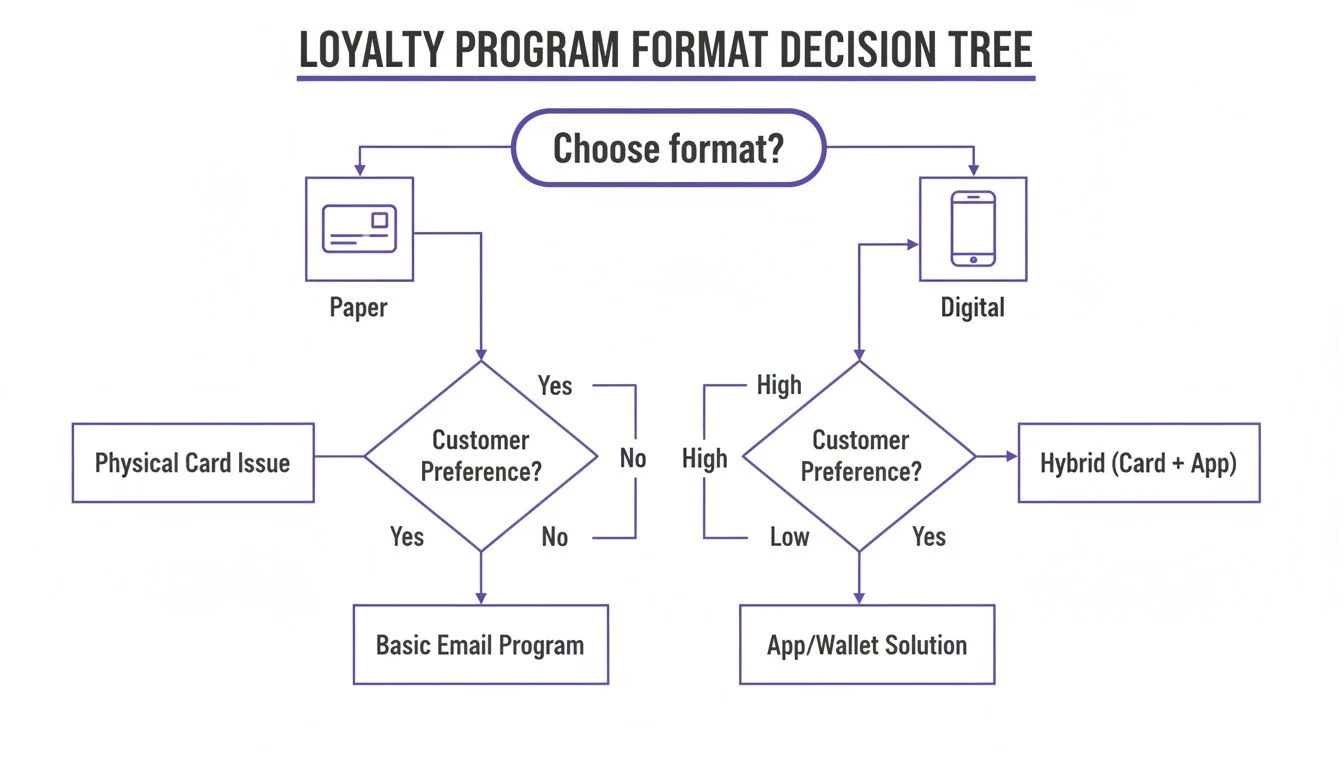
As you can see, going digital opens the door to more flexible and creative rewards, while giving you the data to see what works.
Calculating the Cost of Your Loyalty Program
Treat your reward as a marketing expense, not a loss. A good rule of thumb is to aim for a reward value that is 5% to 10% of the total customer spend required to earn it.
Here’s a simple calculation:
- Cafe Example: A customer buys 9 coffees at $4 each (total spend: $36). The 10th free coffee is worth $4. The reward value is 11% ($4 ÷ $36). This is a strong, motivating offer.
- Boutique Example: A customer must spend $200 to earn a $15 store credit. The reward value is 7.5% ($15 ÷ $200). This is sustainable and still feels worthwhile.
Pro Tip: Give new members an instant win. Stamping the first square on a paper card or digitally adding a bonus "welcome" stamp makes customers feel they've already made progress. This leverages the endowed progress effect and makes them far more likely to continue.
Make the Reward Feel Achievable
The #1 mistake is setting the finish line too far away. If the reward seems unreachable, customers won't even start. The number of loyalty card stamps required should align with your typical customer visit frequency.
A digital tool like BonusQR removes the guesswork. You can set up your program in minutes, define the rules, and use a simple dashboard to see how it's performing. This allows you to test different rewards and see what people love based on real-time data, not hunches.
Putting Your Loyalty Program Into Action
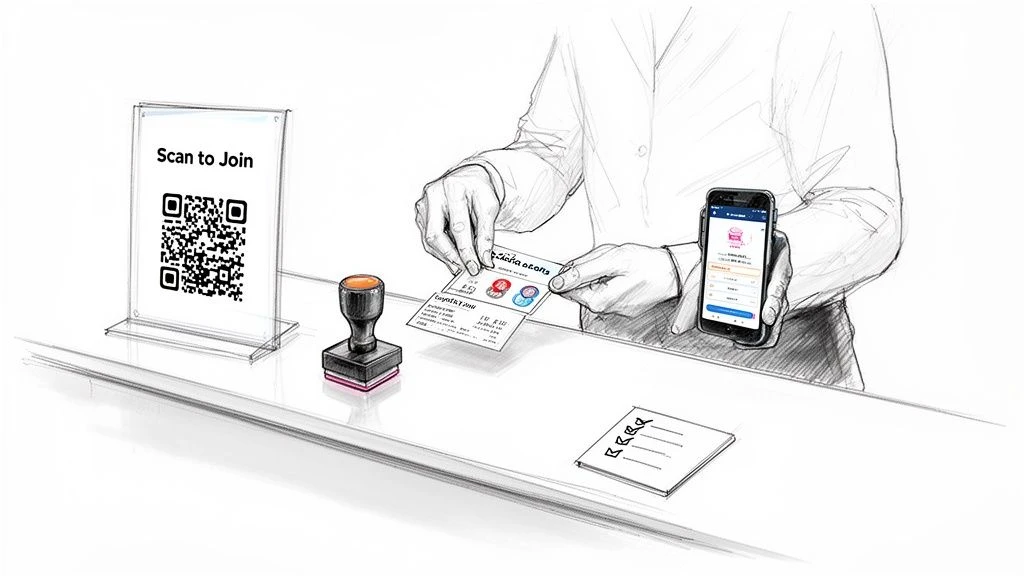
You have a plan. Now it’s time to bring it to life. Launching your program is a series of small, manageable steps. A smooth rollout comes down to preparing your materials and, most importantly, your team.
And customers are waiting. With the loyalty market projected to grow massively, these programs are no longer a "nice-to-have"-they're essential for staying competitive. You can dig into market trends in the latest market intelligence reports.
Launching Your Physical Card Program
If you’ve chosen paper loyalty card stamps, your first task is creating the cards. The design should reflect your brand, and the cardstock must be durable.
Next is the stamp. Don't use a generic star from an office supply store-that's an invitation for fraud. A custom rubber stamp with your logo is a small investment that adds security and professionalism.
Your launch checklist for a paper program:
- Design and Print Cards: Ensure the reward is clearly explained.
- Order a Custom Stamp: Make it unique to prevent fraud.
- Create In-Store Signage: Place signs near your entrance and checkout counter.
Launching a Digital Program in Minutes
For those going digital, the launch process is dramatically faster and simpler. A platform like BonusQR is built for speed. You can have your program live in the time it takes to brew a pot of coffee.
The setup is incredibly easy:
- Sign up and create your campaign online.
- Set the number of stamps and the reward.
- Customize the digital card to match your brand.
When you hit "publish," you get a unique QR code.
That QR code is the key. Customers scan it with their phone's camera to instantly add the loyalty card to their Apple Wallet or Google Wallet. No app download is needed. The whole process takes less than 10 seconds.
Your only task is to print and display that QR code at your checkout counter. That's it. Your program is now active, secure, and ready to attract members.
Training Your Team to Drive Sign-ups
Your employees are the face of your loyalty program. Their enthusiasm is contagious. If they are confident and can explain it simply, customers will be eager to join.
Give them a simple, consistent script to use.
Example Staff Script: "Would you like to join our free loyalty program? You get a stamp for every purchase, and after 9 stamps, your 10th coffee is on us! Just scan this QR code to get started."
This script is effective because it:
- Offers a clear benefit ("free loyalty program").
- Explains the simple rule ("9 stamps, 10th free").
- Provides a simple call to action ("scan this QR code").
By empowering your team with the right tools and simple messaging, you turn your program launch into a smooth, successful part of your daily operations.
How to Promote Your Program and Measure Its Success
A brilliant loyalty program is useless if customers don't know about it. Promotion is key to turning your investment into profit. The good news is, it doesn’t require a big budget-just consistency and making it incredibly easy for people to join.
Let's cover simple ways to promote your program and, crucially, how to measure if it's actually working.
Spreading the Word Without Spending a Fortune
Forget expensive ads. Your most powerful promotional tools are your physical space and your team. Your checkout counter is your #1 sign-up station.
Your staff are your biggest advocates. Train them to personally invite every customer to join. A friendly, one-on-one offer is far more effective than a passive sign.
Here are a few simple but powerful promotional tactics:
- Point-of-Sale Signage: Place a small, well-designed sign with your QR code right at the checkout. Message: "Join Our Rewards Program & Get Your First Stamp Today!"
- The Personal Invite: This is critical. Have staff say, "Are you part of our free rewards program yet? You can sign up right now by scanning this code."
- Social Media Kick-off: Announce the program on your social channels. Post a photo of the QR code stand and explain the simple benefits.
The goal is immediate sign-ups. The best time to get someone to join is when they are standing at your counter, ready to pay. Make it an effortless part of the transaction.
Tracking What Matters: Are You Making More Money?
Once people join, you need to know if the program is delivering results. How you measure success depends entirely on your choice of paper or digital.
With paper loyalty card stamps, your tracking is manual and limited. You can count redeemed cards to get a rough idea of engagement. But you’re missing the big picture: you don't know who your most loyal customers are, how many cards are active, or why some people stop participating.
This is where a digital solution like BonusQR provides an enormous advantage. Instead of guessing, you get a clear dashboard with actionable data.
You can see, in real-time:
- Total Members: How many customers have joined.
- Visit Frequency: How often members return compared to non-members.
- Redemption Rates: Which rewards are most popular.
- Customer Lifetime Value: Identify your top spenders and most frequent visitors.
This data moves you from "I think this is working" to "I know this is working." You can see the direct ROI and make smart decisions to improve your program. If you notice a drop-off after the third stamp, you can test a mid-way reward to keep people motivated.
Common Questions About Loyalty Stamp Programs
Even with a great plan, questions will come up. Here are answers to the most common queries from small business owners.
Are loyalty programs actually still effective?
Yes, absolutely. Rewarding regulars is a timeless business principle. The core "collect and redeem" model of a loyalty card stamp still works because it's simple for customers to understand and makes them feel appreciated.
The key to success isn't paper vs. digital-it's simplicity. A straightforward program with an achievable, desirable reward will always be effective.
How do I calculate what the reward should cost?
A safe and effective rule is to set the reward's value at 5-10% of the total amount a customer must spend to earn it. This makes the prize motivating without hurting your profit margins.
Don't view the reward as a loss. It's a marketing expense. It’s the cost of guaranteeing a future visit from a happy customer, which is far cheaper than acquiring a new one.
For a "buy 10, get one free" coffee program, that's a 10% reward value. Run the numbers for your own products to find the sweet spot where both you and your customers win.
What's the biggest mistake to avoid when starting?
The single biggest mistake is making the reward too hard to earn. If a customer thinks, "I'll never get there," they won't even start. The program must feel achievable.
- For a high-frequency business (daily customers), 8-10 stamps is a good target.
- For a low-frequency business (monthly clients), 4-6 stamps for a smaller reward is much more effective at keeping them engaged.
How can I stop customers from cheating a paper card system?
Fraud is a real and costly risk with paper cards. Using a custom-made stamp or having staff initial each stamp can help.
However, the only 100% fraud-proof solution is to go digital. A system like BonusQR eliminates cheating entirely. Each digital stamp is securely tied to a verified customer account, protecting your bottom line and ensuring every reward is earned legitimately.