Most restaurants lose a guest after the very first visit. No follow-up, no reason to return, no connection built. That’s a significant revenue loss, because acquiring a new guest costs five to seven times more than keeping an existing one. A well-designed rewards program changes this pattern by giving guests a clear, personal reason to choose you again. Rewards programs that are too complex or hard to use show a 65% non-redemption rate and push 50% of members to never return. This guide covers every step you need, from setup to optimization, so you can avoid those traps and build something that actually works.
Key Takeaways
| Point | Details |
|---|---|
| Prioritize simplicity | Simple rules and easy participation drive higher rewards program adoption and retention. |
| Integrate with POS | Using POS-integrated platforms with digital wallet passes automates tracking and reduces errors. |
| Promote everywhere | Consistent in-store and digital promotion is essential to grow loyalty program reach. |
| Monitor and adjust | Track key metrics and regularly optimize rules, tiers, and offers for maximum impact. |
What you need before you start
Now that we’ve established why loyalty matters, let’s lay out exactly what you’ll need before jumping into setup.
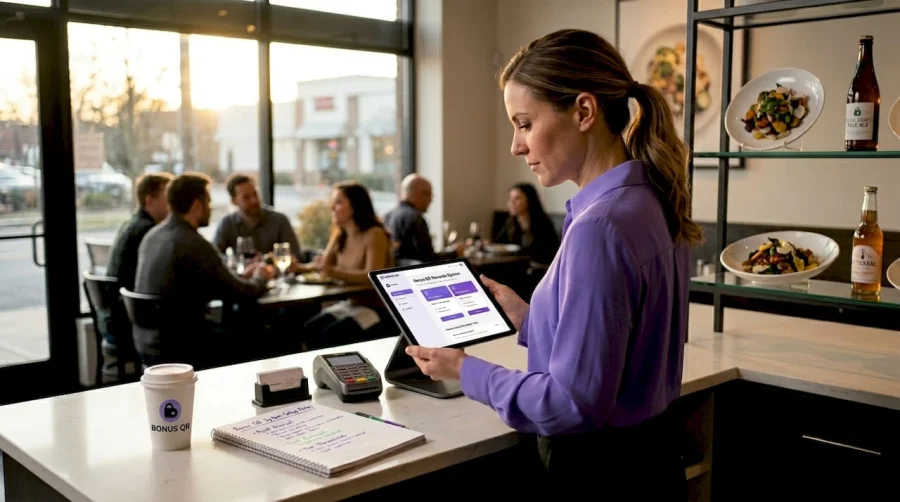
Before you design a single reward, take stock of your current tools and team readiness. A rewards program is only as strong as the infrastructure behind it. Missing a key piece upfront leads to confusion at the counter, frustrated guests, and wasted budget.
Here are the core requirements you should have in place:
- A point-of-sale (POS) system that can either integrate with your rewards platform or at least support a simple scan or check-in process
- Digital wallet support or a web-based enrollment option so guests can join without downloading an app
- Clear program goals, such as increasing visit frequency, boosting average check size, or improving guest retention rates
- A trained front-of-house team that knows how to enroll guests quickly, explain the benefit in one sentence, and troubleshoot basic issues
- A simple earning structure that guests can understand in under 30 seconds
POS integration is essential for digital rewards programs to run smoothly and minimize staff friction. When your POS talks directly to your rewards platform, points are applied automatically at checkout. No manual entry, no missed stamps, no arguments at the register.
You also need to decide on your program structure before launch. There are three common options:
| Structure type | Best for | Complexity level |
|---|---|---|
| Stamp card (visits) | Cafes, fast casual | Low |
| Points per dollar spent | Full service, bars | Medium |
| Tiered VIP program | High-frequency guests | Higher |
Start simple. You can always add tiers and VIP perks later once you understand how your guests engage. Understanding digital loyalty program basics will help you choose the right structure from day one. If you’re deciding between paper and digital options, reviewing the case for digital vs. paper loyalty systems is worth your time before committing.
Pro Tip: Start with the simplest tools that work with your existing setup. A digital stamp card delivered via a wallet pass requires zero new hardware and can be live within a day.
Step-by-step restaurant rewards setup process
With essentials in place, here’s an actionable, proven step-by-step setup so you can build a program that actually works.
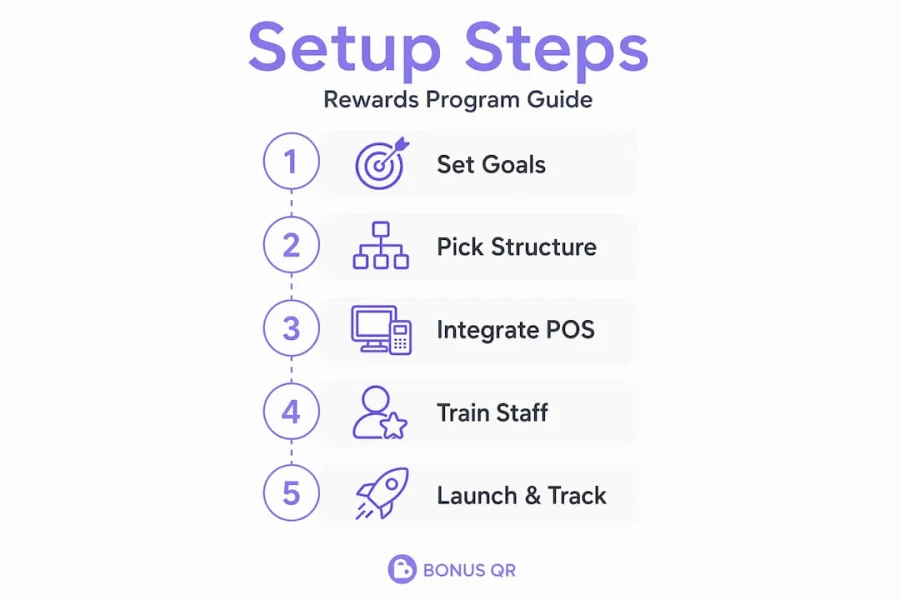
A structured setup process covers defining goals, choosing a reward structure, selecting a POS-integrated platform, designing simple rules, enrolling guests via QR codes and staff prompts, training staff, and promoting everywhere. Follow this sequence and you’ll have a functional, guest-ready program within a week.
-
Define your program goals and key metrics. Are you trying to increase visit frequency from once a month to twice a month? Raise your average check by 10%? Grow your email list? Pick one or two clear goals so you can measure success honestly.
-
Choose your reward type. Points per dollar spent reward higher spenders, which is ideal for full-service restaurants. Points per visit work well for quick-service or coffee shops where frequency matters more than ticket size. Decide which model aligns with your guest behavior.
-
Select a platform. Look for a platform that supports automatic POS integration and digital wallet passes. This removes manual steps for both your staff and your guests. Evaluate whether the platform offers push notifications, real-time analytics, and customizable branding, all of which make a measurable difference in engagement.
-
Design simple earning and redemption rules. A rule like “earn 1 point for every $1 spent, redeem 100 points for $10 off” is clear and easy to remember. For stamp cards, 8 to 10 stamps for a free item is a proven sweet spot. Anything more complex and you’ll start losing guests at the moment they try to understand the offer.
-
Set up enrollment tools. Place QR code signs at tables, at the register, and on carry-out bags. A small tent card at every table is one of the highest-performing enrollment tactics available. Train staff to introduce the program during the transaction with a simple script: “Would you like to earn a free [item] after your next few visits?”
-
Train your team thoroughly. Staff who don’t believe in the program won’t promote it. Run a short training session. Cover enrollment steps, common guest questions, and what to do if something doesn’t scan correctly. Role-playing the enrollment conversation takes ten minutes and dramatically increases sign-up rates.
-
Promote everywhere on launch day. Post on social media, add a note to your email list, put a sign in your window, and brief your team the morning of launch. A quiet rollout is a failed rollout.
| Step | Action | Timeline |
|---|---|---|
| 1 | Set goals and metrics | Week 1, Day 1 |
| 2 | Choose reward type | Week 1, Day 2 |
| 3 | Select platform | Week 1, Days 2-3 |
| 4 | Build earning and redemption rules | Week 1, Days 3-4 |
| 5 | Set up enrollment tools | Week 1, Days 4-5 |
| 6 | Train staff | Week 1, Days 5-6 |
| 7 | Launch and promote | Week 1, Day 7 |
For real-world ideas on how other restaurants have structured their programs, browse these loyalty program examples to see what’s working across different formats and price points.
Pro Tip: Set up automated milestone notifications. A message like “You’re 2 visits away from a free drink!” sent via push notification or wallet pass alert is one of the most cost-effective re-engagement tools you have.
Avoiding common rewards program mistakes
Even with a solid setup, pitfalls abound. Get ahead by learning from what commonly goes wrong.
Common failures include making rewards too hard to reach, requiring app downloads, treating all guests the same, promoting poorly, and ignoring program data. Each of these mistakes quietly erodes the value you’ve worked to build.
Here’s what to watch out for:
- Rewards set too far out of reach. If a guest needs 20 visits to earn a free appetizer, most will give up before getting there. Keep the first reward achievable within three to five visits. That early win creates a habit.
- Forcing guests to download an app. App download rates for loyalty programs hover around 10 to 20%, while digital wallet passes see adoption rates of 65 to 75%. Remove as much friction as possible from enrollment.
- Treating all guests the same. Your guest who visits three times a week deserves a different experience than someone who comes once a month. Add a VIP tier with exclusive perks like early access to specials or a birthday bonus for your most loyal guests.
- Weak promotion inside and outside the restaurant. Your most enthusiastic guests won’t know the program exists if you don’t tell them. Promote at the register, on receipts, on your website, in your email footer, and across social media consistently.
- Ignoring your program data. Most platforms give you real-time analytics. Use them. If redemption rates are low, your rewards may be too hard to earn. If enrollment is stalling, your enrollment process may have too many steps.
“The biggest loyalty program failures aren’t technical. They’re behavioral. When guests feel like they’re working hard for a small reward, they stop engaging entirely.”
Review these common loyalty mistakes to identify any gaps in your current or planned setup before they cost you guests.
Pro Tip: Eliminate point expiration from your program rules. Research shows that 35% of guests disengage specifically because their points expired. Removing expiration is a zero-cost change that protects your retention rate.
Tracking success and optimizing your rewards program
Once your program is live, let’s make sure it’s delivering results and that you keep improving it over time.
Launching a rewards program is not a “set it and forget it” task. Your program needs regular review, just like your menu or your staffing schedule. The good news is that most modern loyalty platforms give you the data you need to make smart decisions quickly.
Here are the key metrics to track from day one:
- Enrollment rate: What percentage of your unique guests have joined? Aim for 30% or higher.
- Active participation rate: Of enrolled members, how many are actually earning or redeeming? Target 50% or more as an active base.
- Redemption rate: Are guests using their rewards? A healthy range is 20 to 40%. Below that means rewards feel too hard to reach.
- Visit frequency change: Are loyalty members visiting more often than non-members? This is your clearest proof of program ROI.
- Average check size: Are members spending more per visit? A well-designed program often lifts average spend by 10 to 20%.
Healthy program targets set enrollment at 30% or more of unique guests, active participation above 50%, and redemption rates between 20 and 40%. Use these benchmarks to evaluate your program every 30 days for the first three months, then monthly after that.
Segmentation is your next lever. Once you have enough data, separate your guests into groups: first-time visitors, regulars, lapsed guests (haven’t visited in 60 or more days), and VIPs. Each group responds to different offers. A win-back offer for lapsed guests, such as “We miss you, here are 50 bonus points,” often outperforms any general promotion.
Explore these loyalty rewards ideas for creative ways to re-engage different guest segments. You’ll also find practical tactics to increase customer loyalty through small, consistent program improvements that compound over time.
Pro Tip: Celebrate guest milestones publicly and personally. A push notification that says “Congratulations, you’ve reached Silver status!” costs nothing and creates real emotional connection to your brand.
What most rewards guides miss: Focus on fast wins and smart balance
Most rewards program guides spend too much time on software features and not enough time on what actually drives behavior. Here’s a counterintuitive truth we’ve seen play out repeatedly: the fanciest loyalty platform in the world won’t save a program with confusing rules or a staff team that doesn’t buy in.
Mechanics that prioritize simplicity and quick wins consistently outperform complex gamification systems because guests don’t want to think. They want to feel rewarded quickly and effortlessly. When a guest earns their first reward on their second or third visit, that experience wires a behavioral loop. They come back expecting that feeling again. That’s the real engine behind loyalty.
Another insight most guides overlook: rewards programs are not a standalone marketing strategy. Loyalty programs are powerful, but they aren’t magic on their own. Restaurants that rely entirely on their loyalty program to drive traffic often see engagement slump when the novelty wears off. Pairing your program with regular email campaigns, seasonal promotions, social media engagement, and community events is what creates sustained revenue lift.
The restaurants that see the best results treat their rewards program as one piece of a broader guest relationship strategy. They use program data to inform their marketing calendar. They celebrate milestone moments with personal messages. And critically, their staff execute the program with zero friction because it’s been made genuinely simple.
Our recommendation is to resist the urge to add more features too early. A clean, fast program with a well-trained team beats a sophisticated program that confuses everyone involved. Build your digital retention strategy around simplicity first, then layer in complexity only where the data tells you it will help.
Discover smart tools for your rewards program
Ready to apply these steps? Here’s how BonusQR can power up your rewards program.
Building a rewards program from scratch doesn’t have to mean months of technical work or a big upfront investment. BonusQR gives you a fast, flexible platform built specifically to handle everything covered in this guide, from points and stamp cards to digital wallet passes, push notifications, and real-time analytics.
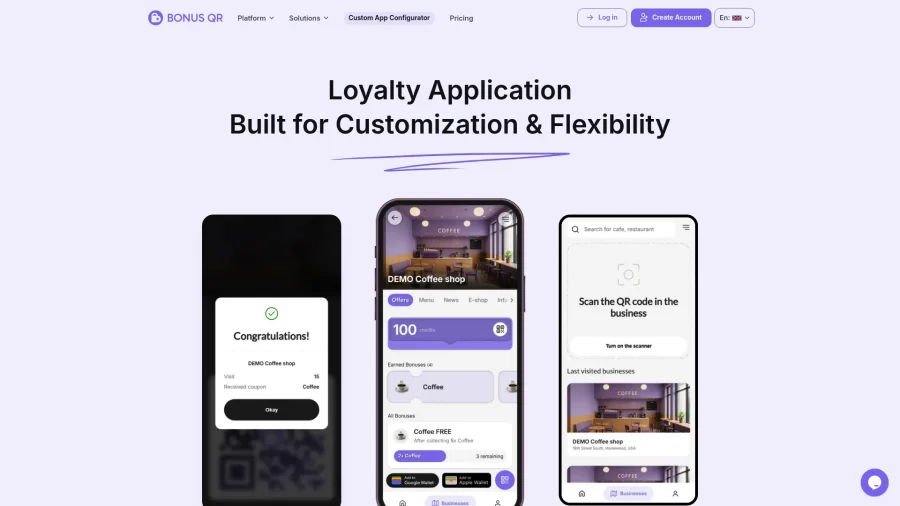
With BonusQR, you can launch a fully branded digital rewards program in hours, not weeks. Choose from points-per-dollar, visit-based stamps, cashback, or tiered VIP structures. Connect your program to digital wallet passes for frictionless guest enrollment. And manage everything, including your guest segments, redemption rates, and milestone messages, from one simple dashboard. Whether you’re running a single location or a growing group of restaurants, BonusQR scales with you. Explore BonusQR’s loyalty features and start building a program your guests will actually use.
Frequently asked questions
What are the best ways to promote my restaurant rewards program?
Promote in-store with QR codes at tables and the register, have staff introduce the program during each transaction, and reinforce enrollment online via email and social media. Enrolling via QR codes and staff prompts combined with consistent external promotion gives you the widest reach.
How many guests should enroll in a good rewards program?
Aim for over 30% of your unique guests joining your program, with more than half of enrolled members regularly engaging with earning or redemptions.
Should I use a mobile app or digital wallet for rewards?
Most guests prefer digital wallet passes because they require no download. Digital wallet passes achieve 65 to 75% adoption compared to 10 to 20% for dedicated loyalty apps, making them the smarter choice for most restaurants.
How do I keep guests from feeling frustrated by the rewards program?
Keep rewards easy to reach, make the first milestone achievable within three to five visits, and remove point expiration entirely. Avoiding point expiration is especially important because 35% of guests disengage specifically when they lose accumulated points.


