
 Deutsch
 Español
 Français
 Italiano
 Magyar
 Polski
 Slovenčina
 Čeština
TL;DR:
- Cashback offers immediate, transparent rewards that customers prefer over traditional points.
- It increases customer retention, spending, and visit frequency while providing measurable ROI.
- Simple, targeted cashback structures and tracking incrementality are key to successful programs.
Loyalty programs have a reputation problem. Many retailers invest in complex points systems, only to watch customers collect points they never redeem and disengage within months. If that sounds familiar, you’re not alone. 68% of shoppers view cashback as more valuable than equivalent points or discounts, and 86% prefer financial rewards over other loyalty perks. Cashback is changing the loyalty conversation by offering something customers actually understand and want: real money back. This guide covers what cashback means in retail, how it works in practice, and how you can use it to drive repeat purchases, higher spend, and lasting customer loyalty.
Key Takeaways
| Point | Details |
|---|---|
| Cashback builds loyalty fast | Offering cashback rewards drives repeat purchases, higher spend, and long-term loyalty among retail customers. |
| Instant value beats complexity | Transparent, easily-understood cashback programs outperform points-based rewards, leading to higher engagement and redemption. |
| Start simple and measure | Launching with simple, instant cashback on key products and tracking incremental sales provides reliable ROI and minimizes risk. |
| Program structure is key | Choosing the right format—instant, tiered, or category—determines margin impact and customer satisfaction. |
What is cashback and how does it work?
Now that you understand why loyalty fatigue is real, let’s get clear on exactly what cashback means in the retail context.
Cashback is a loyalty mechanism where customers receive a percentage of their purchase value returned to them, either as store credit or cash. Unlike points, which require accumulation and can expire or go unredeemed, cashback is immediate and transparent. As cashback programs reward customers with a percentage of purchase value returned as store credit or cash, often instantly at checkout, they are far more transparent than traditional points systems. Customers always know exactly what they’re getting.
Understanding how cashback in retail works helps you see why it outperforms older loyalty models. There are four main structures retailers use:
- Instant cashback: A fixed percentage returned immediately at checkout, often as store credit usable on the next visit.
- Cumulative cashback: Rewards accumulate over time and are redeemed once a threshold is reached, similar to points but expressed in dollar amounts.
- Category-specific cashback: Higher rates on selected product categories, useful for promoting high-margin items or slow-moving inventory.
- Tiered cashback: Customers earn higher rates as they reach spending milestones, rewarding your most loyal buyers.
Here’s how cashback compares to traditional points programs at a glance:
| Feature | Cashback program | Points-based program |
|---|---|---|
| Customer clarity | High (dollar value is clear) | Low (point value is often unclear) |
| Redemption complexity | Simple | Often complex |
| Breakage risk | Low | High (points expire or go unused) |
| Perceived value | High | Moderate to low |
| Speed of reward | Instant or near-instant | Delayed |
| Margin control | Predictable | Variable |
“68% of customers prefer cashback over equivalent discounts, citing transparency and immediate value as the primary reasons.”
The psychology behind this preference is straightforward. Customers respond to tangible, immediate rewards. When someone earns $2.50 back on a $50 purchase, they understand it instantly. When they earn 250 points, they often have no idea what that means or when they can use it. That clarity is what makes cashback a powerful driver of repeat visits and stronger customer relationships.
Why cashback loyalty works: Benefits for retailers and customers
Understanding the basics is one thing, but what does the data say about real-world impact?
Cashback programs drive repeat purchases, higher lifetime value, and are more cost-effective for retention than acquiring new customers. Retaining an existing customer costs significantly less than winning a new one, and cashback accelerates that retention by giving customers a concrete reason to return.

The numbers back this up. Upside users show 24% more visits and 5% higher spend per visit compared to non-participants. Even more striking, every $1 in cashback offered yields approximately 32 cents in additional revenue above baseline. That means cashback isn’t just a cost. It’s an investment that generates measurable incremental returns.
Here’s a snapshot of the impact metrics retailers can expect:
| Metric | Typical impact with cashback |
|---|---|
| Visit frequency | Up to 24% increase |
| Average spend per visit | Up to 5% increase |
| Customer retention rate | Significant improvement |
| Revenue per $1 cashback | ~$1.32 return |
| Customer churn reduction | Measurable decrease |
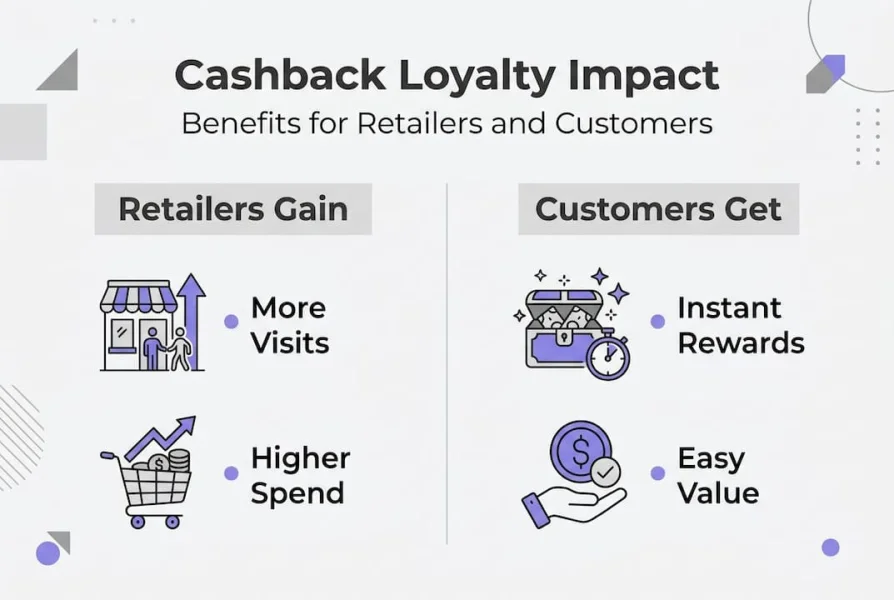
The benefits extend beyond numbers. Customers who participate in cashback programs feel more valued. They associate your store with a positive financial outcome, which builds emotional loyalty on top of transactional loyalty. That combination is powerful.
For retailers, the key advantages are:
- Lower acquisition costs: Retaining a loyal customer through cashback is far cheaper than running promotions to attract new ones.
- Increased basket size: Customers spend more when they know they’re earning back a portion of every dollar.
- Reduced churn: Regular cashback rewards create a habit of returning to your store.
- Predictable costs: Unlike discounts that erode margin unpredictably, cashback rates are set in advance and easy to model.
Building retention with cashback is one of the most reliable paths to long-term profitability. And when you consider the retention for retail success data, the case for cashback becomes even stronger.
Pro Tip: Use cashback to increase both visit frequency and basket size simultaneously. A well-structured program rewards customers for spending more, not just for showing up, which protects your margins while growing revenue.
Common cashback program structures: Choosing the right fit
Not all cashback is created equal. Let’s break down which model works best for your business.
Types include cumulative, category-specific, tiered, and store-locked cashback, each with unique advantages and levels of operational complexity. Choosing the right structure depends on your margins, customer base, and business goals.
Instant or store-locked cashback is the simplest and most popular starting point. Customers earn a fixed percentage back on every purchase, redeemable as store credit on their next visit. This format is easy to communicate, easy to manage, and delivers the immediate gratification customers respond to most.
Cumulative cashback works well for businesses with frequent, lower-value transactions. Customers build up a balance over time and redeem it once they hit a threshold. This encourages repeat visits and creates a sense of progress.
Category-based cashback lets you target specific products or departments. This is especially useful for promoting high-margin items or moving seasonal inventory. You can offer 10% back on a specific category while keeping standard rates elsewhere.
Tiered cashback rewards your biggest spenders with progressively higher rates. While this format is effective for VIP retention, tiered programs can risk confusing customers and eroding margins if the tiers aren’t designed carefully and incrementally. You can also explore tiered cashback programs to see how structured tiers can be built sustainably.
Before choosing a format, run through this checklist:
- What is your average transaction value and visit frequency?
- Which product categories have the highest margins?
- How tech-savvy is your customer base?
- Do you have the tools to track and distribute cashback accurately?
- Are you trying to attract new customers, retain existing ones, or both?
For retailers deciding between cashback and other formats, the cashback vs stamp card comparison is a useful reference point. You can also look at service coupon examples for inspiration on hybrid approaches.
Pro Tip: Start with instant, store-locked cashback at a simple flat rate. Once you understand your customer behavior and margins, layer in category-specific or tiered elements. Complexity added too early is the number one reason cashback programs underperform.
How to design, launch, and optimize a cashback program
Once you’ve chosen a structure, it’s time to put it into action. Here’s how to get it right from the start.
Implementation involves setting clear objectives, defining your program structure, choosing the right technology, and committing to ongoing optimization. Skipping any of these steps is where most programs go wrong.
Follow this step-by-step process:
- Set your objectives. Are you focused on reducing churn, increasing average order value, or winning back lapsed customers? Your goal shapes every other decision.
- Define your cashback structure. Choose your format, set your rate, and decide on redemption rules. Keep it simple enough for customers to explain to a friend.
- Choose your platform. You need a system that tracks purchases, calculates cashback accurately, and distributes rewards without manual effort. No POS integration should be required for basic setups.
- Launch with a clear communication plan. Tell customers what they earn, how they redeem it, and why it matters. Use push notifications, in-store signage, and email.
- Monitor key metrics from day one. Track visit frequency, average spend, redemption rates, and incremental revenue. These numbers tell you if the program is working.
- Optimize based on data. Adjust rates, test category-specific offers, and use personalization to deliver the right reward to the right customer.
Start small, test 5% instant cashback, track results for 6 to 18 months, and then optimize with personalization for maximum ROI. That timeline is realistic and gives you enough data to make confident decisions.
Most retailers who commit to tracking incrementality from launch see meaningful program ROI within 6 to 18 months. Those who don’t track it often can’t tell whether cashback is growing their business or just subsidizing purchases that would have happened anyway.
For a deeper look at execution, the guide on how to offer cashback rewards covers practical steps tailored to small and mid-size retailers in 2026.
Pro Tip: Use dynamic cashback rates tied to customer segments. Your best customers might earn 5% while new customers earn 8% for their first three visits. Personalization like this drives both acquisition and retention without applying the highest rate across the board.
Our perspective: Where most cashback programs go wrong (and how to truly win)
Despite the best intentions, even the most promising cashback programs can fail to deliver unless retailers focus on what matters most.
The most common mistake we see is over-complication. Retailers build tiered structures with confusing rules, then wonder why customers don’t engage. The second mistake is treating cashback as a discount tool rather than a retention and incrementality tool. Those are fundamentally different goals, and confusing them leads to margin erosion with no loyalty payoff.
Smart retailers prioritize instant, store-locked cashback for one reason: it works. Customers understand it, redeem it, and come back for it. Explore tiered cashback pitfalls before adding complexity you don’t yet need.
The real differentiator is tracking incrementality. You need to know whether your cashback program is driving purchases that wouldn’t have happened otherwise, or simply rewarding customers who would have bought anyway. That distinction determines whether your program is profitable or just expensive. Pair this with strong customer retention strategies and you have a system that actually grows your business. Keep it simple, measure what matters, and optimize from there.
Get started: Power your retail growth with modern cashback solutions
If you’re ready to make loyalty an engine for profit, here’s your next move.
BonusQR gives retail businesses the digital tools to launch, manage, and optimize cashback programs without the complexity of legacy systems. You can explore the full range of BonusQR loyalty features to see how cashback fits alongside points, stamp cards, and push notification campaigns in one unified platform. Whether you run a boutique, a service business, or a multi-location retail operation, the cashback loyalty for services module is built to scale with you. No POS integration required. Setup is fast, pricing is flexible, and real-time analytics mean you always know what’s working. Book a demo and see how BonusQR can turn your loyalty program into a measurable growth driver.
Frequently asked questions
How does cashback differ from points-based loyalty rewards?
Cashback gives customers instant monetary value they can understand and use immediately, while points often go unredeemed due to complexity and expiration. The transparency of cashback is its biggest advantage over traditional points systems.
Is cashback suitable for small retailers with tight margins?
Yes, as long as you start conservatively. Begin with 5% instant cashback on your highest-margin categories, track incremental sales carefully, and expand the program only when the data supports it.
What’s the expected ROI or payback period for a retail cashback program?
Most retailers see meaningful returns within 6 to 18 months. Payback timelines of 6 to 18 months are typical for well-designed programs that track incrementality from the start.
Can cashback rewards cannibalize full-price sales?
When structured carefully, cashback drives new purchases rather than replacing them. Cashback complements loyalty programs and lowers retention costs without cannibalizing full-price sales, especially when rates are tied to incremental spend thresholds.
Does the tech platform matter for cashback loyalty programs?
Absolutely. Choosing the right technology is essential for accurately tracking purchases, distributing rewards, and optimizing your program over time. A unified platform eliminates manual errors and gives you the data you need to improve results.