
 Deutsch
 Español
 Français
 Italiano
 Magyar
 Polski
 Slovenčina
 Čeština

TL;DR:
- Subscription-based loyalty provides ongoing value, strengthening emotional bonds and boosting retention.
- It aims for predictable revenue and deeper customer relationships through exclusive benefits.
- Successful implementation requires clear perks, transparent communication, and monitoring churn metrics.
Most businesses assume that offering points or a punch card is enough to keep customers coming back. It isn’t. Points alone are not enough to inspire true loyalty, and many small business owners are losing repeat customers without realizing why. Subscription-based loyalty programs offer a fundamentally different approach. Instead of rewarding isolated purchases, they deliver ongoing, perceived value that keeps customers engaged week after week. This guide explains what subscription-based loyalty is, why it outperforms traditional models, where it can fail, and how you can implement it step by step in your own business.
Key Takeaways
| Point | Details |
|---|---|
| Define subscription-based loyalty | This model offers ongoing perks for a recurring fee, creating sustained customer engagement. |
| Retention advantage | Subscriptions drive stronger loyalty with emotional connection and tenure rewards. |
| Avoid common pitfalls | Don’t launch a program without clear value, free tiers, and churn monitoring. |
| Benchmark for success | Aim for 20-30% subscription penetration and monitor breakage for optimal results. |
| Practical setup tips | Design perks, communicate ROI, and review metrics frequently to ensure effectiveness. |
What is subscription-based loyalty?
Subscription-based loyalty is a model where customers pay a recurring fee, monthly or annually, to access exclusive benefits, perks, or rewards. Think of it less like a punch card and more like a membership. Customers opt in, pay upfront, and receive consistent value in return. That ongoing exchange creates a stronger relationship than a points balance that expires quietly in the background.
This model differs significantly from traditional loyalty structures. A standard points program rewards customers after a transaction. A punch card gives a free item after ten visits. Both are reactive. Subscription-based loyalty is proactive: customers invest in the relationship before they even walk through your door, which means they are more motivated to keep coming back to get their money’s worth.
Subscription-based loyalty delivers recurring value and works best with frequent customer interactions. That’s an important qualifier. If your customers visit once a year, a subscription model is a tough sell. But if you run a coffee shop, a beauty salon, a fitness studio, or a retail boutique with regular shoppers, the model fits naturally.
Here’s a quick comparison of the three most common loyalty structures:
| Feature | Points-based | Punch card | Subscription-based |
|---|---|---|---|
| Customer investment | None upfront | None upfront | Recurring fee |
| Engagement frequency | Per transaction | Per visit | Ongoing |
| Perceived value | Low to medium | Low | High |
| Retention potential | Medium | Low | High |
| Personalization options | Medium | Low | High |
The key advantages of subscription-based loyalty over other models include:
- Predictable revenue for your business from subscription fees
- Higher engagement because customers want to maximize what they paid for
- Stronger emotional connection through exclusive access and curated perks
- Better data on customer behavior and preferences over time
For inspiration on how businesses structure these programs, explore innovative loyalty program examples and best loyalty campaigns that small businesses are running right now.
Why subscription-based loyalty increases retention
With a clear definition in hand, let’s look at why subscription-based loyalty actually drives stronger, lasting retention.
The biggest mistake businesses make is treating loyalty as a purely transactional exchange. Give a discount, get a repeat visit. That logic works short-term, but it doesn’t build the kind of customer relationship that survives a competitor offering a bigger discount. Emotional bonds and shared values matter more than transactional perks alone, and subscription models are uniquely positioned to deliver both.
Consider what happens when a customer pays for a loyalty membership. They’ve made a commitment. That psychological investment changes how they interact with your brand. They’re not just a shopper anymore; they’re a member. That identity shift is powerful.

The data backs this up. Here’s how subscription loyalty compares to standard programs on key retention metrics:
| Metric | Standard program | Subscription program |
|---|---|---|
| Average repeat visit rate | 30-40% | 55-70% |
| Emotional brand connection | Low | High |
| Customer lifetime value | Medium | High |
| Churn after 6 months | 50-60% | 20-35% |
“Tenure rewards extend customer lifespan and breakage averages around 26%, meaning a meaningful portion of subscription value is never redeemed, which directly benefits your bottom line.”
To maximize the retention power of your subscription program, follow these steps:
- Lead with experiential perks. Priority access, early product launches, and members-only events create emotional value that discounts can’t replicate.
- Layer in material rewards. Cashback, free products, or exclusive pricing satisfy the practical side of the value equation.
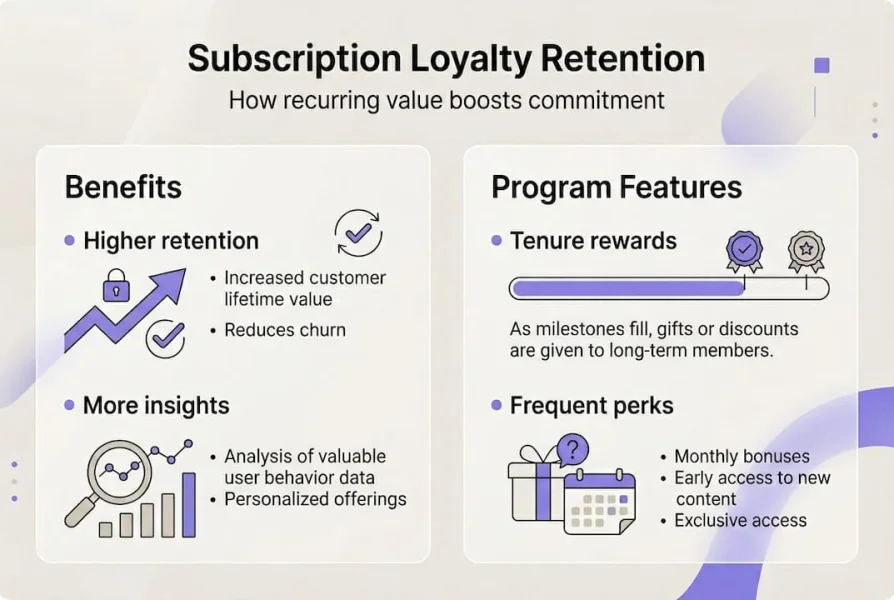
- Build tenure rewards. Reward customers for staying subscribed for three, six, or twelve months. This extends customer lifespan more than any single transaction reward.
- Communicate value clearly. Show members what they’ve saved or received each month. Visibility reinforces the decision to stay subscribed.
The customer retention benefits of a well-run subscription program extend well beyond repeat purchases. You also gain more predictable revenue, higher average spend, and customers who are far more likely to refer others. For a broader view, the loyalty program benefits for retail and service businesses are well documented and worth reviewing before you design your own structure.
Common pitfalls and edge cases
Despite its advantages, subscription-based loyalty isn’t universal. Here’s what to watch out for.
The most common failure point is a value mismatch. If customers feel the subscription fee isn’t worth what they receive, they cancel fast and they don’t come back. High churn occurs when perks lack perceived value, and this is especially true in the first 90 days when customers are evaluating whether the program delivers on its promise.
Here are the most frequent pitfalls businesses encounter:
- Vague or underwhelming perks. If customers can’t clearly articulate what they get, they won’t stay subscribed.
- Hidden fees or complicated terms. Transparency is non-negotiable. Any friction in the billing or cancellation process destroys trust.
- No free tier option. Requiring payment upfront with no trial or free alternative limits your reach significantly.
- Infrequent communication. Members need regular reminders of the value they’re receiving. Silence breeds doubt.
- Ignoring churn signals. If a member hasn’t used their perks in 60 days, that’s a warning sign. Automated re-engagement can recover them before they cancel.
Edge cases matter too. Low-frequency businesses, such as furniture stores, tax preparers, or seasonal services, are poor fits for subscription loyalty. If customers only interact with you once or twice a year, the recurring fee feels unjustified. In these cases, a points or cashback model is more appropriate.
For price-sensitive customers, a subscription can feel like a barrier rather than a benefit. That’s why combining a paid tier with a free tier is one of the smartest structural decisions you can make. The free tier captures customers who aren’t ready to commit. The paid tier converts your most engaged customers into members.
Pro Tip: Monitor your churn rate monthly and your breakage rate quarterly. If churn spikes above 35%, review your perk lineup immediately. If breakage drops below 15%, customers are over-redeeming and your margins may be at risk.
For more ideas on building programs that hold up over time, look at innovative loyalty schemes and top customer loyalty examples from businesses in similar sectors.
How to implement subscription-based loyalty in your business
If you’re convinced by the potential, here’s how to start building subscription-based loyalty in your business.
The process doesn’t need to be complicated. Most small businesses can launch a functional subscription loyalty program within a few weeks if they follow a clear structure.
- Define your goals. Are you trying to increase visit frequency, raise average spend, or reduce churn? Your goal shapes every other decision.
- Design your perk tiers. Offer at least two levels: a free or entry-level tier and a paid membership tier. The paid tier should deliver 3 to 5 times the value of its cost in tangible or experiential benefits.
- Set your pricing. A monthly fee between $5 and $15 works well for most retail and service businesses. Annual plans with a discount encourage longer commitment.
- Choose your metrics. Track churn rate, breakage rate, tenure length, and subscription penetration from day one.
- Communicate the value. Send members a monthly summary of what they’ve earned or saved. Make the value visible and specific.
- Review and adjust quarterly. Loyalty programs that don’t evolve lose relevance. Survey members, analyze behavior, and refresh perks regularly.
On benchmarks: aim for 20 to 30% subscription penetration among your active customer base and focus on tenure rewards to maximize program lifespan. Reaching that range means your program has genuine appeal without being artificially inflated.
Pro Tip: Don’t launch with too many perks. Start with three to four clear benefits, measure which ones drive the most engagement, and expand from there. Overcomplicating the offer at launch confuses customers and raises your cost before you’ve validated the model.
For real-world context, review retail loyalty programs that are performing well, study customer retention examples from businesses like yours, and if you’re in food service, check out restaurant loyalty examples for sector-specific ideas.
What most loyalty guides miss about subscription models
Most how-to articles focus on the mechanics: tiers, pricing, perks, metrics. Those things matter. But they miss the deeper driver of why subscription loyalty actually works at its best.
The businesses with the highest retention rates aren’t winning because their perks are more generous. They’re winning because their members feel like they belong to something. Deep loyalty comes from values and exclusivity, not just perks. When your program communicates what your brand stands for, and when membership signals something meaningful to the customer, the relationship becomes harder to replace.
This is why tenure rewards matter so much more than most guides acknowledge. A customer who has been a member for 12 months isn’t just a repeat buyer. They’ve built an identity around your brand. Recognizing that milestone with a meaningful reward, not just a coupon, deepens that bond in a way no discount can.
If you run restaurant loyalty programs or service-based memberships, this principle applies directly. Focus less on what you’re giving and more on what membership means.
Make subscription loyalty easy with BonusQR
Ready to put this into practice? BonusQR makes it straightforward to build, launch, and manage a subscription-based loyalty program without complex integrations or technical headaches. You can explore the full range of loyalty system features to find the right combination of tools for your business model. If you operate in a service-based sector, the loyalty for services application is built specifically for your needs. You can also set up an electronic reward platform that automates reward delivery, tracks engagement, and keeps your members active. BonusQR handles the infrastructure so you can focus on the customer experience.
Frequently asked questions
Is subscription-based loyalty suitable for all businesses?
No. It works best for businesses with frequent customer interactions and clear recurring value, like retail and beauty services. Low-frequency purchase businesses are generally a poor fit for this model.
How can I reduce churn in my subscription-based loyalty program?
Ensure perks have clear, perceived value and combine with a free tier for broader appeal. Programs with high churn often lack a compelling enough reason for customers to stay subscribed past the first few months.
What benchmarks should I use for subscription penetration?
Aim for 20 to 30% subscription penetration among your active customers and monitor breakage to optimize margins. A breakage average of 26% is a useful industry reference point.
Why are tenure rewards important?
Tenure rewards extend customer lifespan more effectively than spend-based rewards because they recognize loyalty over time, not just transaction volume.
What drives deeper loyalty beyond discounts and perks?
Shared values, emotional bonds, and exclusivity are the key drivers. Research shows that 63% of high-loyalty consumers cite brand values as a primary reason for their loyalty, well above discounts or rewards alone.