
 Deutsch
 Español
 Français
 Italiano
 Magyar
 Polski
 Slovenčina
 Čeština
Most digital loyalty programs quietly fail before they ever get a chance to work. Customers sign up, never redeem a reward, and forget the program exists within a week. The problem almost never comes down to the rewards themselves. It comes down to onboarding. When joining your program feels complicated, slow, or unclear, customers walk away before they even start. Getting onboarding right means more enrollments, faster first redemptions, and dramatically better customer retention. This guide walks you through exactly how to plan, launch, and refine a loyalty onboarding process that works from day one.
Key Takeaways
| Point | Details |
|---|---|
| Remove onboarding friction | Make signup effortless at every customer interaction to boost participation. |
| Keep value proposition simple | Customers should be able to understand and redeem rewards in under two minutes. |
| Avoid complex rules | Confusing redemption systems and expiration dates decrease engagement. |
| Measure and iterate | Track enrollments and actions, then adjust touchpoints and messaging for improvement. |
What you need for successful loyalty onboarding
Now that you understand why onboarding is critical, let’s outline what you’ll need before you get started.
Before you build anything, you need the right tools in place. Effective loyalty onboarding relies on a combination of technology, training, and touchpoint strategy. Each of these elements supports the others, and skipping one weakens the whole system.
Here’s what you need to have ready:
- Digital enrollment forms. Keep them short. Ask only for the essentials: name, email or phone number, and a consent checkbox. Every extra field you add reduces your completion rate.
- QR codes. These are one of the most powerful onboarding tools available to small businesses. A QR code placed at a checkout counter, on a table tent, or printed on a receipt takes customers directly to your signup page with zero friction. How QR codes boost signups is worth understanding before your launch.
- Point-of-sale (POS) prompts or integrations. If your POS system supports it, add a loyalty program prompt at the moment of payment. This is one of the highest-converting places to ask.
- Staff training. Your team is your most powerful onboarding tool. If staff members can confidently explain your program in one sentence and show customers how to join, your enrollment rate will climb immediately.
- Multi-channel visibility. Your signup opportunity should exist everywhere customers interact with your brand: at checkout, on your website, in confirmation emails, and on social media.
Effective onboarding strategies all share one quality: they bring the signup to the customer rather than expecting the customer to seek it out. Research confirms that effortless signup visibility across key touchpoints like checkout, website, and staff prompts is the starting point for any effective digital loyalty onboarding.
Onboarding tools comparison
| Tool | Effort to set up | Conversion rate | Data captured |
|---|---|---|---|
| QR code at checkout | Low | High | Basic to moderate |
| Online enrollment form | Low | Moderate | Moderate to high |
| POS integration prompt | Medium | High | Moderate |
| Staff verbal prompt | None | Moderate | Minimal |
| Receipt with link | Low | Low to moderate | Minimal |
Pro Tip: Don’t assume customers will go out of their way to find your loyalty program. Put the signup where they already are, not buried in an app menu or on a page three clicks deep.
Step-by-step: Designing a frictionless onboarding journey
With your tools and requirements ready, let’s map out each step for a truly frictionless customer experience.
A frictionless onboarding journey means the customer moves from “never heard of this” to “actively participating” without hitting a single confusing roadblock. Here’s how to design that path systematically.
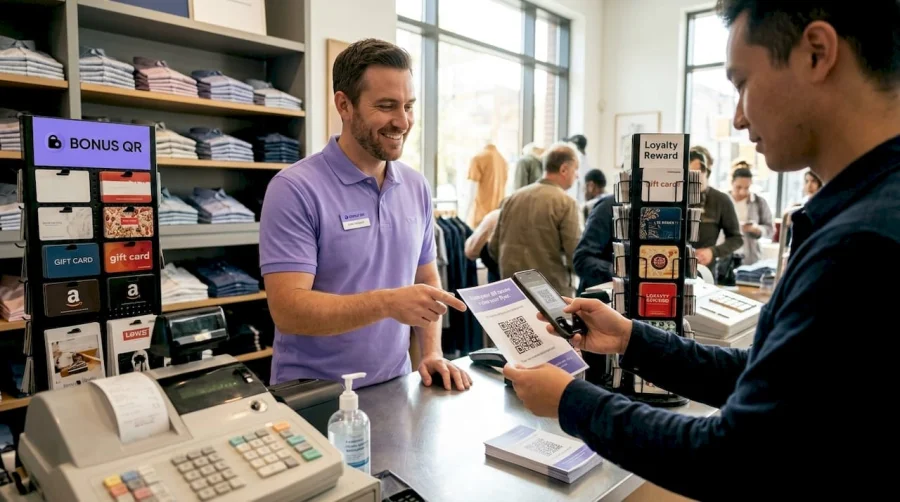
Step 1: Create visible entry points everywhere. Your loyalty program should be impossible to miss. Place enrollment prompts at your physical checkout counter, on your website’s homepage, in your email footer, and on your social profiles. Customers can’t join what they don’t see.
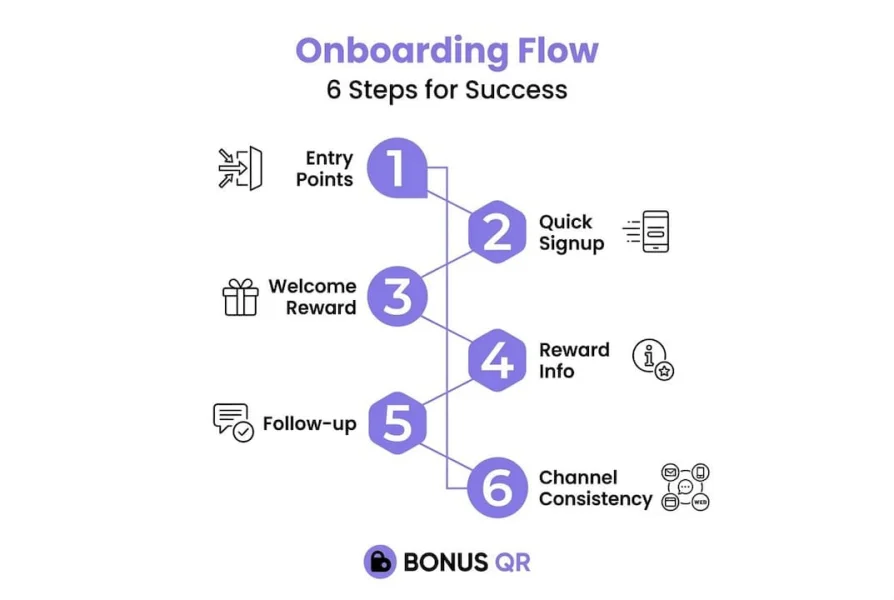
Step 2: Make signup take under 60 seconds. The form should collect only essential information. Test it yourself: if it takes you more than a minute to complete, shorten it. Every extra second lowers your completion rate. Straightforward onboarding is not a compromise; it’s your biggest competitive advantage.
Step 3: Deliver instant confirmation and a welcome reward. The moment someone signs up, send them a confirmation message that includes either a welcome discount, bonus points, or a free item. This confirmation should arrive in real time, not hours later. The faster a customer experiences their first benefit, the more likely they are to stay engaged.
Step 4: Communicate how to redeem rewards clearly and immediately. Do not make your customer guess how the program works. Your welcome message should answer three questions: How do I earn? How do I redeem? When do my points or stamps expire? Keeping the onboarding value proposition simple ensures customers understand and redeem rewards quickly, which directly drives repeat visits.
Step 5: Follow up with a reminder within 48 hours. A brief push notification or email reminding new members of their pending reward pulls many borderline participants back in. This second touchpoint is low-cost and high-impact.
Step 6: Ensure consistency across channels. If a customer signs up in your store but can’t access their account online, they lose trust. Build your onboarding to work the same way regardless of where the customer interacts with your brand. Consistent customer retention tactics reinforce this point.
Enrollment method comparison
| Method | Customer effort | Conversion likelihood | Data quality |
|---|---|---|---|
| QR code scan | Very low | Very high | Basic |
| Online form (web/app) | Low | High | High |
| Manual entry by staff | None for customer | Moderate | Variable |
One important insight from retention marketing best practices is that loyalty program dropout happens most often at two moments: during signup and at the point of first redemption. If you smooth out both moments, you’ll retain far more members.
Industry research shows that onboarding mechanics need to reduce friction at redemption, specifically avoiding confusing redemption rules and expiration policies that frustrate customers right when they’re motivated to act.
Pro Tip: Time your onboarding from signup to first reward redemption and try to get it under two minutes. If it takes longer, identify exactly where the delay is and cut it.
Avoiding costly onboarding mistakes
Even with a great plan, it’s easy to stumble into preventable mistakes. Here’s how to avoid them.
The most common loyalty onboarding problems are not technical. They’re structural. Businesses often design programs that make sense internally but confuse customers externally. Understanding these mistakes early saves you time, money, and member churn.
The top onboarding mistakes and how to fix them:
- Complicated signup forms. Asking for date of birth, home address, and multiple preferences on the first form overwhelms customers. Fix: Limit your initial form to three fields maximum and collect additional details later through optional profile updates.
- Unclear value proposition. If a customer can’t immediately answer “what do I get for joining?”, they won’t join. Fix: Put your core benefit in the headline of every enrollment prompt. “Earn a free coffee after 10 visits” beats “Join our rewards program” every time.
- Reward expirations with no warning. Points or stamps that expire without a clear heads-up feel like a bait-and-switch. Customers who lose rewards they thought they had don’t come back. Fix: Automate expiration reminder messages at 30 days and 7 days before expiration. This is one of the most impactful changes you can make.
- Disconnected digital and physical experiences. A customer who signs up in your store shouldn’t have to re-enroll online, and vice versa. Siloed experiences create confusion and drop-off. Fix: Use a platform that syncs membership across all channels from day one.
- Reward systems that are too complex. Multiple tiers, complicated multipliers, and special category bonuses might sound exciting but they create hesitation. You can avoid common onboarding errors by keeping reward rules simple enough to explain in one sentence.
For industry-specific onboarding, the rules vary slightly, but the principle holds universally: simplicity drives participation. A coffee shop with a 10-stamp card outperforms a competitor with a complicated tiered system almost every time, because customers understand it immediately.
“Friction at the moment the reward is supposed to land is where loyalty programs die. Confusing redemption rules and unclear expirations are the two fastest ways to destroy the trust you built during enrollment.” (Loyalty programmes that actually work)
The takeaway here is straightforward: simplicity removes hesitation. When customers understand your program instantly, they participate. When they have to think too hard about how it works, they disengage.
Measuring onboarding success and making improvements
To ensure your onboarding keeps improving, you need a way to measure success and rapidly adjust.
You can’t improve what you don’t measure. Tracking a handful of focused metrics gives you clear signals about what’s working and where customers are dropping off. These metrics don’t require sophisticated analytics tools. Basic tracking through your loyalty platform or a simple spreadsheet gets you started.
Key onboarding metrics to track:
- Enrollment rate. What percentage of customers who interact with a signup prompt actually complete enrollment? Below 30% suggests your signup process has too much friction.
- Time to first reward redemption. How long does it take from signup to the first time a member uses a reward? The shorter this window, the better your long-term retention tends to be.
- Channel conversion rate. Are in-store QR code signups converting better than your website form? Knowing this helps you allocate your promotion budget and effort more effectively.
- 30-day retention rate. Of all new members, how many are still active 30 days later? This tells you whether your onboarding is creating genuine habits or just one-time signups.
- Redemption rate. If members earn rewards but never redeem them, your redemption process may still be too complicated.
Experiments to run for continuous improvement:
- Test a clearer, more benefit-focused call-to-action on your QR code signage.
- Add a verbal script for staff to use when mentioning the program at checkout.
- Send a reward reminder notification at 48 hours and track if redemption rates improve.
- Move your website enrollment button to a more prominent position and measure the click-through rate.
- Simplify your reward structure and compare enrollment rates before and after.
The results from brands that act on this data are significant. Chipotle’s loyalty enrollment rose by 25% in daily signups after implementing in-store QR code placements specifically designed to reduce enrollment friction. That kind of lift is achievable for small businesses too, because the underlying principle is the same: remove barriers at the moment customers are most motivated to act.
Reviewing reward types and strategies alongside your metrics can help you understand whether the issue is your onboarding process or your reward structure. Sometimes both need adjusting. Use reward program benchmarks to gauge how your metrics compare to industry standards and set realistic improvement targets. A practical customer retention guide can also give you context for how onboarding fits into your broader retention strategy.
A realistic take: Why onboarding simplicity trumps grand gestures
Businesses sometimes spend months planning elaborate loyalty programs with tiered memberships, gamification badges, partner integrations, and exclusive VIP events. Then they launch and wonder why enrollment stalls. The uncomfortable truth is that most customers don’t want impressive. They want easy and clear.
The most effective loyalty onboarding we see consistently shares one characteristic: it asks very little of the customer upfront and delivers value immediately in return. That’s it. No fancy app, no complex points calculator, no elaborate welcome package. Just a fast signup, a clear benefit, and a smooth first redemption.
Cross-channel experience advice consistently points to cohesion as the critical variable. When a customer signs up in your store and then gets a confirmation email that references their in-store visit, that cohesion builds trust. When those two experiences feel disconnected, trust erodes before the relationship even begins.
Budget and feature planning for SMB loyalty onboarding works best when guided by reward economics and simplicity constraints rather than ambition. A smaller, well-run program beats a large, confusing one every time. Research backs this up, and practical experience reinforces it repeatedly.
Pro Tip: Before you spend a dollar on rewards, spend time training your staff to deliver the same onboarding message at every touchpoint. A consistent, confident human recommendation is more powerful than any digital marketing tactic.
Look at proven onboarding templates from businesses similar to yours. You don’t need to invent a new approach. Use what works, keep it simple, and optimize from there. Feature overload is a real risk. Limiting your reward complexity during the first 90 days of your program launch gives you cleaner data and higher initial adoption. You can always add more features once your members are engaged and familiar with the basics.
Take your loyalty program onboarding further with BonusQR
For those ready to optimize onboarding and see real results, here’s how BonusQR can accelerate your progress.
BonusQR is built specifically to remove the technical barriers that slow down loyalty onboarding for small and medium-sized businesses. The platform handles everything from digital reward delivery to fully branded member experiences, without requiring POS integration or a development team.
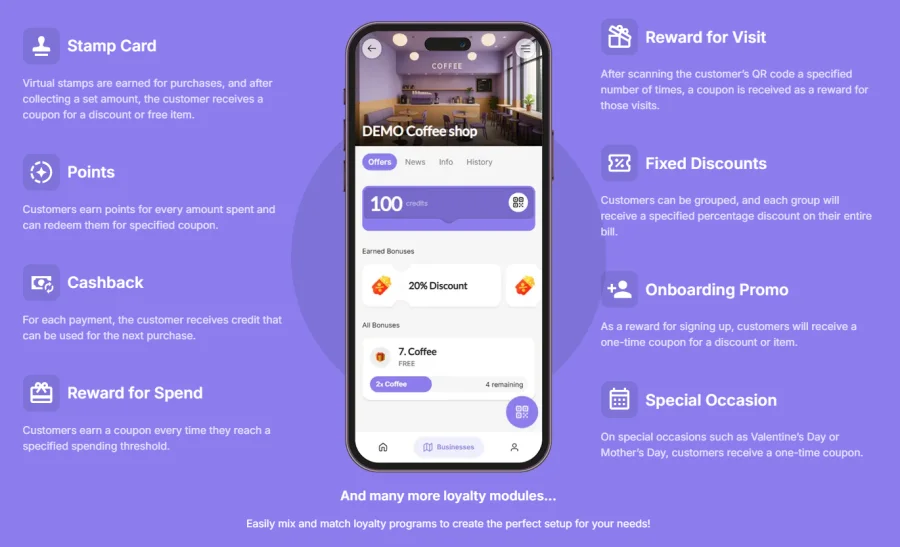
With BonusQR, you can launch an electronic rewards solution that delivers instant confirmation and welcome rewards the moment a customer enrolls. The mobile and web app onboarding features ensure your program works consistently across every channel your customers use, whether they find you in-store or online. Whether you run one location or several, BonusQR’s SMB loyalty solutions give you the flexibility to start simple and scale as your program grows. Getting your onboarding right has never been more accessible.
Frequently asked questions
What is the biggest obstacle to successful loyalty program onboarding?
The main issue is too much friction at signup. When enrolling or redeeming rewards isn’t fast and simple, most customers abandon the process before completing it.
How can I make it easier for customers to join my loyalty program?
Use visible prompts, QR codes, and simple forms at every physical and digital customer touchpoint. Research consistently shows that effortless signup visibility at checkout, on your website, and through staff prompts drives the highest enrollment rates.
How long should the onboarding process take for a digital loyalty program?
Aim for the entire process, from first seeing the signup prompt to receiving a welcome reward, to take under two minutes. Keeping the value proposition simple ensures customers don’t stall at any step.
What metrics should I track to evaluate loyalty program onboarding?
Monitor sign-up rate, first reward redemption speed, and enrollment by channel. Brands that track these closely, like those using in-store QR code enrollment tactics, consistently report measurable and sustained enrollment growth.
How much should onboarding rewards cost compared to the customer’s value?
Best practice is to keep reward costs between 5% and 10% of customer lifetime value. This range keeps your program financially sustainable while still offering genuine incentive to join and participate.