Choosing a loyalty program for your retail or service business feels straightforward until you actually try to do it. There are points systems, punch cards, cashback models, tiered VIP tiers, and dozens of apps promising to deliver the best customer loyalty programs on the market. The range of loyalty program examples alone can make the decision feel paralyzing. This article cuts through that noise. You will walk away with a clear framework for evaluating your options, a practical look at proven models, and real-world customer loyalty programs examples that show what works and why.
Key criteria for choosing effective loyalty programs
Before comparing specific options, you need a framework. Not every program works for every business, and picking the wrong model wastes time and customer goodwill. The most durable loyalty program examples combine obvious, immediate value with progression or status, favoring tiered systems and mobile-first enrollment.
Here is what to evaluate before choosing any loyalty rewards program:
- Immediate value clarity. Customers should understand what they earn and when they can use it within seconds. Complexity kills participation.
- Progression mechanics. Programs with levels, milestones, or status tiers give customers a reason to keep coming back beyond the next transaction.
- Mobile-first access. If customers cannot enroll or check their balance on their phone in 30 seconds, your participation rate will suffer. Mobile-first design is not optional.
- Omnichannel consistency. A customer who earns points in your store should see that reflected in your app or website immediately. Inconsistency damages trust fast.
- Fit with purchase frequency. A punch card suits a coffee shop with daily visits. A tiered program suits a boutique where customers spend more but shop less often.
Understanding how loyalty reward types interact with these criteria gives you a much clearer filter for every program you consider. You can also use relationship marketing strategies to reinforce the emotional side of your loyalty model beyond just transactional rewards.
Pro Tip: Write down your average purchase frequency and average order value before evaluating any program. These two numbers alone will eliminate at least half the options from consideration.
Points-based loyalty programs: flexible and popular choice
With a clear set of criteria in hand, let’s look at the most widely used model across small and mid-sized businesses. Points-based programs are the closest thing to a universal starting point in customer loyalty.
The model is simple. Customers earn points when they spend, typically 1 point per dollar, and redeem those points for discounts, free products, or store credit. The simplicity is the strength. Customers understand it immediately, and you can communicate the value proposition in a single sentence.
Key benefits of points-based programs for SMBs:
- Clear earning structure. Every purchase has a visible payoff, which motivates customers to choose you over a competitor even when prices are close.
- Flexible redemption. You control what points are worth and what they can buy, giving you room to protect margins while still delivering value.
- Wide platform support. Most digital loyalty platforms integrate points programs with minimal setup, and many work without any POS integration at all.
- Scalable complexity. You can start simple and layer in bonuses, double-point days, or category multipliers as your program matures.
Points programs work especially well for businesses with moderate purchase frequency, meaning customers who visit somewhere between once a week and once a month. For a deeper look at how small businesses have applied this model successfully, these small business points-based examples show real configurations worth studying.
Pro Tip: Set your points redemption threshold low enough that new customers can earn their first reward within three to four visits. Early wins build the habit of returning.
Tiered VIP programs: drive aspiration and increased spending
Another effective model works on a different psychological lever. Instead of just rewarding past spending, tiered programs reward how much a customer is willing to invest in their relationship with your brand.
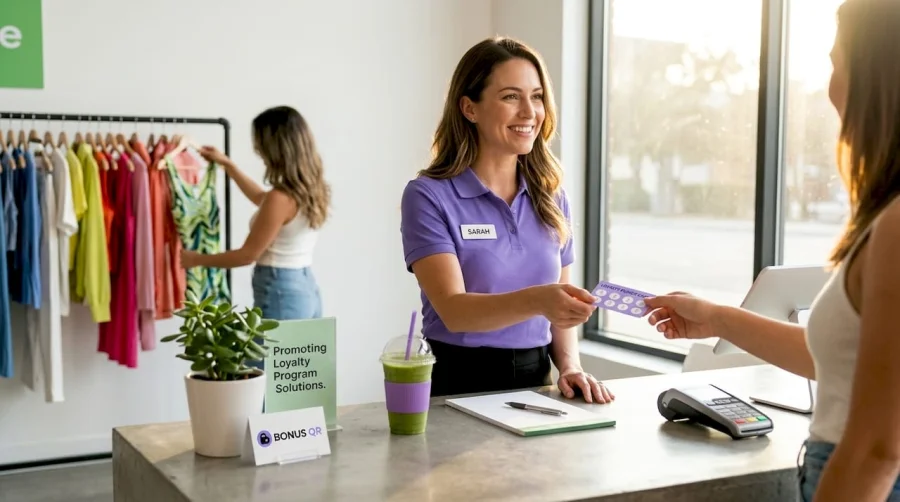
Tiered VIP programs add levels of status with escalating perks, creating aspiration and loss aversion. Bronze, Silver, and Gold (or any naming system that fits your brand) each carry increasingly valuable perks, from priority service to exclusive discounts to early access.
What makes tiered programs powerful for SMBs:
- Aspiration. Customers who are close to the next tier will often increase spending to get there. Even a small gap motivates action.
- Loss aversion. Once a customer reaches a status level, they do not want to fall back. This drives repeat visits and consistent spending to maintain status.
- Segmentation built in. Your best customers self-identify by reaching the top tier, giving you a ready-made group for exclusive offers and feedback requests.
- Higher perceived value. Status feels more meaningful to many customers than points balances, especially in lifestyle, apparel, or beauty categories.
The tradeoff is setup complexity. Tiered programs require clear rules around how customers earn status, how long it lasts, and what happens when they miss a renewal threshold. Get this communication wrong and customers feel punished rather than motivated. For practical tiered loyalty examples across different business types, there are configurations that translate well to smaller retail and service contexts.
Punch-card and cashback programs: simple yet effective alternatives
Not every business needs layered points and status systems. For some, a simpler model produces strong results with far less overhead.
Punch-card programs suit businesses with frequent, similar purchases, while cashback appeals to higher average order value stores where money back feels meaningful. Both models are easy for customers to understand and for you to manage.
Punch-card programs work on a single promise: complete a set number of purchases and earn a free one. Buy 9 coffees, get the 10th free. The mechanic is universally understood, and digital versions eliminate the lost-card problem that plagued paper formats for years.
Cashback programs return a percentage of each transaction as store credit. A 5% cashback on a $200 purchase creates $10 in credit that pulls the customer back. The reward feels tangible and proportional, which customers at higher spending levels genuinely appreciate.
Here is a quick guide to deciding between the two:
- Choose punch-card if your customers make frequent, similar purchases (coffee, lunch, blowouts, car washes).
- Choose cashback if your customers have variable order sizes and higher average transactions, such as in specialty retail or professional services.
- Consider combining both by using a stamp card for frequency and cashback for high-value transactions, which some platforms support in a single program.
- Test with a defined window. Run either model for 60 days and measure repeat visit rate before committing to a full rollout.
For operators in food service, these punch-card loyalty examples for restaurants show how to configure and communicate the model in a high-frequency environment.
Top real-world loyalty program examples and their results
The best way to understand what makes a loyalty program work is to look at programs that have produced measurable results. These three examples span different models and industries, but each carries lessons that translate directly to smaller operations.
Chipotle ran an in-store marketing campaign that made QR code signups the centerpiece of its restaurants. The result: a 25% increase in daily enrollments compared to baseline. The lesson for SMBs is direct. In-store visibility drives digital enrollment. A QR code on your counter, receipt, or menu board is one of the lowest-cost acquisition tools available.
Starbucks launched a $2 discount reward that became responsible for one-third of all loyalty redemptions, contributing to a 4% membership increase to a record 35.6 million members. The takeaway: a single, simple, low-barrier reward drives more engagement than a complex catalog of options. Simplicity scales.
Food Lion’s MVP program focuses on personalized savings and omnichannel access, reaching 1 million active customers with consistent offers across in-store and digital channels. The omnichannel consistency point is critical for any retailer running both physical and online touchpoints.
| Brand | Model | Key tactic | Result |
|---|---|---|---|
| Chipotle | Points + enrollment | QR code in-store signups | +25% daily enrollments |
| Starbucks | Points + rewards | $2 simple reward offer | +4% membership, record 35.6M members |
| Food Lion MVP | Personalized cashback | Omnichannel personalization | 1 million active customers |
What these successful loyalty programs share is not budget. It is clarity. Each program makes one clear promise, delivers it reliably, and removes friction from the customer experience. For a broader look at what the best retail loyalty programs are doing right now, there are additional examples worth reviewing before you finalize your approach.
Pro Tip: Study what these programs do before the first purchase, not just after. Onboarding communications and first-reward timing often determine whether a new member ever engages again.
Good customer retention strategies treat the post-enrollment period as the highest-priority window for driving behavior, and your loyalty program should do the same.
Comparing loyalty program models: which suits your business?
With real-world examples in mind, this comparison helps you match your business model to the right loyalty structure. No single model is best for everyone, and understanding where each one fits helps you avoid building something your customers will not use.
| Program type | Ease of setup | Customer appeal | Best fit |
|---|---|---|---|
| Points-based | Easy | High, clear and universal | Most retail and service SMBs |
| Tiered VIP | Moderate | Very high for aspirational customers | Fashion, beauty, lifestyle, multi-product retail |
| Punch card | Very easy | High for frequent buyers | Coffee, food service, personal care |
| Cashback | Easy to moderate | High for big spenders | Specialty retail, professional services, higher AOV businesses |
The right choice is almost always the one that matches your purchase frequency and average order value first, then your customer psychology second. A tiered program at a coffee shop feels meaningless. A punch card at a furniture store makes no sense. These customer retention examples show how businesses have applied this logic across different sectors with strong results.
What most loyalty program guides get wrong
Most articles about good loyalty programs focus almost entirely on which features to include. They tell you to add tiers, add gamification, add referral bonuses. What they rarely tell you is that the biggest predictor of loyalty program failure has nothing to do with features. It is poor timing of the first reward.
Here is what we have observed repeatedly: businesses build well-structured programs, set reasonable earn rates, and then place the first redemption threshold too high. Customers earn points, feel no tangible payoff for weeks, and quietly disengage. The program never fails dramatically. It just fades.
The fix is to treat your program’s first 30 days as a separate retention challenge. Offer an enrollment bonus. Set the first reward threshold at a level customers can reach in three visits, not ten. Send a push notification when they are one purchase away from their first reward. These are not expensive tactics. They are behavioral triggers that close the gap between enrollment and habit.
The examples of customer rewards that perform best are not necessarily the most generous. They are the most timely. A $3 reward delivered after the third visit does more loyalty work than a $20 reward that takes three months to earn. If your program is underperforming, start there before changing anything else.
Build your own loyalty program with BonusQR
If these loyalty program examples have helped clarify your direction, the next step is building something your customers will actually use.
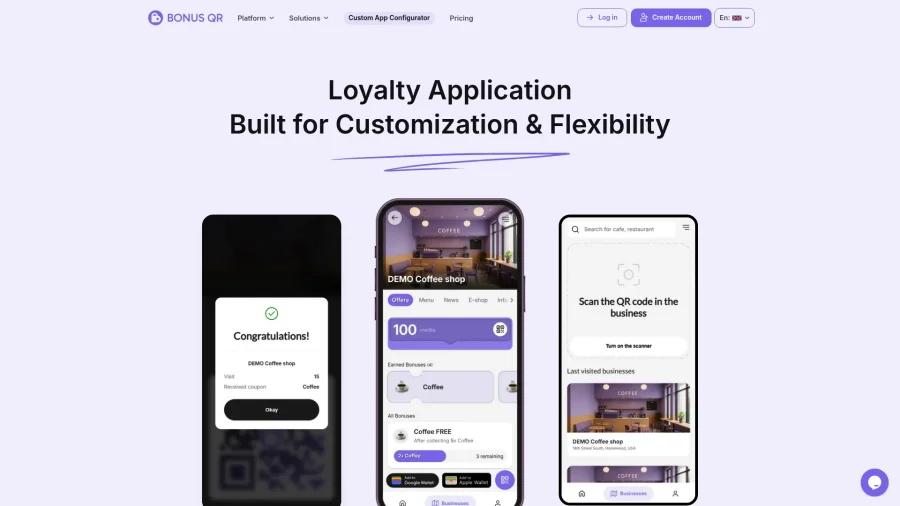
BonusQR gives you a digital loyalty platform that supports points collection, stamp cards, cashback, coupons, and tiered rewards, all configurable without POS integration. You can launch a customized program in hours, not weeks, and reach customers through a mobile-friendly experience that works for both in-store and online touchpoints. Real-time analytics show you what is working, and push notifications help you close the gap between enrollment and first redemption. Whether you are starting with a simple punch card or building a tiered VIP structure, BonusQR has a pricing tier that fits where you are today.
Frequently asked questions
What is the easiest loyalty program type to implement for small businesses?
Points-based programs are the easiest to set up and communicate, making them the best starting model for most small businesses launching their first loyalty program.
How can loyalty programs improve customer retention in retail?
Personalized savings and omnichannel access consistently produce higher retention by giving customers relevant offers at every touchpoint, not just in-store visits.
What features help boost loyalty program enrollment in physical stores?
In-store QR codes and visible signage are among the most effective enrollment tools. Chipotle’s 25% enrollment increase came directly from making QR code signups prominent inside its restaurants.
Why are tiered loyalty programs effective?
Tiered programs motivate spending by creating both aspiration (reaching the next level) and loss aversion (not wanting to fall back), two behavioral drivers that points-only programs cannot replicate as effectively.


