
 Deutsch
 Español
 Français
 Italiano
 Magyar
 Polski
 Slovenčina
 Čeština
Ever feel like your sales are on a rollercoaster you can't control? One month you're up, the next you're down, with no clear reason why. What if you're losing customers and don't even know it? The fastest way to get answers is to ask your customers directly-and the best time is right after they buy, by making it incredibly simple to share what they think.
Why You're Losing Customers Without Realizing It
Here’s a tough reality for many small business owners: most of your unhappy customers will never complain. They just... leave. This is silent churn, and it’s a quiet profit killer. You’re left staring at sales reports, guessing what went wrong, while your customer base slowly shrinks.
This isn't just a theory; it's a daily drain on your revenue. A classic example is when a potential customer calls, you don't pick up, and they immediately dial your competitor. Every missed connection is a sale handed to someone else, as one business owner discovered when a Customer Called Competitor Because I Didnt Answer.
The Expectation to Be Heard
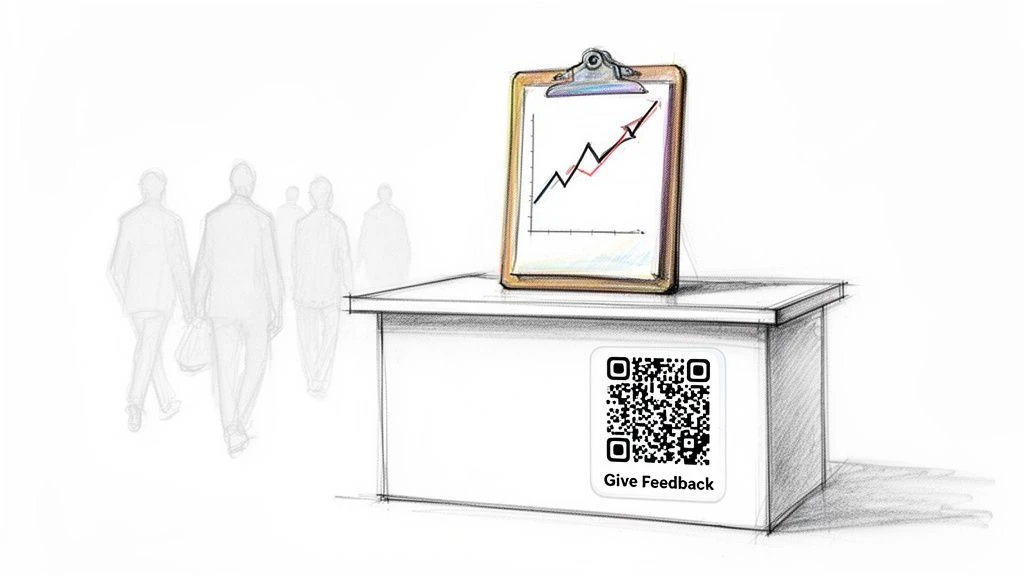
Today's customers expect to be heard. When an experience is a letdown, they don't just get annoyed-they walk away. The data is stark: only 3 in 10 customers will bother to tell you why they're leaving.
Compounding the problem, people are tired of long, clunky surveys and are now 29% less likely to give feedback at all. When you consider that 92% of people will switch brands after a single bad experience, the danger of not listening becomes clear. You're flying blind, trying to solve problems you can't see.
Customer feedback isn't a 'nice-to-have'; it's your most powerful business intelligence tool. It reveals the why behind your sales numbers, helping you make smart, data-backed decisions instead of relying on guesswork.
Turning Transactions Into Listening Posts
This is where you need to flip the script. Stop chasing feedback and start building it directly into your customer's journey. The best time to ask for input is right after a purchase when the experience is fresh and they're most willing to share a quick thought.
A simple QR code on a receipt, a sticker on the counter, or a quick prompt in a loyalty app like BonusQR transforms a simple sale into a conversation. You're not just closing a transaction; you're opening a dialogue that builds genuine trust and loyalty.
By making it effortless for customers to talk to you, you can:
- Stop the silent exodus: Catch problems before they drive good customers away for good.
- Get actionable ideas: Uncover real-world suggestions on what to fix, from service speed to product quality.
- Build unbreakable loyalty: Showing you care enough to ask and listen is one of the most powerful ways to keep people coming back.
This proactive approach puts an end to the guessing games. It gives you a direct line to what your customers are really thinking. To go deeper, our guide on how to measure customer satisfaction and stop losing your best customers is a great next step.
Choosing the Right Channels to Hear Every Customer
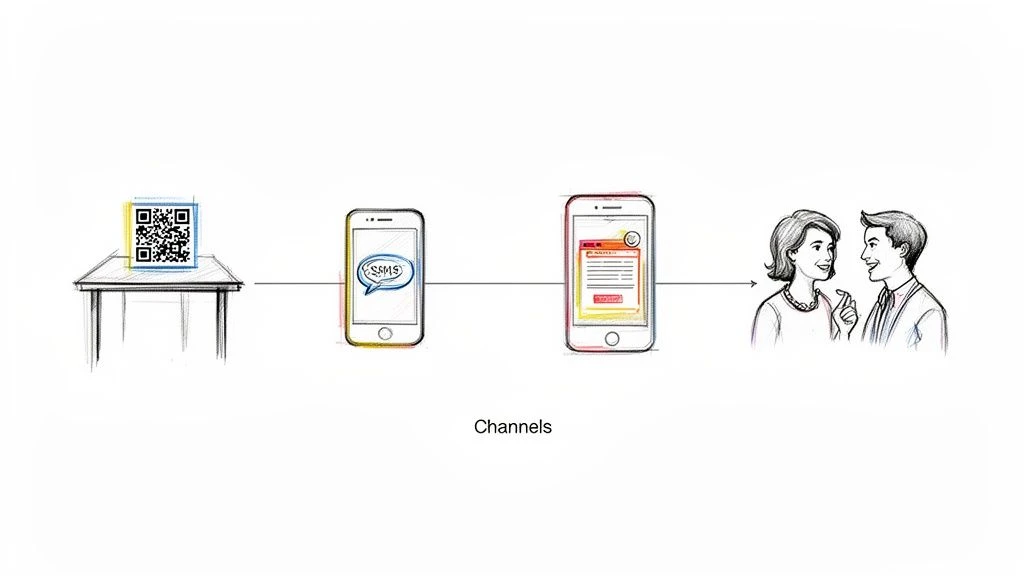
You know you need to listen to your customers. But the next, most critical question is: where should you ask for their opinion to actually get a response?
Your goal isn't just to collect data for data's sake. You want real insights from real people at the moment it counts most. The secret is to meet them where they already are. A clunky, multi-step survey will be ignored every time. But a quick, seamless request that fits right into their experience? That’s where you’ll strike gold.
Match the Channel to the Customer Journey
There’s no one-size-fits-all solution. The best feedback channels are the ones that feel totally natural to your customers. Think about their journey and identify the path of least resistance.
For example, a busy coffee shop can get instant feedback with a simple QR code on a cup sleeve. A hair salon, on the other hand, might get a much better response rate with a friendly text a few hours after an appointment.
Consider what makes sense for your specific setup:
- Restaurants & Cafes: A QR code on the table, menu, or receipt is a no-brainer. Customers can scan and answer a question while settling the bill.
- Retail Stores: Catch them while the purchase is still fresh. A prompt at the point-of-sale or a link on a digital receipt works wonders.
- Service Businesses (Salons, Spas, Auto Repair): A follow-up SMS or email a few hours post-service is perfect for asking about their experience with a specific staff member.
The goal is to make giving feedback feel like a natural part of the transaction, not a chore.
The easier you make it to give feedback, the more feedback you will get. Focus on integrating your request directly into the customer's path, whether that's on a physical product, a digital receipt, or an app they already use.
Digital Channels for Modern Customers
Let’s be honest: digital channels are the most efficient way to listen in today's world. They can be automated, tracked, and analyzed with minimal hands-on effort-exactly what a busy business owner needs.
In-App and Loyalty Program Feedback This is the gold standard for a reason. If you're using a digital loyalty app like BonusQR, you can automatically trigger a feedback request the moment a customer scans their code after a purchase.
This approach is incredibly powerful because:
- It's perfectly timed: The request appears when the experience is top-of-mind.
- It's contextual: You know who the customer is and what they bought.
- It's frictionless: They're already on their phone, engaging with your brand.
This creates a seamless, automated loop. You reward their loyalty and get priceless insights from a single, simple action.
Email and SMS Surveys Email and text messages remain heavy hitters, especially when you need more detail. They give you the space to ask more in-depth questions than you could in a quick, in-the-moment prompt.
A few tips to get it right:
- Keep it short: Start by saying it will only take "2 minutes." People are busy.
- Personalize it: Use their name and reference their recent visit or purchase.
- Offer a small 'thank you': A coupon or a few bonus loyalty points can dramatically improve your response rates.
Social Media Listening Your customers are already talking about you. Social media listening is about tuning into platforms like Instagram, Facebook, and Google Reviews to catch mentions of your brand. It’s a fantastic way to capture raw, unfiltered opinions you might otherwise miss. Just set up alerts for your business name and see what people are saying.
Don't Forget the Power of Human Connection
For all the efficiency of digital tools, never underestimate the power of a real conversation. This is especially true if your business is built on personal relationships, like a local boutique or a family-run diner.
A simple, "How was everything for you today?" at the checkout can tell you so much. The trick is to train your team to genuinely listen and be open to whatever they hear-good or bad. This offline feedback may be harder to track, but it often delivers the most authentic and valuable insights. It shows you care, and that’s the real foundation of loyalty.
Asking Questions That Get Real, Actionable Answers
Collecting feedback is one thing; asking the right questions is another. This is what separates a pile of useless data from a clear roadmap for growth.
If your questions are vague and generic, your answers will be too. The magic happens when you stop asking “How was everything?” and start digging into specific moments of the customer journey. That’s how you uncover the why behind their feelings and get insights you can actually use.
The Two Types of Questions You Need to Ask
First, you need to understand the two main kinds of questions. Both are incredibly valuable, but they serve different purposes. A good feedback strategy uses a mix of both to paint the full picture.
Closed-Ended Questions: These are your multiple-choice, yes/no, or rating scale questions (e.g., "Rate your visit from 1-5 stars"). They’re quick for customers to answer and give you clean, quantitative data that’s easy to analyze.
Open-Ended Questions: These invite customers to explain their thoughts in their own words. Think "What's one thing we could do better?" or "What did you enjoy most about your visit?" This is where you find the rich, qualitative context behind the numbers.
Pro-Tip: Start with a quick closed-ended question (like a star rating) and follow it up with an optional open-ended one. This respects the customer's time but gives them the chance to elaborate if they have more to say.
The Three Metrics Every Small Business Should Track
You don't need a data science degree to understand customer sentiment. In fact, three simple, proven metrics can give you a powerful snapshot of how you're doing.
They are easy to implement and even easier to track over time, especially with a simple tool like BonusQR that can automate the entire process for you.
1. Customer Satisfaction (CSAT)
This is the most direct metric. It asks customers to rate their satisfaction with a specific interaction, like checking out or speaking with an employee. The question is usually, "How satisfied were you with your experience today?" on a 1-5 scale or with simple emojis (😠to 😄). It gives you an immediate pulse-check on key touchpoints.
2. Net Promoter Score (NPS)
NPS is all about loyalty. It measures how likely a customer is to recommend your business to friends or family. You’ll ask, "On a scale of 0-10, how likely are you to recommend us?" Based on their answer, customers are grouped into Promoters (9-10), Passives (7-8), and Detractors (0-6). A rising NPS score is a powerful predictor of future growth because it means you’re creating brand advocates.
3. Customer Effort Score (CES)
This metric measures how easy you are to do business with. It asks, "How easy was it to get what you needed from us today?" on a simple scale like "Very Difficult" to "Very Easy." In a world where convenience is king, a low-effort experience is a massive driver of repeat business.
Don't get overwhelmed by these metrics. Just start with one. CSAT is often the easiest to get going. The goal is to set a baseline and watch how your score improves as you act on the feedback you’re collecting.
How to Frame Questions That Inspire Honesty
The way you ask a question changes everything. Customers are far more likely to give you honest, detailed feedback if they feel you genuinely want to hear it-and plan to do something about it.
In fact, being transparent is key. Recent market analysis shows that 46% of customers are willing to share more information if you’re open about how you use their data. You can find more on this in a great report about the rise of enterprise feedback on futuremarketinsights.com.
So, how do you actually write these questions? Here are a few ready-to-use templates to get you started.
Question Templates for Your Small Business
Don't just ask "How did we do?". Get specific! Good questions are tailored to your business type and your feedback goals. Here are a few examples to spark some ideas.
| Business Type | Goal | Sample Question (Open-Ended) | Sample Question (Rating) |
|---|---|---|---|
| Coffee Shop | Improve Product/Menu | "What's one drink or food item you wish we offered?" | "How would you rate the quality of your coffee today? (1-5 Stars)" |
| Retail Boutique | Enhance In-Store Experience | "Was there anything you had trouble finding during your visit?" | "How helpful and friendly was our staff? (1-5 Stars)" |
| Restaurant | Refine Service Quality | "What's one thing we could do to make your next dining experience even better?" | "How would you rate the speed of your service tonight? (1-5 Stars)" |
| Hair Salon | Boost Customer Loyalty | "How did you feel about the final result of your service today?" | "On a scale of 1-10, how likely are you to rebook with your stylist?" |
Notice the pattern? These questions are specific and forward-looking. Instead of just grading past performance, they ask for advice on how to be better in the future.
This small shift encourages constructive ideas, not just complaints or compliments. When you start asking the right questions, feedback stops being a report card and becomes your personal roadmap for success.
Turning Feedback Into Your Greatest Growth Strategy
Collecting customer feedback is only half the battle. The real magic happens when you turn those raw comments and ratings into your single greatest growth strategy.
If you don't act on what you hear, your customers will eventually stop talking. When that happens, you lose your most direct line to improving your business. Insights are useless when they’re stuck in a spreadsheet. The process of turning data into decisions doesn't have to be complex; for a busy small business owner, a simple framework is always better.
Organize Feedback to See the Bigger Picture
First, bring order to the chaos. As comments, ratings, and suggestions roll in, you have to categorize them. This is the only way to stop getting bogged down by individual remarks and start spotting the recurring themes that really matter.
Think of it as creating simple buckets to sort everything into:
- Service & Staff: Any comments about the speed, friendliness, or helpfulness of your team.
- Product & Quality: Feedback on your core offerings-the taste of a dish, the quality of a haircut, or the durability of a product.
- Ambiance & Environment: Remarks about your physical space, from music volume and cleanliness to decor.
- Price & Value: Perceptions of whether your offerings are worth the cost.
One customer complaining that the music is too loud is an opinion. But if you get five similar comments in your 'Ambiance' bucket over two weeks, you’ve just found an easy, high-impact fix.
By organizing feedback, you shift from reacting to individual comments to proactively addressing systemic issues. This is how you turn a simple score into a strategic tool.
Prioritize Changes for Maximum Impact
Once your feedback is organized, you'll likely have a long list of potential improvements. You can’t tackle everything at once, so prioritization is critical. The simplest way to do this is with an effort-versus-impact analysis.
For each theme you've identified, ask yourself two simple questions:
- How much effort will this take? (Low, Medium, or High)
- How big of an impact will this have on the customer experience? (Low, Medium, or High)
Always start with the low-effort, high-impact changes. These are your quick wins. Things like adjusting store music, adding a popular flavor syrup, or rewriting a confusing sign are easy to implement and show customers you're listening right away. To truly understand what changes will have the biggest impact, you need to know what your customer is trying to accomplish. Approaches like the Jobs to Be Done framework can be invaluable for crafting questions that elicit honest and actionable answers.
Close the Loop to Build Unshakeable Loyalty
This is the most crucial-and most often skipped-step. Closing the loop simply means letting customers know you heard them and made a change because of what they said.
This single act can build more trust and loyalty than almost any marketing campaign. It proves their voice matters and that filling out your survey wasn't a waste of time.
Closing the loop doesn't have to be a huge production:
- Put up a small sign: A chalkboard at your counter saying, "You asked, we listened! We now offer oat milk," is incredibly powerful.
- Send a personal email: If a customer left specific, negative feedback, an email saying, "Thanks for your feedback on our slow service. We've since added another staff member during peak hours," can turn a detractor into a lifelong fan.
- Post on social media: Share a quick story highlighting a change you made thanks to customer suggestions.
This communication is a massive driver in a market projected to hit $11.2 billion by 2033. Feedback management helps businesses pinpoint pain points and reduce churn from "silent switchers"-the 30% of customers who leave without a word. When you consistently organize, prioritize, and close the loop, customer feedback becomes your free, crowdsourced roadmap to a more resilient business.
Weaving Feedback Right Into Your Loyalty Program
What if collecting customer feedback took almost zero effort? That’s not a fantasy. It’s exactly what happens when you build your feedback strategy directly into your digital loyalty program, creating a process that’s automated, timely, and incredibly insightful.
Think about it: a modern loyalty app isn't just for tallying points. It's the perfect pipeline for gathering high-quality feedback right after a purchase. This creates a powerful, self-sustaining growth cycle where happy customers fuel smarter business decisions.
The Automated Feedback Loop
Picture this: a customer grabs their morning coffee, scans their loyalty app, and-boom-a push notification pops up: "How was your visit today? Tap to rate." It’s a single tap, takes two seconds, and you’ve just captured valuable data from an engaged customer.
That’s the magic of integration. Tools like BonusQR automatically trigger a feedback request the moment a transaction is complete. You set it up once, and it works for you every single day.
This hands-off approach gives you major advantages:
- Perfect Timing: The request arrives while their experience is top-of-mind, meaning more accurate feedback.
- Targeted Insights: You’re hearing directly from your most frequent and loyal customers-the people whose opinions matter most.
- Effortless Collection: No more remembering to ask or sending manual emails. The system does all the heavy lifting.
The most effective feedback strategies feel invisible. By building feedback collection into your loyalty program, you make it a natural part of the customer interaction, not an annoying chore.
This simple workflow helps you organize, prioritize, and act on feedback to drive real, continuous growth.
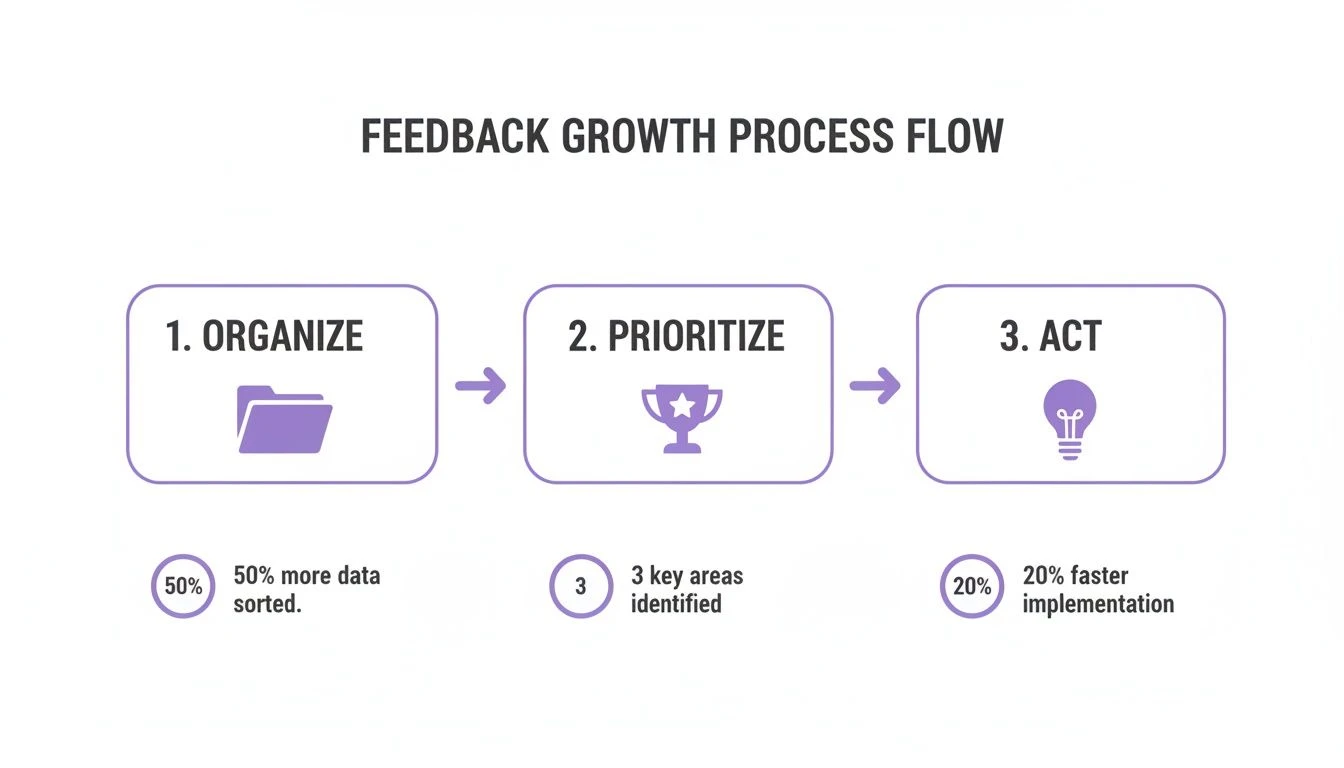
The real takeaway here is that feedback isn't a one-time project. It’s a continuous loop where the insights you gather lead directly to action and improvement.
A Mini-Playbook for Your Loyalty App
Setting up a feedback loop inside your loyalty app is surprisingly simple. It’s the most cost-effective way for a small business to roll rewards and insights into a single growth engine. Here’s how to get started with BonusQR.
1. Start with One Simple Question Don't overwhelm your customers. Kick things off with one high-impact, closed-ended question. A simple star rating (CSAT) or a "How likely are you to recommend us?" (NPS) question is a perfect place to start. The goal is to establish a baseline metric you can track over time.
2. Set Up Your Automated Trigger Next, jump into your loyalty app’s dashboard. Set the feedback request to trigger immediately after a customer makes a purchase or redeems a reward. This timing is key. With a system like BonusQR, this is usually as simple as checking a box in your settings.
3. Add an Optional Follow-Up Question For customers who give a really high or really low rating, offer a chance to elaborate. Add an optional, open-ended question like, "Thanks! Care to tell us a bit more?" This lets your most passionate customers provide valuable context without forcing every user to type a response.
4. Check Your Dashboard and Hunt for Trends Finally, make it a weekly habit to check your feedback analytics. Are your ratings trending up or down? Do you see scores dipping at specific times of day? These patterns are your roadmap to making smarter operational moves. You can learn more about how to leverage loyalty app analytics for your business to uncover these valuable trends.
By wiring feedback directly into your loyalty system, you turn it from a chore into an automated, strategic asset. You’re no longer guessing what your best customers want; you're asking them directly and building a stronger, more resilient business with every scan.
Your Top Questions About Customer Feedback, Answered
Thinking about asking for feedback? It’s normal to have a few questions. For a busy small business owner, it's easy to wonder if you’re doing it right, or if it's even worth the time.
Let's cut through the noise and tackle the most common concerns we hear from business owners just like you, so you can start collecting feedback with confidence today.
What If I Get Negative Feedback? Should I Worry?
Honestly, it might sting for a second, but negative feedback is one of the most valuable things you can get. It's not an attack; it's a map telling you exactly what’s broken and how to fix it.
Think of it this way: would you rather have a customer tell you your service was slow, or have them just walk away and never come back? The customer who takes the time to complain is giving you a second chance. Studies show that customers whose issues are resolved quickly often become even more loyal than those who never had a problem.
Negative feedback is basically free consulting. Thank them for their honesty, apologize sincerely, and use their insight to make a real change. That’s how you turn a critic into your biggest fan.
How Can I Realistically Do This with Zero Time?
This is the number one hurdle for most small business owners. The answer isn't to work harder; it's to start small and automate. You don't need a massive, multi-channel feedback system from day one.
The smartest approach is to bake feedback collection into a tool you're already using. A modern loyalty program is perfect for this. With a platform like BonusQR, you can set up a single, automated question that pops up right after a customer makes a purchase.
This works so well because it’s:
- Effortless: You set it up once, and it runs on its own.
- Timely: It catches customers when the experience is fresh in their minds.
- Actionable: It links feedback directly to a specific customer and their visit.
Starting with a simple "Tap a star to rate your visit" is more than enough. Consistency beats complexity, every time.
How Many Questions Should I Ask in a Survey?
Fewer is almost always better. Your guiding principle should be respecting your customer's time. The right number of questions depends on where and when you're asking.
For "in-the-moment" feedback-like a QR code on a receipt or a prompt in your loyalty app-keep it to 1-3 questions, max. A single rating question followed by an optional comment box is a winning combination.
If you're sending a follow-up email survey, you have a bit more leeway. You can stretch to 5-7 questions, but you must set clear expectations. Always start with something like, "Got two minutes? Share your thoughts in our quick survey." Shorter, more frequent check-ins will always outperform one long, annual survey.
How Do I Get More Customers to Actually Give Feedback?
Getting customers to participate isn't about begging or throwing discounts at them. It's about making the process feel easy, timely, and meaningful.
Here’s the simple formula that works:
Make It Easy: Use dead-simple channels. QR codes have zero learning curve. An in-app prompt from a loyalty program like BonusQR is even better-it’s seamless and requires no extra effort from your most loyal customers.
Make It Timely: Ask for feedback immediately after the experience. Don't wait a week. The memory is freshest right after they've left your shop, making the feedback more accurate.
Make It Impactful: This is your secret weapon. Close the loop and show people you're actually listening. A small sign on your counter that says, “You asked, we listened! Gluten-free options are now on the menu, thanks to your suggestions!” does more to encourage future feedback than any incentive ever could. It proves their voice matters, and that’s the best motivation there is.