
 Deutsch
 Español
 Français
 Italiano
 Magyar
 Polski
 Slovenčina
 Čeština
Loyalty program members spend 18% more than non-members, yet many supermarket managers still assume rewards programs are only for major chains with massive marketing budgets. That assumption is costing them repeat customers and real revenue. The truth is that modern rewards programs are flexible, affordable, and practical for stores of any size. In this article, you will learn exactly what supermarket rewards programs are, the specific benefits they deliver, and how smaller grocery stores can launch and run programs that genuinely compete with the big players.
Key Takeaways
| Point | Details |
|---|---|
| Increased customer spending | Members of supermarket rewards programs typically spend 18% more than others. |
| Retention and loyalty | Rewards drive frequent visits and higher retention, growing lifetime customer value. |
| SMB competitive advantage | Small supermarkets can deploy simple, customizable rewards to compete with big chains. |
| Omnichannel engagement | Using apps and digital cards alongside physical rewards increases reach and participation. |
| Simplicity wins | Keeping rewards programs easy to use and quick to join maximizes customer engagement. |
What are supermarket rewards programs?
A supermarket rewards program is a structured system that encourages customers to return to your store by offering them something valuable in exchange for their purchases or visits. The core idea is simple: shoppers earn rewards over time, and those rewards give them a reason to choose your store again over a competitor down the street.
These programs go by many names, including loyalty programs, rewards clubs, and shopper points programs. But regardless of the label, they all share a common goal: building a consistent relationship between your store and your customers so that shopping with you becomes a habit rather than a one-time transaction.
There are several formats commonly used in grocery retail, and the best choice often depends on your store size, customer base, and operational setup. Here are the most practical options:
- Stamp cards: Customers collect a stamp for each qualifying visit or purchase. After reaching a set number of stamps, they earn a reward such as a free product, a discount, or bonus points. Stamp cards are simple to understand and require very little technology.
- Points programs: Shoppers earn points based on how much they spend. Points accumulate in a digital or physical account and can be redeemed for discounts, free items, or exclusive offers. This format works especially well for encouraging larger basket sizes.
- Digital coupons: Members receive personalized or general coupons through an app or email. These coupons can be tied to specific products, categories, or spending levels, giving you strong control over margin and promotions.
- Cashback rewards: A percentage of each purchase is returned to the customer as store credit or actual cash. This format is straightforward and appeals to price-conscious shoppers.
- Visit frequency rewards: Customers earn bonuses for visiting a certain number of times within a given period, regardless of spend. This is highly effective for building habit and foot traffic.
You can explore the full range of reward types for retailers to find the format that fits your store best. A well-designed, simple rewards system design does not need to be complicated to perform well. In fact, the simpler the format, the faster customers adopt it. And faster adoption means faster returns on your investment.
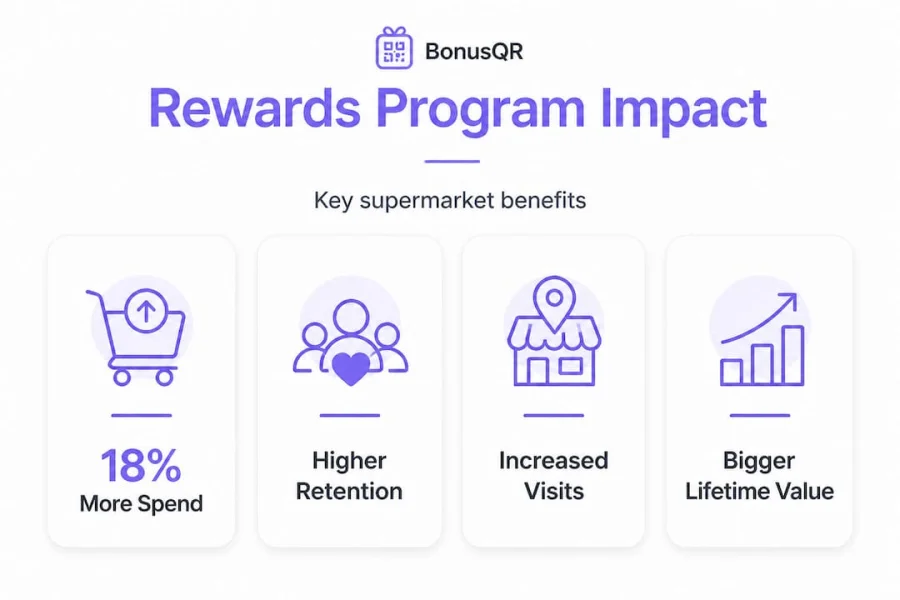
The financial impact is measurable. Loyalty program members spend 18% more than non-members, which means every enrolled customer is worth considerably more to your business than someone without a loyalty account.
Key benefits of using rewards in supermarkets
Now that we understand what rewards programs are, let’s explore the concrete benefits they deliver for supermarkets.
The most immediate benefit is customer retention. Retaining an existing customer costs significantly less than acquiring a new one. When shoppers are enrolled in your program, they have a tangible reason to come back. They have points to spend, stamps to complete, or rewards waiting for them. That unfinished progress is a proven psychological motivator.
“Loyalty program members spend 18% more than non-members.” — Comosoft
That 18% increase in spend is not a small margin in grocery retail, where average profit margins are tight, typically between 1% and 3% for traditional supermarkets. An 18% lift in customer spend among your loyalty members can meaningfully change your bottom line without increasing your marketing spend proportionally.
Here is a breakdown of the primary business benefits rewards programs deliver:
| Benefit | How it works | Impact on your store |
|---|---|---|
| Higher customer retention | Members return more often due to active rewards | Lower churn, more consistent revenue |
| Increased basket size | Points per dollar spent encourages larger purchases | Higher average transaction value |
| More frequent visits | Visit-based rewards drive habit-building | More foot traffic per week |
| Better customer data | Loyalty sign-ups collect purchase behavior | Smarter promotions and stock decisions |
| Stronger brand connection | Personalized offers make customers feel valued | Higher word-of-mouth referrals |
Beyond spend, loyalty programs directly affect how often customers visit. A shopper who visits three times per month rather than twice per month is contributing significantly more annual revenue to your store. Loyalty programs are one of the most reliable tools for shifting that behavior. You can see the full picture of customer retention benefits to understand why retaining each customer has compounding long-term value.
The concept of customer lifetime value, often called CLV, becomes very real when you run a loyalty program. A customer who shops with you consistently for five years is worth many times more than a one-time buyer. Loyalty programs extend that relationship and deepen it. Well-designed programs, as detailed in loyalty program retention strategies, consistently outperform general promotions when it comes to keeping customers engaged over time.
Pro Tip: For smaller grocery stores, the fastest win is to incentivize visit frequency rather than spend alone. A reward for visiting five times in a month costs you very little but creates a strong habit loop that is hard for competitors to break.
How rewards programs drive loyalty for SMB grocers
After understanding the core rewards program benefits, let’s see how SMB supermarkets can practically implement and compete through customizable solutions.
One of the biggest misconceptions is that smaller supermarkets cannot compete with the rewards programs that large chains offer. In reality, SMB grocery stores have a distinct advantage: they can personalize their programs in ways that feel genuine and local, something that large chains consistently struggle to replicate.
Customization is the key. According to research on customer loyalty, SMB grocers should prioritize customizable setups, visit frequency rewards, simple omnichannel delivery, and low-friction enrollment to compete without needing large budgets. That means you do not need a custom-built app or an enterprise software contract to run an effective program.
Here is how SMB programs stack up against big chain programs:
| Feature | Big chain programs | SMB customizable programs |
|---|---|---|
| Enrollment process | Often complex, requiring apps | Simple QR code or card sign-up |
| Reward personalization | Algorithm-based, less personal | Manual or rule-based, more personal |
| POS integration | Usually built-in, expensive | Flexible, often no POS needed |
| Program flexibility | Rigid, set by corporate | Fully customizable to your store |
| Cost | Enterprise pricing | Free to low-cost subscription tiers |
| Customer experience | Standardized | Local, relevant, personal |
The comparison shows that smaller stores are not at a disadvantage. They are at a different advantage. You can move faster, make decisions without corporate approval, and respond to your specific customer base in real time.
A grocery store loyalty app built for supermarkets can get you running within days, not months. Here is a straightforward process for launching your first program:
- Define your reward structure. Decide whether you will use points, stamps, cashback, or a combination. Keep it simple at the start, one clear reward type is easier to explain and adopt.
- Choose your enrollment method. A QR code at the register, a link on your receipt, or a card sign-up at the counter are all effective and low-friction options.
- Set your reward thresholds. Determine how many points or stamps equal a reward. Make the first reward achievable quickly to build early momentum.
- Communicate the program to your customers. Use in-store signage, bag stuffers, and social media to announce the launch. Tell customers exactly how to join and what they earn.
- Launch and monitor. Track enrollment rates and early redemptions. Adjust thresholds or reward values if participation is lower than expected.
- Collect feedback. Ask enrolled customers what they value most and use their input to improve the program over time.
Strategies for boosting business loyalty in smaller stores consistently point to low friction as the top priority. If signing up takes more than 60 seconds or redeeming a reward requires too many steps, customers will disengage.
Pro Tip: Keep your reward earning rate visible and easy to calculate. If a customer cannot quickly figure out what they are earning, they will not feel motivated. A simple rule like “earn 1 point per dollar, get $5 off at 100 points” is far more effective than a complicated tiered system. For more inspiration, look at proven loyalty campaign ideas that work specifically for small businesses.
Omnichannel experiences and customer engagement
With SMB-focused strategies covered, let’s look at customer engagement, the key to loyalty, through smart omnichannel rewards that work on any budget.
Omnichannel simply means meeting your customers wherever they are, whether that is in your physical store, on their phone, or shopping online for pickup or delivery. For supermarkets, an omnichannel rewards approach ensures that your program is active and visible across all the touchpoints where customers interact with your brand.
The good news is that you do not need a large technology team or a six-figure budget to make this work. Modern solutions allow even small grocery stores to offer user-friendly reward systems that function across physical and digital environments seamlessly.
Here is what a practical omnichannel rewards setup looks like for a mid-sized independent supermarket:
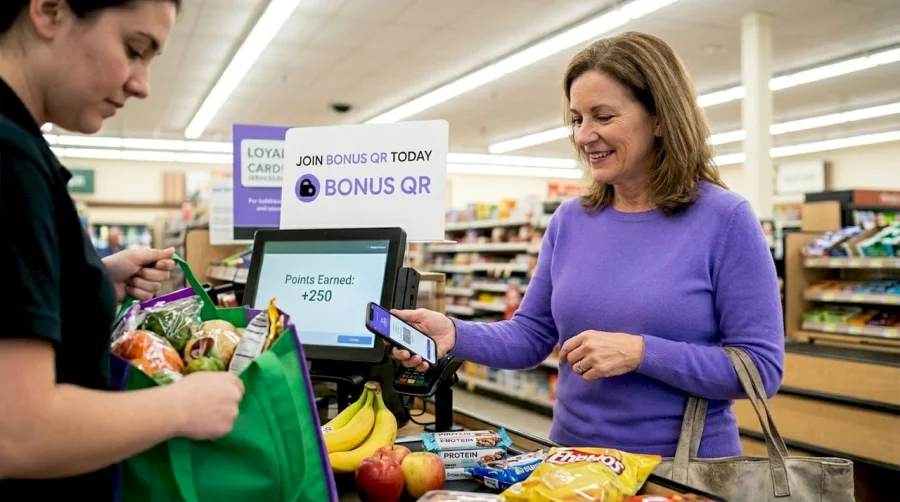
- In-store QR codes at the register or on shelf displays allow customers to scan, sign up, and start earning immediately without needing to download a separate app beforehand.
- Digital loyalty cards stored in a mobile wallet (like Apple Wallet or Google Wallet) eliminate the need for plastic cards and reduce friction at checkout.
- Push notifications sent through a loyalty app remind customers when they are close to a reward threshold, driving them back into the store to complete a purchase.
- Email-based coupons tied to loyalty membership allow you to send targeted offers based on purchase history, for example, a discount on coffee to someone who buys it every week.
- Online order integration ensures that customers earn points whether they shop in-store or order ahead for pickup, creating consistency across all channels.
Customer engagement strategies in retail consistently show that customers who interact with a brand across multiple channels have higher retention rates than those who only engage in one way. This applies directly to supermarkets. A shopper who earns points both in-store and through your app is significantly less likely to switch to a competitor.
The most important thing about your omnichannel rewards setup is consistency. Customers should earn and redeem rewards the same way regardless of how they shop with you. Inconsistency, such as points only counting in-store but not for online orders, creates confusion and erodes trust in the program quickly.
Low-cost digital engagement tools, when used consistently, are more effective than expensive one-off promotions. A weekly push notification reminding a customer they are 10 points away from a reward costs nearly nothing but can drive a visit that would not have happened otherwise.
A fresh perspective: Customization and simplicity win over complexity
Here is our candid take on what actually moves the needle for supermarket loyalty, and it might surprise you.
Most supermarket managers who contact us have the same instinct: they want to build a program that matches or exceeds what the large chains offer. They look at the apps, the tiered reward structures, and the gamification features of major retailers and assume they need all of it to compete. In our experience, that instinct leads to one of the most common loyalty program mistakes: over-engineering a system that your customers will not use.
The most effective loyalty programs we have seen from independent and medium-sized grocery stores share one trait. They are easy to join, easy to understand, and easy to use. That is it. There is no special formula beyond removing every possible reason a customer might hesitate to sign up or engage.
Simplicity is not a fallback position for stores with limited budgets. It is a genuine competitive advantage. A program that 60% of your customers use is more valuable than a feature-rich system that only 15% engage with. Enrollment and active participation are the metrics that matter most, especially in the first year.
Customization matters for a different reason. It allows you to build a program that reflects your actual customer base. A store in a neighborhood with many families might benefit from family-sized product rewards. A store with a large senior customer base might prioritize easy-to-use physical stamp cards over digital apps. Trying to copy a national chain’s program without adapting it to your community is almost always the wrong call.
The brands that get the most out of loyalty programs are the ones that treat their program as a living system. They test, listen, and adjust. Small business loyalty strategies that work long-term are built on real customer feedback, not assumptions.
Pro Tip: Every 90 days, ask your five most frequent customers one question: what could we do to make your rewards even more valuable? Their answers will tell you more than any analytics dashboard.
Get started with modern supermarket rewards
For those ready to upgrade their supermarket rewards strategy, here’s how to take the next step with available solutions.
Building a rewards program does not have to be a long or complicated process. bonusqr.com provides customizable loyalty solutions designed specifically for businesses like yours, including supermarkets and grocery stores looking to launch quickly without expensive infrastructure.
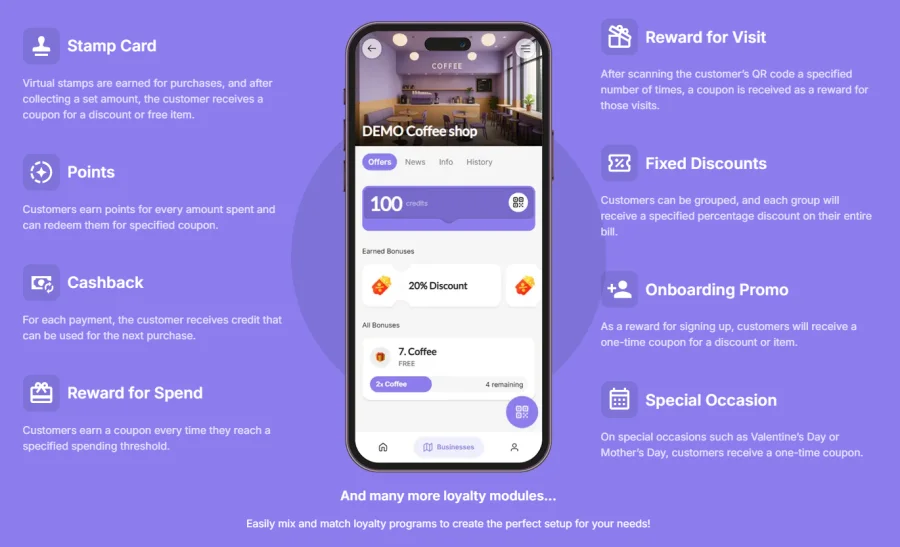
You can explore all available loyalty system features to understand what tools are at your disposal, from stamp cards and points programs to push notifications, digital coupons, and real-time analytics. If you run a service-oriented side of your store such as a deli counter or in-store café, the service loyalty app is worth reviewing as a complementary tool. For stores that want a proven starting point, the stamp card program is one of the easiest formats to launch and one of the fastest to gain customer adoption. Pick the format that fits your store and your customers, and start building the loyalty your business deserves.
Frequently asked questions
Do rewards programs really increase spending in supermarkets?
Yes, loyalty program members spend 18% more than non-members, which offers clear and measurable financial benefits even for smaller supermarkets.
How can smaller supermarkets compete with big chains using rewards?
SMBs can use customizable rewards via POS integrations, prioritize visit frequency incentives, and keep enrollment simple to compete effectively without large marketing budgets.
Are omnichannel rewards costly or complicated to set up?
Not necessarily. Modern platforms let SMB supermarkets launch digital rewards programs quickly and affordably, often without requiring any POS system integration at all.
What types of rewards work best for supermarkets?
Stamp cards and points programs are consistently preferred because they are easy for customers to understand and quick to engage with from the very first visit.
How do supermarkets measure rewards program success?
The most useful metrics are member spend compared to non-member spend, visit frequency among enrolled customers, and overall retention rates tracked month over month.