TL;DR:
- Discounts offer immediate savings, while rewards build long-term customer relationships.
- Rewards programs tend to drive higher repeat engagement and loyalty over time.
- Combining discounts and rewards creates a flexible, effective loyalty strategy tailored to your business.
Loyalty programs are one of the most powerful tools small businesses have for keeping customers coming back, but not all programs are built the same. Many business owners treat discounts and rewards as interchangeable, when they actually work in very different ways and produce very different outcomes. One approach rewards your customer right now at the register, while the other builds a relationship over time. Choosing the wrong one for your business can mean spending money without seeing meaningful retention gains. This guide breaks down exactly how discounts and rewards work, how they compare, and how to decide which strategy fits your goals.
Key Takeaways
| Point | Details |
|---|---|
| Discounts vs rewards defined | Discounts offer instant savings; rewards build ongoing value for loyal customers. |
| Choose based on business goals | Select the approach that matches your store’s audience and objectives for best results. |
| Hybrid strategies win | Mixing discounts and rewards can engage a wider range of customers and boost retention. |
| Leverage modern tools | Digital platforms make running flexible, effective loyalty programs much easier for small businesses. |
Understanding discounts and rewards in loyalty programs
Before you can choose the right strategy, you need a clear picture of what each one actually involves. These two tools are not just variations of the same idea. They operate differently and appeal to customers for different reasons.
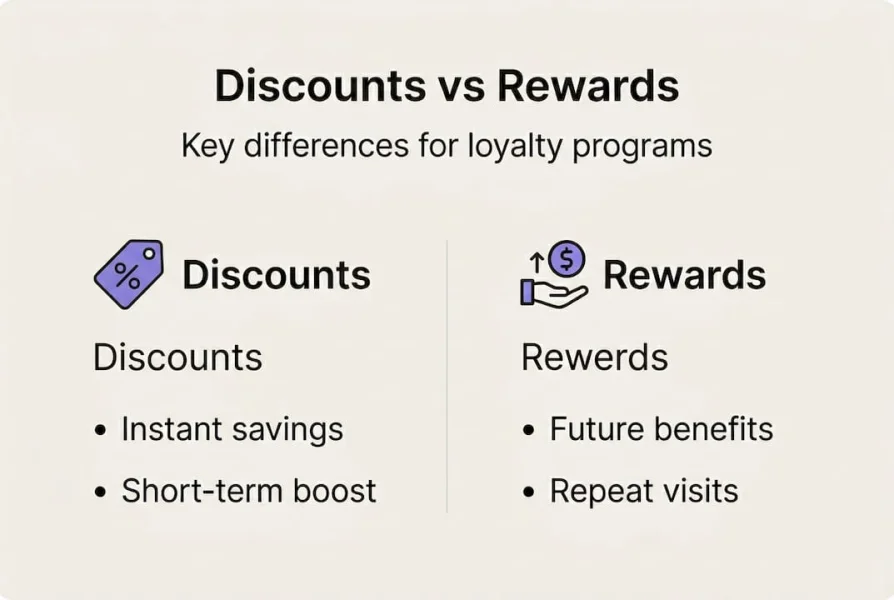
Discounts are straightforward price reductions applied at the point of sale. They can take the form of a percentage off (10% discount on your total), a fixed dollar amount ($5 off your next purchase), or threshold-based savings (spend $50, save $10). Customers see the benefit immediately, which makes discounts highly visible and easy to understand. You can explore how discount strategies for grocery loyalty businesses apply these mechanics at scale to drive volume.
Rewards, on the other hand, are future-facing benefits. Customers earn points, stamps, or credits through purchases or visits and redeem them for gifts, free products, exclusive experiences, or cashback at a later date. The value builds over time, which encourages customers to return repeatedly. Learning more about rewards program types can help you understand the full range of options available for retailers today.
Here is a quick breakdown of how each approach typically appears in practice:
| Feature | Discounts | Rewards |
|---|---|---|
| When value is received | Immediately | Over time |
| Customer action required | Single purchase | Repeated engagement |
| Complexity to manage | Low | Moderate to high |
| Best for | Price-sensitive buyers | Loyal, repeat customers |
| Example | 20% off today | Earn 1 point per $1 spent |
From a customer’s perspective, discounts feel like a win in the moment. Rewards feel like a game worth playing. Both have real appeal, but they attract different motivations. Common use cases for each include:
- Discounts: Flash sales, new customer promotions, seasonal clearance, referral bonuses
- Rewards: Ongoing loyalty points, birthday perks, VIP tiers, milestone gifts
One important reality to keep in mind: discounts often produce immediate sales spikes but may not build long-term loyalty. That is a critical distinction when you are thinking about sustainable growth rather than just short-term revenue bumps. For a broader view of how these tools fit into a larger retention strategy, the customer loyalty programs overview from Shopify offers useful context.

Head-to-head: Comparing discounts and rewards
With clear definitions in hand, it is crucial to see how discounts and rewards stack up when put side by side. Both have genuine strengths. The key is matching the right tool to the right situation.
| Metric | Discounts | Rewards |
|---|---|---|
| Customer perception | Immediate savings | Long-term value |
| Repeat purchase rate | Moderate | High |
| Profit margin impact | Can erode margins | Lower direct cost |
| Engagement level | Low to moderate | High |
| Program flexibility | Limited | Very flexible |
| Best business fit | High-volume, low-margin | Relationship-driven |
Discounts can attract new customers and move inventory quickly. But they train buyers to expect lower prices, which can hurt your margins over time. Rewards programs tend to drive higher long-term engagement than simple discounts, which is why many growing businesses eventually shift their focus toward reward-based systems.
Some key distinctions worth noting:
- Discounts are transactional. They close a sale today but do not guarantee the customer returns tomorrow.
- Rewards are relational. They give customers a reason to come back, creating a cycle of engagement.
- Discounts are easy to copy. A competitor can match or beat your offer overnight.
- Rewards build identity. Customers who collect points or hold VIP status feel connected to your brand.
The loyalty program benefits of reward-based approaches are especially clear in businesses where repeat visits matter, such as coffee shops, salons, or specialty retailers. For inspiration, reward system examples from real businesses show how these programs translate into practice.
The data backs this up too. Research highlighted by Forbes confirms that reward-based incentives outperform cash discounts when it comes to building genuine loyalty over time.
Pro Tip: If your average customer visits less than once a month, discounts may feel more impactful in the short term. If they visit weekly, rewards will compound in value and keep them engaged far longer.
Choosing the right strategy for your business
After weighing the pros and cons, how can you apply these insights to your specific store or business? The answer is not one-size-fits-all. Here is a practical decision process to guide you.
- Analyze your margins. Discounts cut directly into profit. If you operate on thin margins (think grocery, fast food, or budget retail), aggressive discounting can do more harm than good. Rewards, while requiring upfront setup, often cost less per customer over time.
- Understand your customers. Are your buyers primarily price-driven, or do they shop with you because they trust your brand? Defining your target market is a foundational step before committing to any loyalty structure.
- Clarify your goal. Do you need to move product fast, or do you want to increase how often loyal customers visit? Discounts serve the first goal well. Rewards serve the second.
- Check your average transaction value. Higher-ticket purchases lend themselves well to rewards because customers are motivated to accumulate value across multiple big purchases. Lower-ticket, high-frequency businesses benefit from simple point systems.
- Watch for warning signs. If customers only visit during discount events, your strategy may be attracting deal-seekers rather than loyal fans. That is a sign to shift toward a rewards structure that incentivizes repeat behavior regardless of pricing.
As the most successful loyalty programs demonstrate, programs tailored to a store’s unique needs consistently outperform generic approaches. The loyalty benefits for small businesses are most visible when the strategy aligns tightly with what your specific customers actually value.
Pro Tip: Start with a simple survey or ask your staff what customers most often comment on. Real feedback will tell you whether your audience responds more to saving money now or earning something special later.
Real-world examples: Discounts and rewards in action
To bring these strategies to life, let’s examine how real businesses have implemented discounts and rewards and what results they have seen.
Businesses succeeding with discounts:
- A regional grocery chain runs a weekend flash sale offering 15% off select categories. Foot traffic spikes every weekend, and basket size increases because shoppers stock up.
- A local clothing boutique offers a referral discount: bring a friend and both of you get $10 off. New customer acquisition costs drop significantly.
Businesses excelling with rewards:
- A neighborhood coffee shop uses a digital stamp card: buy nine drinks, get the tenth free. Customers visit more frequently just to reach that milestone.
- A beauty salon awards points for every appointment and double points on birthdays. Their rebooking rate climbed after introducing the program.
Hybrid programs combining both:
- A specialty food retailer gives points on every purchase and also runs seasonal discount events exclusively for loyalty members. This approach rewards everyday shoppers while creating excitement around limited-time offers.
“Loyalty is not just about the next purchase. It is about building a habit that keeps customers in your ecosystem.”
Blended loyalty strategies are on the rise, providing flexibility and greater appeal across diverse customer segments. You can browse standout retail loyalty program examples for more ideas on how leading brands structure their programs.
For businesses that want to manage both approaches digitally, coupon management tools can automate discount distribution while your rewards engine runs in the background. Real-world data from Retail TouchPoints confirms that the most memorable programs often layer instant savings with long-term reward accumulation.
Our perspective: Blending the best of both worlds
Here is something most guides will not tell you: choosing strictly one strategy often leaves money on the table. Businesses that commit only to discounts risk training customers to wait for the next sale. Businesses that commit only to rewards sometimes struggle to attract new customers who need an immediate reason to try them out.
What we have observed across many small business loyalty programs is that the most effective operators use discounts as an entry point and rewards as the retention engine. Welcome a new customer with a first-visit discount. Then shift that relationship into a rewards program that makes them want to come back week after week. These two tools are not rivals. They are partners when used thoughtfully.
The long-term loyalty benefits of this blended approach are real and measurable. Customers who feel both valued in the moment and excited about future rewards are simply more likely to stay. Do not let the false choice between discounts and rewards slow you down. Build a program that does both.
Start building a loyalty strategy with the right tools
Understanding the difference between discounts and rewards is one thing. Putting that knowledge into a working system is another. BonusQR makes it straightforward for small and medium-sized businesses to launch digital loyalty programs that handle both approaches without complicated setup or POS integration.
You can activate an electronic rewards platform that tracks points and automates reward delivery, manage promotions through an integrated coupon management feature, and give your customers a seamless experience through mobile loyalty tools they can access anytime. Whether you choose discounts, rewards, or a blend of both, BonusQR gives you the flexibility to build it your way.
Frequently asked questions
What is the main difference between discounts and rewards in loyalty programs?
Discounts provide instant savings while rewards encourage repeat visits by building future value through points, gifts, or exclusive perks earned over time.
Do rewards work better than discounts for customer retention?
Reward strategies are more effective for long-term loyalty than discounts in most cases, though your customer base and business model will shape which approach delivers the strongest results.
Can I combine discounts and rewards in one loyalty program?
Hybrid loyalty programs are becoming increasingly popular, and many businesses find that blending both approaches engages a wider range of customers more effectively than using either alone.
How do I decide which loyalty strategy is best for my store?
The smartest approach is tailored to your specific business and customer needs, so evaluate your margins, visit frequency, and retention goals before committing to one path or the other.


