
TL;DR:
- Stamp cards are simple, quick to implement, and effective for high-frequency, small purchase businesses.
- Rewards programs offer scalability, personalized data insights, and are better for increasing customer lifetime value.
- Choose based on your business model, customer behavior, and long-term growth goals, avoiding trend imitation.
Stamp Cards vs Rewards: Best Loyalty Choice for SMBs
Many small business owners assume all loyalty programs work the same way. They believe that simply offering some kind of reward is enough to keep customers coming back. That assumption leads to frustration and wasted budget. The real decision that shapes your customer retention results is whether to run a stamp card program or a point-based rewards system. These two tools are built on different principles, attract different behaviors, and suit different business types. This guide walks you through the key differences, real-world effectiveness, and a practical framework to help you choose the right loyalty approach for your business goals in 2026.
Key Takeaways
| Point | Details |
|---|---|
| Simplicity builds results | Stamp cards are still a top choice for SMBs needing quick, easy loyalty solutions. |
| Rewards bring flexibility | Digital rewards programs enable advanced features and data insights but can be complex without the right setup. |
| Know your customers | Choosing the right tool depends on your audience’s tech comfort and engagement style, not just trends. |
| AI boosts loyalty | Personalized and AI-powered programs can drive 20-50% higher customer lifetime value when properly matched to your business. |
Understanding stamp cards and rewards programs
Before comparing their results, it helps to understand exactly what each system is and how it works from a customer’s perspective.
Stamp cards are one of the oldest and most recognizable loyalty tools. The classic format is simple: a customer makes a purchase, earns a stamp, and once they collect enough stamps, they receive a free product or discount. The buy-nine-get-one-free coffee card is the most well-known example. Customers understand the value immediately, with no explanation needed. This zero-friction experience is a major reason why stamp cards remain popular today, even as digital alternatives have become more accessible. The stamp card loyalty basics have not changed much in concept, but the delivery method has shifted significantly from paper to digital.

Points-based reward programs work differently. Customers accumulate points for purchases, visits, referrals, or other defined actions. Those points convert into rewards like discounts, free products, or exclusive perks. The value exchange is slightly more abstract than stamps, which means some customers need a little more onboarding before they feel the program’s appeal. However, what points programs lack in simplicity, they can gain back in flexibility, personalization, and data collection. Businesses can offer bonus point events, reward specific behaviors, and tailor offers to individual customer preferences.
Here is a breakdown of the core differences at a glance:
Stamp card advantages:
- Instantly understood by almost any customer
- Low cost to launch, especially digitally
- Minimal staff training required
- Encourages repeat visits within a short time window
Stamp card drawbacks:
- Limited data about customer spending habits
- Hard to personalize rewards at scale
- Physical cards can be lost, forged, or forgotten
Rewards program advantages:
- Highly flexible reward structures
- Enables customer data collection and behavioral insights
- Supports personalized marketing and targeted offers
- Scales well as your business grows
Rewards program drawbacks:
- Can feel complex for customers unfamiliar with points systems
- Higher setup time and ongoing management effort
- Risk of customers hoarding points without redeeming
The benefits of branded loyalty programs extend beyond just driving repeat visits. A well-designed program reinforces your brand identity and gives customers a reason to choose you over a competitor with equal or lower prices. The Paytronix 2026 Loyalty Report confirms that points programs are losing ground to experiential and AI-driven solutions, while simplicity remains a dominant winning factor for small and mid-sized businesses specifically.
Pro Tip: When evaluating either system, always ask how quickly your staff can explain it to a customer in ten seconds or less. If they cannot, the program may be too complex for your operation.
Comparing effectiveness: Which drives more loyalty?
Understanding the mechanics is one thing. Seeing how each system performs in the real world is where the decision gets clearer.
| Factor | Stamp cards | Rewards programs |
|---|---|---|
| Simplicity | Very high | Moderate |
| Flexibility | Low | Very high |
| Setup cost | Low | Moderate to high |
| User engagement | High for frequency | High for spend value |
| Scalability | Limited | Strong |
| Data insight | Minimal | Rich |
This table shows a clear pattern. Stamp cards win on simplicity and initial engagement, while rewards programs outperform on scalability and data insight. For a coffee shop with high daily visit frequency, stamps drive repeat behavior effectively. For a boutique retailer trying to increase average order value and track buying patterns, a rewards program is far more powerful.
One critical finding that shapes how we should think about this comparison:
“AI-driven and experiential loyalty programs can increase guest lifetime value by 20 to 50 percent.”
This is significant for any SMB thinking long-term. If you are in a business model where customers can grow their spending over time, such as a spa, a fitness studio, or a specialty food store, a rewards program gives you the tools to capture that growth. However, if your typical customer makes small, frequent purchases, a stamp card may actually convert at a higher rate because the reward feels closer and more achievable.
Here are the main outcome differences, ranked by what matters most to most SMBs:
- Repeat visit rate: Stamp cards tend to generate more frequent return visits in the short term because customers can see their progress visually.
- Customer lifetime value: Rewards programs, especially those using branding for increased visits and personalization, build deeper loyalty over time.
- Redemption rates: Stamp cards typically see higher redemption rates because the reward is simple and clear.
- Customer data quality: Rewards programs generate far better data, enabling smarter marketing decisions.
- Retention during price competition: Rewards programs with experiential perks are more resilient when competitors lower prices, because they build emotional connection rather than just transactional habit.
One factor that is often overlooked is price sensitivity. When a competitor offers a sale or better deal, customers in a purely transactional relationship, like a basic stamp card, may switch. Retail price matching strategies can lure away loyalty card holders unless your program has built real emotional attachment. Rewards programs with personalized perks create that attachment far more reliably. For deeper strategies on keeping customers close, explore customer retention for SMBs to see what the data says about long-term retention tactics.
Pros and cons for small business owners
Knowing how each program performs in comparison, you now need a practical view of what operating each system actually means for your business day to day.
| Practical factor | Stamp cards | Rewards programs |
|---|---|---|
| Launch cost | Low | Moderate |
| Staff learning curve | Minimal | Moderate |
| Fraud risk | Moderate (physical) | Low (digital tracking) |
| Customer tracking | Limited | Strong |
| Customization options | Low to moderate | High |
| Long-term value | Good for simplicity | Better for growth |
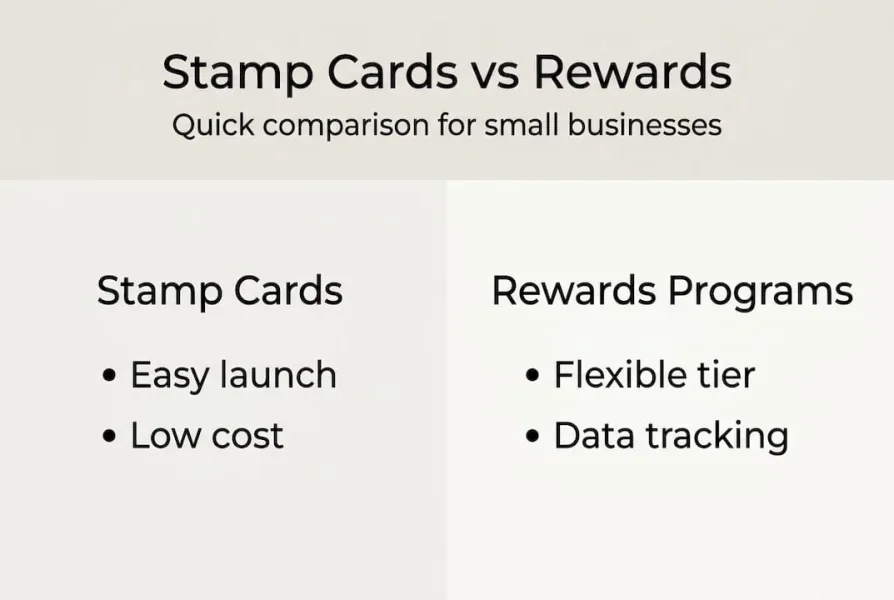
The Paytronix 2026 Loyalty Report highlights a real tension in the SMB loyalty space: stamp cards are still viewed by many operators as the go-to for simplicity and ease, while points-based programs offer far more long-term flexibility but face growing criticism for becoming outdated unless they are updated with personalization and AI features.
Biggest advantages:
- Stamp cards: They get customers enrolled and engaged within seconds. There is no app download required, no points explanation, and no confusion. For high-traffic businesses like cafes, bakeries, or barbershops, this immediacy translates directly into repeat visits.
- Rewards programs: They allow you to reward behaviors beyond just purchases. You can give points for referrals, social media shares, birthdays, or reaching a spending milestone. This flexibility means you can shape customer behavior far more strategically.
Biggest headaches:
- Stamp cards: Without digital tracking, you have very little visibility into your customers. You may not know how many active members you have, what they buy, or when they are at risk of churning.
- Rewards programs: The setup and ongoing management can feel overwhelming for a small team. If your staff is not trained properly or the system is too complex, customers may simply ignore the program after signing up.
Pro Tip: Cafes, quick-service restaurants, and high-frequency service businesses like nail salons typically see faster, more measurable results from stamp cards. Retail stores, service providers with longer purchase cycles, and businesses with multiple product categories tend to get more from a structured rewards program. Match the tool to your visit frequency.
For practical strategies you can apply today, reviewing customer retention strategies alongside customer engagement strategies will give you a clearer picture of what works across different business types.
Which is right for your business? Key decision factors
With a clear view of the strengths and weaknesses of each system, you are ready to make an informed decision. Here is a practical framework to guide you.
Key factors to evaluate before deciding:
- Business model: Do you sell products or services? Are your transactions small and frequent or large and infrequent?
- Customer visit frequency: Customers who visit weekly or more often respond well to stamps. Monthly or seasonal customers benefit more from points accumulation.
- Staffing capacity: A small team with high turnover needs a simple system. A more stable team with time for customer interaction can manage a richer rewards program.
- Budget: Stamp cards, especially digital ones, can be launched at very low cost. Rewards programs may require more investment upfront but deliver stronger returns as your customer base grows.
- Data goals: If understanding your customers deeply is a business priority, only a rewards program gives you the tracking capability to do that well.
The Paytronix 2026 Loyalty Report is clear that simplicity wins for many SMBs, but reward programs can offer far greater flexibility if they are personalized to the customer. This does not mean you must choose one or the other forever. Many businesses start with stamps and evolve.
Steps to audit your current retention and choose the right approach:
- Measure your current repeat visit rate. If fewer than 30 percent of your customers return within 90 days, any loyalty program will help, but start simple.
- Survey your best customers. Ask them what would make them visit more often or spend more. Their answers reveal whether simplicity or personalization matters more to them.
- Evaluate your tech readiness. Do you have a smartphone-friendly checkout process? If not, a digital stamp card is a good entry point before moving to full rewards.
- Set a 90-day goal. Define what success looks like: more visits, higher average spend, or new customer referrals. Different goals favor different systems.
- Review in 90 days. If your stamp card is working well but customers are asking for more, that is a natural signal to consider upgrading to a rewards program.
For creative program ideas that go beyond basics, look at best loyalty campaign ideas. To understand the deeper connection between program design and retention outcomes, why loyalty drives retention breaks down the psychology behind it.
Why following the crowd with loyalty programs can backfire
Here is something most loyalty program guides will not tell you: copying what big brands do can actively hurt your small business.
Large chains invest millions in AI-driven personalization, dedicated app development, and loyalty data science teams. When a small business tries to replicate that complexity on a limited budget, the result is often a half-built program that confuses customers and burns out staff. We have seen this happen repeatedly. A boutique clothing shop launches a points app inspired by a national retailer, spends months configuring it, and then watches customers ignore it because checking a balance was not worth the effort.
Meanwhile, a nearby coffee shop running a simple digital stamp card sees genuine growth in repeat visits. The lesson is not that technology is bad. It is that operational fit matters more than trend-chasing. Stamp card success stories consistently show that customers value speed, clarity, and a reward they can see getting closer. Your customers want to feel recognized, not enrolled in a complex system. Challenge yourself to choose the loyalty tool that genuinely delights your specific customers, not the one that looks impressive in a pitch deck.
Level up your loyalty program with BonusQR
Whether you are ready to launch your first stamp card or take the step up to a full digital rewards program, BonusQR makes it easy to get started without complicated setup or POS integration. You can design a program that matches your business model, your customers’ habits, and your budget from day one. Explore electronic loyalty rewards to see how digital tools can replace outdated paper methods with trackable, engaging experiences. If you want to reward customers for their spending, check out how reward programs for spend can increase your average transaction value automatically. BonusQR gives you the flexibility to grow from a simple stamp setup into a fully personalized loyalty engine as your business scales.
Frequently asked questions
Are physical stamp cards still effective in 2026?
Yes, many SMBs still find classic stamp cards effective for driving repeat visits due to their simplicity and instant gratification. The Paytronix 2026 report confirms that simplicity remains a dominant winning factor for small businesses specifically.
Do reward programs with points always require an app?
No, some modern programs use digital wallets or email-based tracking, but mobile apps are common for personalized features. As AI and personalization shape the future of loyalty, app-based programs are becoming more capable and easier for customers to use.
What is the main downside of traditional rewards compared to digital options?
Traditional rewards make it harder to track customer behavior and personalize offers compared to digital programs. Without data, programs risk becoming obsolete as customers expect more relevant, timely engagement.
How do I know if I should switch from stamp cards to a rewards program?
If your business wants deeper customer insights or needs to scale quickly, moving to a rewards system is a smart next step. Reward programs offer greater flexibility and scalability when personalized to your specific customer base.


