
 Deutsch
 Español
 Français
 Italiano
 Magyar
 Polski
 Slovenčina
 Čeština

As a small business owner, you fight hard for every single customer. Their first purchase is a victory. But when that same customer disappears without a word, it’s not just a lost sale-it feels like a personal puzzle you can't solve. You're left wondering: "What did I do wrong? How can I get them to come back?"
This is the core problem for passionate business owners: you're trying to build a loyal community while competing against big brands with massive budgets, and you lack a clear, simple way to see what's actually working.
This guide is your solution. We'll show you how a customer retention metric isn't just a number-it's the answer you've been looking for. It’s a simple signal that tells you exactly how to turn one-time buyers into loyal regulars, helping you build a more profitable and resilient business.
Why Retention Metrics are a Small Business Superpower
Focusing on keeping the customers you already have is the single smartest move you can make. It can cost 5 to 25 times more to attract a new customer than to retain an existing one. By understanding the simple numbers behind loyalty, you gain the power to:
- Spot Problems Early: Identify "leaks" in your customer base before they become a major issue.
- Discover Your VIPs: Pinpoint your most loyal customers so you can treat them like the champions they are.
- Stop Guessing: Make decisions based on real data about what your customers love, not just a gut feeling.
- Boost Your Bottom Line: A tiny 5% increase in customer retention can increase profitability by an incredible 25% to 95%.
The real challenge for most small businesses isn't a lack of passion; it's a lack of insight. You pour your heart into winning every customer, but without the right tools, you can't see why they leave or what makes them stay. This guide gives you that insight.
Before we dive into the formulas, here's a quick overview of the core metrics we’ll be exploring.
The 5 Core Customer Retention Metrics at a Glance
This table gives you a quick snapshot of the essential metrics, what they measure, and why each one is so critical for your small business.
| Metric | What It Tells You | Why It Matters for SMBs |
|---|---|---|
| Customer Retention Rate | The percentage of customers you kept over a specific period. | This is your main loyalty scorecard, showing overall business health. |
| Customer Churn Rate | The percentage of customers you lost during a specific period. | It flags potential problems with your product, service, or pricing. |
| Repeat Purchase Rate | How many of your customers come back for a second purchase. | This reveals the strength of your customer experience and product satisfaction. |
| Purchase Frequency | How often the average customer buys from you within a timeframe. | It helps you understand customer buying habits and plan marketing efforts. |
| Customer Lifetime Value | The total revenue you can expect from a single customer account. | It identifies your most profitable customers so you can nurture those relationships. |
We'll provide simple formulas and show you a cost-effective way to not only track but dramatically improve these numbers.
If you're ready to build a more resilient business, our complete guide on how to retain customers and build real loyalty offers even more actionable strategies. Let's get started.
The 5 Essential Metrics for Customer Loyalty
Let's be real-numbers on a spreadsheet don't tell you the whole story. To truly get a feel for how strong your customer relationships are, you need to look at the right vital signs. These five essential metrics are the pulse of your customer loyalty, and they’ll show you exactly where your business stands.
Imagine your customer base is a bucket you're trying to fill with water. You work hard every day to pour more water in (that's acquiring new customers). But what if there are holes in the bucket? You'll be losing water (customers) just as fast as you add it. Your Customer Retention Rate (CRR) is the metric that tells you how well your bucket is holding that water. It’s the ultimate loyalty scorecard.
This visual helps break down how loyal customers bring clarity, strength, and growth to your business.
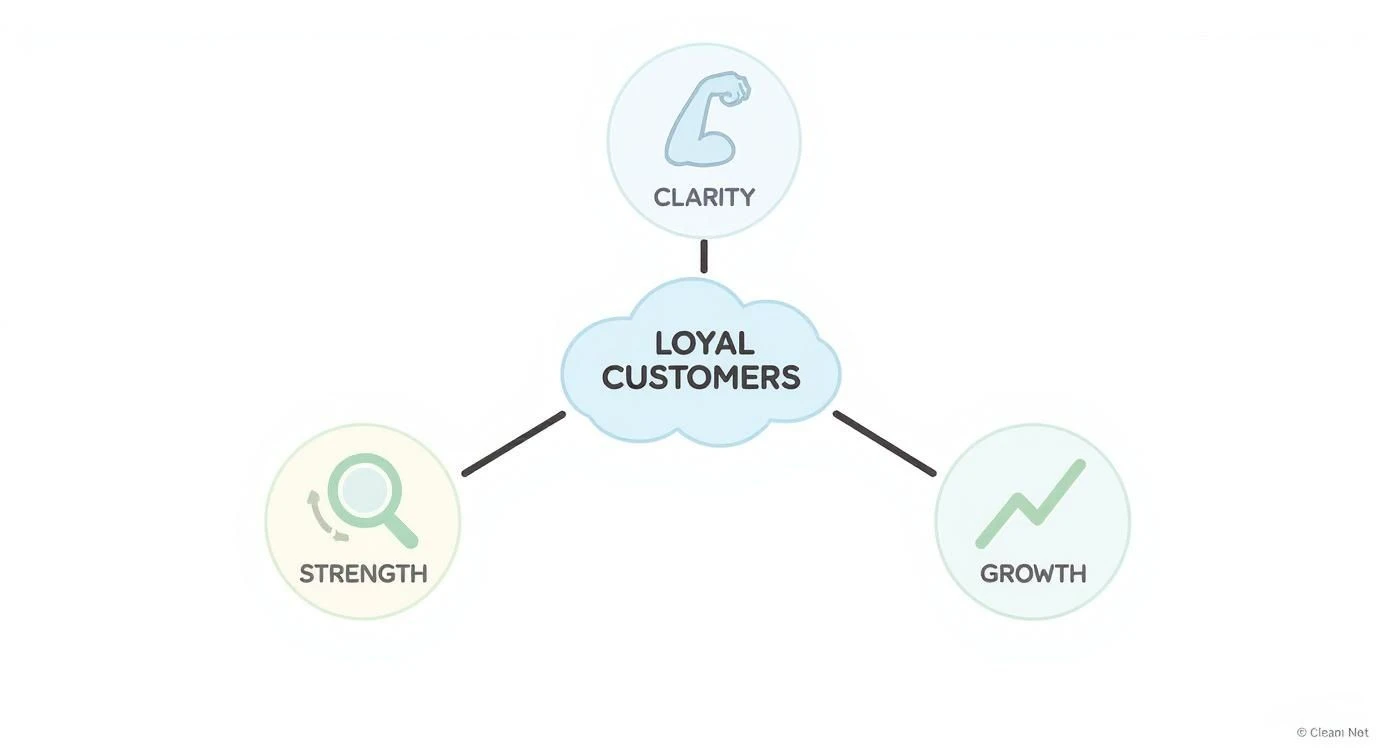
As you can see, focusing on keeping customers around gives you a clearer picture of what's working, makes your business more resilient, and paves the way for real, sustainable growth.
1. Customer Retention Rate (CRR)
Your Customer Retention Rate is simply the percentage of customers who decided to stick with you over a certain time. It's probably the single best indicator of how happy people are with what you're offering. A high CRR is a fantastic sign of a healthy, thriving business.
To figure it out, you only need three pieces of information:
- S: The number of customers you had at the Start of the period.
- E: The number of customers you had at the End of the period.
- N: The number of New customers you brought in during that time.
The Formula:
CRR = [ (E - N) / S ] x 100
Coffee Shop Example: Let’s say your coffee shop started the month with 200 regulars (S). By the end of the month, your loyalty app shows 210 regulars (E), and you know you signed up 30 brand-new people (N).
- Calculation: [ (210 - 30) / 200 ] x 100 = 90%
That's a 90% CRR, which means you kept nine out of every ten of your existing customers. That's fantastic!
2. Customer Churn Rate
Customer Churn Rate is just the other side of the retention coin. It measures the percentage of customers who walked away during a specific period. While CRR celebrates who stayed, churn shines a light on who you lost, helping you spot problems before they get out of hand.
Calculating churn is even simpler:
- S: Number of customers at the Start of the period.
- L: Number of customers you Lost during that period.
The Formula:
Churn Rate = ( L / S ) x 100
Coffee Shop Example: You began the month with 200 regulars (S). Looking through your data, you notice 20 of those original customers never came back (L).
- Calculation: ( 20 / 200 ) x 100 = 10%
Your churn rate is 10%. When you look at this alongside your 90% retention rate, you get the complete picture of customer movement.
3. Customer Lifetime Value (CLV)
This one is a game-changer. Customer Lifetime Value (CLV) is a prediction of the total amount of money you can expect from a single customer over the entire time they're with you. It helps you see who your most valuable customers are, so you know where to invest your energy to build even stronger relationships.
A simple way to calculate CLV uses these ingredients:
- AOV: Average Order Value (total revenue / total number of orders).
- PF: Purchase Frequency (total orders / unique customers).
- ACL: Average Customer Lifespan (how long they typically stick around, in years).
The Formula:
CLV = AOV x PF x ACL
Coffee Shop Example: You figure out that your average customer spends $7 per visit (AOV). Your regulars stop in about twice a week, or 100 times a year (PF). And you’ve noticed that, on average, they stay loyal for about 3 years (ACL).
- Calculation: $7 x 100 x 3 = $2,100
That means each loyal customer is worth an amazing $2,100 to your business. To truly get this right, you have to be intentional about measuring the customer experience with key metrics.
4. Repeat Purchase Rate
This is a beautifully straightforward metric. It tells you the percentage of your customers who've come back to buy from you more than once. It’s an awesome early sign of customer satisfaction. If people are coming back for a second round, you're definitely doing something right.
Here’s what you need to track:
- Multi-Purchase Customers: The number of people who bought from you at least twice.
- Total Customers: The total number of unique customers you served.
The Formula:
Repeat Purchase Rate = (Multi-Purchase Customers / Total Customers) x 100
Coffee Shop Example: Last month, you had 500 different people buy something. Out of that group, your records show 150 came back for at least a second time.
- Calculation: ( 150 / 500 ) x 100 = 30%
A 30% repeat purchase rate is a solid foundation. It shows that people liked their first experience enough to give you another shot. Now, the goal is to turn them into regulars.
5. Net Promoter Score (NPS)
NPS is all about gauging loyalty by asking one simple, powerful question: "On a scale of 0-10, how likely are you to recommend our business to a friend?" This little question tells you so much about customer sentiment and whether they're willing to be an advocate for your brand.
Based on their score, customers fall into one of three camps:
- Promoters (9-10): These are your die-hard fans. They love you.
- Passives (7-8): They're happy enough, but they could easily be tempted by a competitor.
- Detractors (0-6): These are unhappy customers who might even talk badly about your business.
The Formula:
NPS = % Promoters - % Detractors
Coffee Shop Example: You send out a quick survey to 100 customers. The results come back: 60% are Promoters, 25% are Passives, and 15% are Detractors.
- Calculation: 60% - 15% = 45
Your NPS score is 45. That’s a very healthy score, showing that you have way more brand champions than critics.
Getting a handle on these five metrics is your first big step toward building an unbreakable bond with your customers. If you want to dive even deeper, check out our complete guide on mastering customer retention metrics for small business owners.
What Good Retention Looks Like in Your Industry
So, you’ve calculated your customer retention rate. You’re holding a powerful piece of information, but without context, it’s just a number. The very next question every business owner asks is, "Is this number any good?" To answer that, you have to look beyond your own four walls and understand the world your business lives in.
Trying to compare your local coffee shop’s retention rate to a global software giant is like comparing apples to oranges. It’s not a fair fight, and frankly, it won’t give you any useful insights. Different business models naturally create different customer habits. A subscription box, for instance, is built on recurring payments, which almost guarantees higher retention as long as the value is there. A restaurant, on the other hand, has to earn every single return visit with amazing food and an unforgettable experience.
Setting Realistic Benchmarks
The first step to understanding where you stand is knowing what’s normal for your industry. Customer retention rates can swing wildly from one sector to another. For example, media and professional services often boast an incredible 84% retention rate. Meanwhile, highly competitive industries like hospitality, travel, and restaurants see a much lower average, hovering around 55%.
These numbers aren’t just stats on a page; they tell a story about how customers behave. Industries with lots of competition and frequent purchases will almost always have lower retention. The trick is to see these figures not as a source of discouragement but as a realistic yardstick to measure your own progress and set goals you can actually hit.
Your goal isn't to match a completely different industry's benchmark. It's to become a leader within your own. Aim to outperform the average for your sector, and you'll be building a powerful competitive advantage.
Common Retention Rates by Industry
To give you a clearer picture, let’s look at what “good” retention looks like across a few common small business sectors. Just remember, these are averages. Your specific niche, location, and the quality of your service will all play a huge role.
Retail & E-commerce: This space typically sees an average retention rate of about 63%. For brick-and-mortar shops, building those personal connections with regulars can really push this number higher. For online stores, a seamless checkout and quick shipping are absolute game-changers.
Restaurants & Cafes: A fiercely competitive field, this industry averages around 55%. Loyalty here is earned one plate at a time through fantastic service, consistently delicious food, and an atmosphere that makes people feel right at home.
Professional Services (Salons, Consultants, etc.): This sector enjoys one of the highest retention rates, often reaching 84%. It all comes down to the personal, trust-based relationship you build with each client. That’s the secret sauce to their incredible loyalty.
Grocery Stores: While it's tough competing with the big chains, local grocers can build powerful loyalty. A quick look at the top grocery loyalty programs reveals just how effective smart rewards can be at keeping shoppers from going elsewhere.
Instead of chasing a number that doesn’t apply to you, this context helps you focus on what really matters. It gives you the power to create smart, targeted plans that make sense for your business, your customers, and your unique corner of the market.
Ready to Improve Your Retention? Here’s How.
Knowing your customer retention numbers is like checking the dashboard on a road trip-it tells you where you are right now. But to get to your destination-a business that's not just surviving, but thriving-you need to actually drive. This is where you turn those numbers into real, meaningful action.
For small business owners, the best strategies aren't complicated or expensive. They're smart, practical, and built for the real world.
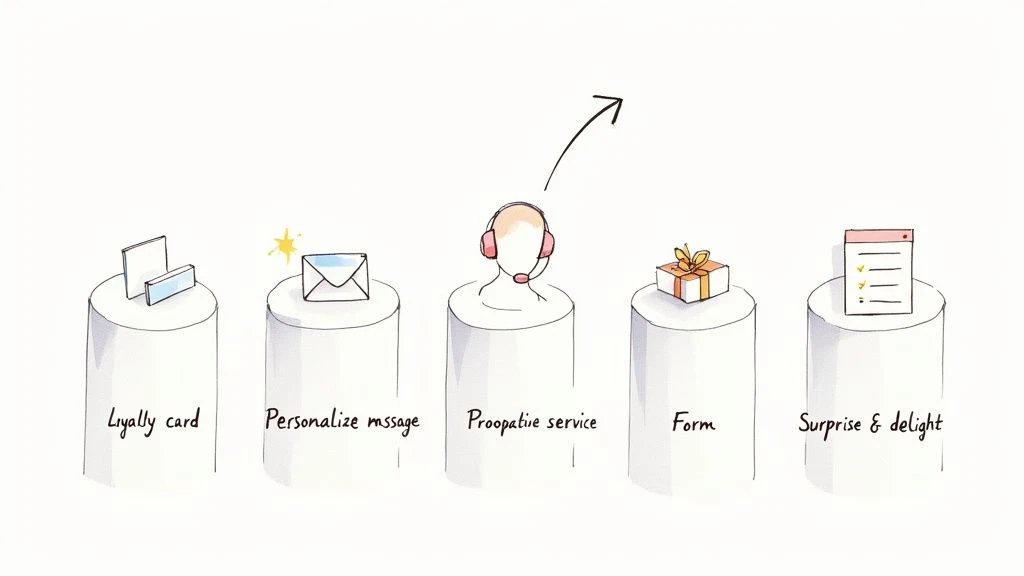
Let’s dig into five simple, powerful ways to inspire your customers to choose you again and again, turning good retention into great retention.
1. Launch a Loyalty Program That Actually Feels Rewarding
The phrase "loyalty program" can sound intimidating, bringing to mind complex software and big budgets. Forget all that. At its core, a loyalty program is just a simple, human promise: "Come back, and we'll show you we appreciate it." It’s about making your customers feel seen and valued.
You don't need a huge investment to make a huge impact. In fact, the programs that work best are often the simplest ones. Think about what would genuinely make your customers happy. A free coffee after five visits? An exclusive discount just for them? Maybe early access to that new product they’ve been eyeing?
This approach pays off-big time. Studies have shown that a tiny 5% increase in customer retention can boost your profits by a mind-blowing 25% to 100%.
Let’s See It in Action:
Imagine a local bakery using a simple digital punch card. Every time a customer buys something, they get a quick QR scan on their phone. Ten scans later, they get a free pastry of their choice. It’s a breeze to track, there's no physical card to lose, and it instantly rewards their most loyal regulars.
Your First Step: Start with a simple "buy X, get Y free" offer. A tool like BonusQR can help you set up a digital punch card in minutes, making it completely effortless for you and your customers.
2. Get Personal-Really Personal
Personalization is so much more than sticking a customer’s first name in an email. True personalization shows you’ve been paying attention. It’s remembering their go-to order, acknowledging how long they've been coming to you, or sending a special offer related to something they bought last month.
This is what makes people feel like cherished regulars, not just another transaction. It doesn't require a fancy system, either. It starts with a simple change in mindset: treat every interaction as a chance to build a relationship.
3. Shift from Reactive to Proactive Service
Most customer service waits for a problem to happen. Proactive service, on the other hand, gets ahead of it. It’s about reaching out before something goes wrong or offering help before a customer even realizes they need it. This approach shows you genuinely care and can turn a potential headache into a moment of delight.
Think of it like this: anyone can hand you an umbrella once it's already pouring. Proactive service is noticing the clouds gathering and offering you one before the first drop falls. It builds an incredible amount of trust.
Let’s See It in Action:
An online plant shop sees that a regular customer hasn't ordered in a while. They send a friendly email: "Hey, we miss you! Here’s 15% off your next order and a guide to prepping your plants for the new season." It's a thoughtful nudge that reminds the customer why they loved shopping there in the first place.
Your First Step: Think of one common question or issue your customers face. Create a simple tip sheet or a quick video you can share before they even run into the problem. You'll look like a hero.
4. Ask for Feedback (and Actually Use It)
Your customers are holding the roadmap to your success. You just have to ask for it. Every piece of feedback-the good, the bad, and the ugly-is a gift. It tells you exactly what’s working and what needs to be fixed.
The key is to make it incredibly easy for people to share their thoughts. But don't just collect it. Act on it, and then-this is the most important part-let them know you did. When a customer sees their suggestion brought to life, you’ve earned an advocate for life. For more great ideas on this, check out these actionable strategies to improve customer retention.
5. Create Moments of "Surprise and Delight"
Good service is expected. Unforgettable experiences are what people talk about. "Surprise and delight" moments are the small, unexpected gestures that go above and beyond. The magic is in their spontaneity-they aren’t part of some formal system.
It could be as simple as tucking a free sample into a shopping bag, offering a cold drink on a hot day, or sending a handwritten thank-you note. These are the things that forge real emotional connections that your competitors can't touch.
Let’s See It in Action:
A coffee shop owner notices a regular looks completely frazled. Along with their usual latte, the owner adds a fresh cookie and says, "On the house. Looks like you could use a little extra today." That small, empathetic act cost next to nothing but created a powerful, lasting memory.
Your First Step: This week, pick one loyal customer and find one small, unexpected way to make their day. The goal isn't to sell them something; it's just to make them smile.
By weaving these five strategies into your daily routine, you’re doing more than just improving a customer retention metric-you’re building a business that people genuinely love being a part of. For even more inspiration, explore our complete guide to customer retention strategies.
The Easiest Way to Track and Boost Loyalty
Let's be honest, tracking customer retention can feel like just another chore on an already overflowing to-do list. You’re a business owner, not a data analyst. You need a simple way to know who your loyal customers are and an easy method to keep them coming back-without sinking a ton of money into complex software or losing hours to spreadsheets.
This is where you can stop guessing and start growing. What if you had a tool that did all the heavy lifting for you? Imagine turning the confusing task of tracking loyalty into something you could check on your phone in a matter of seconds.
Your Loyalty Partner in Your Pocket
We built BonusQR from the ground up with the small business owner in mind. It's more than just an app; it's your dedicated partner in building real, lasting relationships with your customers. It automates the most frustrating parts of tracking loyalty so you can get back to what you do best-running your business.
Instead of trying to manually count repeat customers, BonusQR automatically logs every visit. It gives you a clear, instant picture of your repeat business, turning a once-difficult metric into a simple, readable insight.
The real magic in retention happens when loyalty feels effortless-for both you and your customer. When you get rid of the friction, you create a smooth experience that naturally makes people want to return.
Launch a Digital Loyalty Program in Minutes
With BonusQR, you can launch a professional-grade digital loyalty program in the time it takes to brew a pot of coffee. There's no complicated setup or long-term contract. You get to give your business the same kind of system that has worked wonders for big brands, but designed for your reality.
- Effortless Tracking: See who your most frequent visitors are with a simple, visual dashboard.
- Instant Rewards: Reward your best customers with a single tap, making them feel genuinely valued on the spot.
- Direct Engagement: Open a direct line of communication with your regulars to build a true community around your brand.
The BonusQR dashboard gives you a clean, at-a-glance view of your most important loyalty stats.
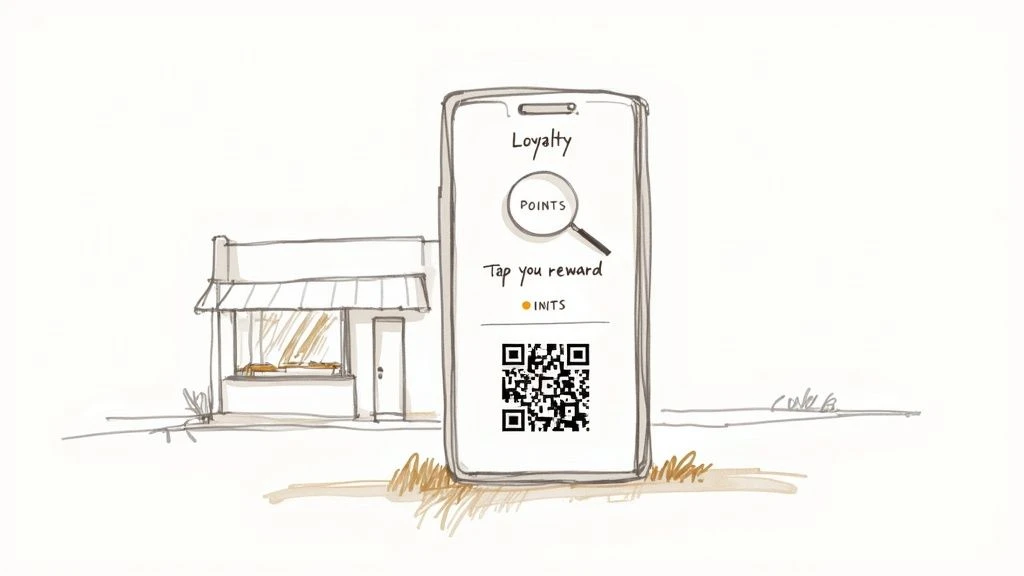
This simple interface shows you exactly who your top customers are, making it easy to see the direct impact of your efforts. By understanding these patterns, you can gain a much deeper insight into your business's health by reviewing the powerful BonusQR analytics and stats.
This isn't just about tracking a customer retention metric; it’s about taking control of it. You gain the power to build a loyal customer base that champions your growth, all through a tool that’s as easy to use as your favorite app. Stop letting your best customers walk away unnoticed-start building a business they can’t wait to come back to.
Got Questions? Let's Talk Retention
As you dive into the world of customer retention, it's natural for questions to bubble up. Think of this as a conversation with a seasoned pro-just straightforward answers to the most common puzzles small business owners face. Let's clear things up so you can move forward with confidence.
How Often Should I Be Looking at These Numbers?
This is a great question, and the answer is all about finding a rhythm that works for you without causing "analysis paralysis."
For most small businesses, calculating your core metrics-like Customer Retention Rate and Churn Rate-on a monthly or quarterly basis is the sweet spot. This cadence is frequent enough to catch important trends and see if your new initiatives are actually working, but not so frequent that you're buried in spreadsheets.
For the bigger picture metrics like Customer Lifetime Value (CLV), you can zoom out a bit. Checking in on that once or twice a year is plenty to understand the long-term value your customers are bringing to the table.
What’s the Real Difference Between Customer Loyalty and Retention?
It's easy to use these terms interchangeably, but they represent two very different things. Getting this distinction is key.
Think of it like this:
- Retention is the transaction. It’s the "what." A customer keeps coming back and spending money. It’s a behavior, and you can measure it on a spreadsheet.
- Loyalty is the relationship. It’s the "why." It's the feeling, the trust, and the emotional connection that makes them want to come back. It's why they'll drive past two other competitors to get to your shop.
Retention is what you track, but loyalty is what you build. When you focus on building genuine loyalty, the retention part takes care of itself.
Do I Really Need Fancy CRM Software to Track This?
Absolutely not. You don’t need to invest in a complicated, expensive Customer Relationship Management (CRM) system right out of the gate. Many small business owners start exactly where you are-by using the sales data they already have from their Point of Sale (POS) system or even a simple appointment book.
That said, there are now fantastic, affordable tools designed specifically for small businesses. They can help you track repeat visits and run a digital loyalty program without the cost and headache of a massive CRM platform.
The best tools are the ones you'll actually use. Simplicity is your secret weapon for consistently tracking your metrics and turning those numbers into meaningful action.
I'm Just Starting Out. What's the ONE Metric I Should Watch?
If you're new to the game, keep it simple. The very first metric you should obsess over is your Repeat Purchase Rate.
Why? Because it’s incredibly easy to calculate and it answers the single most important question for any new business: "Are people who try us coming back for more?"
A strong Repeat Purchase Rate is one of the earliest and most exciting signs that you're onto something special. It's a direct signal that your customers are happy and that you're building a business with real staying power.
Ready to stop guessing and start building a community of loyal fans? BonusQR makes it incredibly easy to launch a digital loyalty program, track repeat customers automatically, and reward the people who matter most-all from your phone.
See how simple it is to boost your retention and watch your business grow.