
 Deutsch
 Español
 Français
 Italiano
 Magyar
 Polski
 Slovenčina
 Čeština
Is your business's perfect memory locked in your head? You know your regulars, their usual coffee order, and their last visit. But what happens when you grow? Retail customer management software is the simple tool that remembers everything for you, turning anonymous sales into lasting customer relationships at scale.
This guide isn't about complex, enterprise-level tools. It's for small businesses-cafes, salons, local boutiques-looking for a simple, cost-effective way to solve real loyalty challenges and drive repeat business.
What Is Retail Customer Management Software (and Why You Need It)
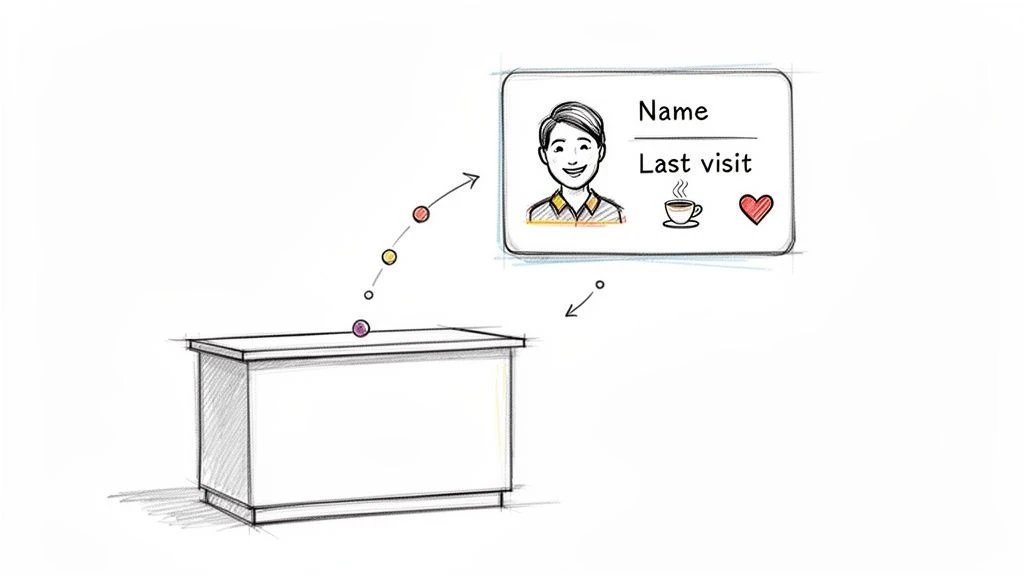
At its heart, retail customer management software is a system built to help you track, understand, and connect with your customers. It cracks a fundamental code for small businesses: how to recognize and reward your loyal customers so they have a reason to keep coming back.
Instead of relying on guesswork or messy paper punch cards, the software creates a clean digital profile for every customer. It logs their visits, tracks their spending, and manages their loyalty points, all in one organized place. This isn't about big data; it's about making customer information simple and genuinely useful for everyone on your team.
In essence, this software turns every transaction into an opportunity. It helps you see who your best customers are, what they love, and how to encourage them to visit again.
A coffee shop manager can instantly see a customer is one visit away from a free drink. A salon owner can send a personalized offer to a client who hasn't booked in two months. This personal touch, once only possible for shops with a handful of regulars, is now achievable for any growing business.
It Solves the Problems That Keep You Up at Night
Small businesses thrive on relationships. But as you grow, it's impossible to remember every face and name. You risk losing the personal connection that sets you apart from big chains. This software bridges that gap by automating the "remembering" so you can focus on the "connecting."
It directly solves the most common pain points that stunt growth.
Key Problems Solved by Customer Management Software
| Your Problem | The Simple Solution |
|---|---|
| "Why don't my customers come back?" | Identifies customers who haven't visited in a while, letting you send a targeted "we miss you" offer to win them back. |
| "Who are my best customers?" | Turns anonymous sales into valuable customer profiles, showing you exactly who your VIPs are and what they buy. |
| "Is my marketing even working?" | Lets you segment customers (e.g., "high spenders," "at-risk") and send relevant promotions instead of generic blasts that get ignored. |
| "My checkout line is too slow." | Streamlines loyalty sign-ups and reward redemptions. Tools like BonusQR use a simple QR code scan to eliminate friction and keep lines moving. |
The benefits are immediate and tangible, addressing the very challenges that prevent local businesses from scaling.
The Growing Need For Smart, Simple Tools
The market for these tools is exploding for a reason. The global Customer Relationship Management market is expected to grow significantly, according to Mordor Intelligence. This growth means more affordable and user-friendly options are hitting the market every day, designed specifically for small businesses.
The impact is clear: simple loyalty programs can boost repeat visits by up to 30%-a massive win for any local shop.
This shift empowers small businesses to compete like never before. Modern customer management isn't just a database; it’s a proactive tool for building loyalty and driving real revenue. To really grasp the potential, it's worth exploring how a chatbot in retail can transform your business by taking the customer experience to the next level.
By embracing simple, cost-effective software, you can turn casual shoppers into your brand's biggest fans.
The Must-Have Features That Actually Drive Loyalty and Sales
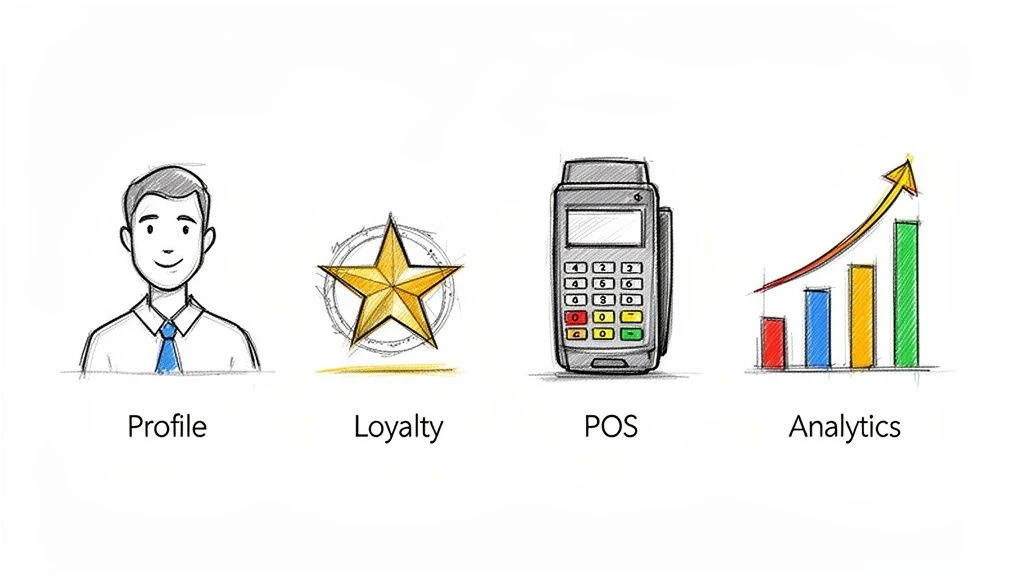
When you're shopping for retail customer management software, it's easy to get lost in a sea of features. But more buttons don't mean better results. The best platforms for small businesses nail a core set of tools designed to make your life easier and your customers happier. These are the non-negotiables.
Think of these features as the ingredients for loyalty. Without them, you're guessing what your customers want. With them, you get a clear, data-backed path to building relationships that last.
Comprehensive Customer Profiles
The foundation of any good system is the customer profile. This is where scattered bits of information-a name, a purchase, a visit date-come together to paint a complete picture of each person who walks through your door.
A solid profile tracks details you can actually act on:
- Visit History: See at a glance when they last stopped by, how often they return, and their total visit count. This helps you spot your VIPs and notice when a regular has gone missing.
- Purchase Data: Know what your customers love. A salon client who always gets a specific treatment, a café regular who orders the same latte-this is gold for personalizing their experience.
- Loyalty Status: Instantly see their points balance and rewards earned. This empowers your staff to say, "Hey, you're only one visit away from a free coffee!" creating a delightful interaction.
This level of detail is a game-changer. A boutique owner can see a customer only buys a certain brand, making it a no-brainer to text them when a new collection drops. It stops you from shouting into the void and starts a real conversation.
An Effortless, Integrated Loyalty Program
A built-in loyalty program is the engine that drives repeat business. It gives people a concrete reason to choose you over a competitor by rewarding them for their loyalty. The secret is making it dead simple for both your customers and your team.
Modern retail customer management software must have simple, effective loyalty tools baked right in.
An integrated loyalty program isn’t just about giving away free stuff. It’s a strategic tool that nudges customers toward specific behaviors-like visiting more often or spending a bit more-that directly grow your bottom line.
This is where a solution like BonusQR excels. Forget asking customers to carry another plastic card or download a clunky app. They just scan a QR code at checkout. All the friction is gone, making it a breeze for customers to join and for your staff to manage. See how this modern approach works in our guide on digital customer loyalty cards.
Seamless POS and CRM Syncing
For any of this to work its magic, your customer management software must talk to your Point of Sale (POS) system. This connection is the bridge that automates everything. Without it, you're stuck punching in data by hand, which is slow, tedious, and a recipe for mistakes.
A seamless sync means that when a customer pays, their visit is logged, their points are updated, and their purchase history is recorded automatically. It all just happens. This keeps the line moving at checkout and guarantees your customer data is always spot-on.
Smart Customer Segmentation
So you're collecting all this great customer data. Now what? This is where customer segmentation comes in. It’s the feature that lets you group customers based on their behavior, so you can stop sending generic blasts and start sending messages that actually hit home.
For example, you could easily create actionable groups like:
- "Your VIPs": The top 5% of customers who visit most often. Send them exclusive early access to a new product.
- "At-Risk Regulars": Customers who used to visit weekly but haven't been in for 60 days. Send them a personalized "we miss you" offer.
- "First-Time Visitors": Anyone who just signed up. Automate a welcome message with a small discount on their next visit.
Imagine your salon is having a slow week. Instead of a generic sale, you could send an exclusive "20% off" offer just to your "At-Risk Regulars" to bring them back. This is smarter-and more profitable-than a blanket discount.
How to Choose the Right Software For Your Business (Without the Headache)
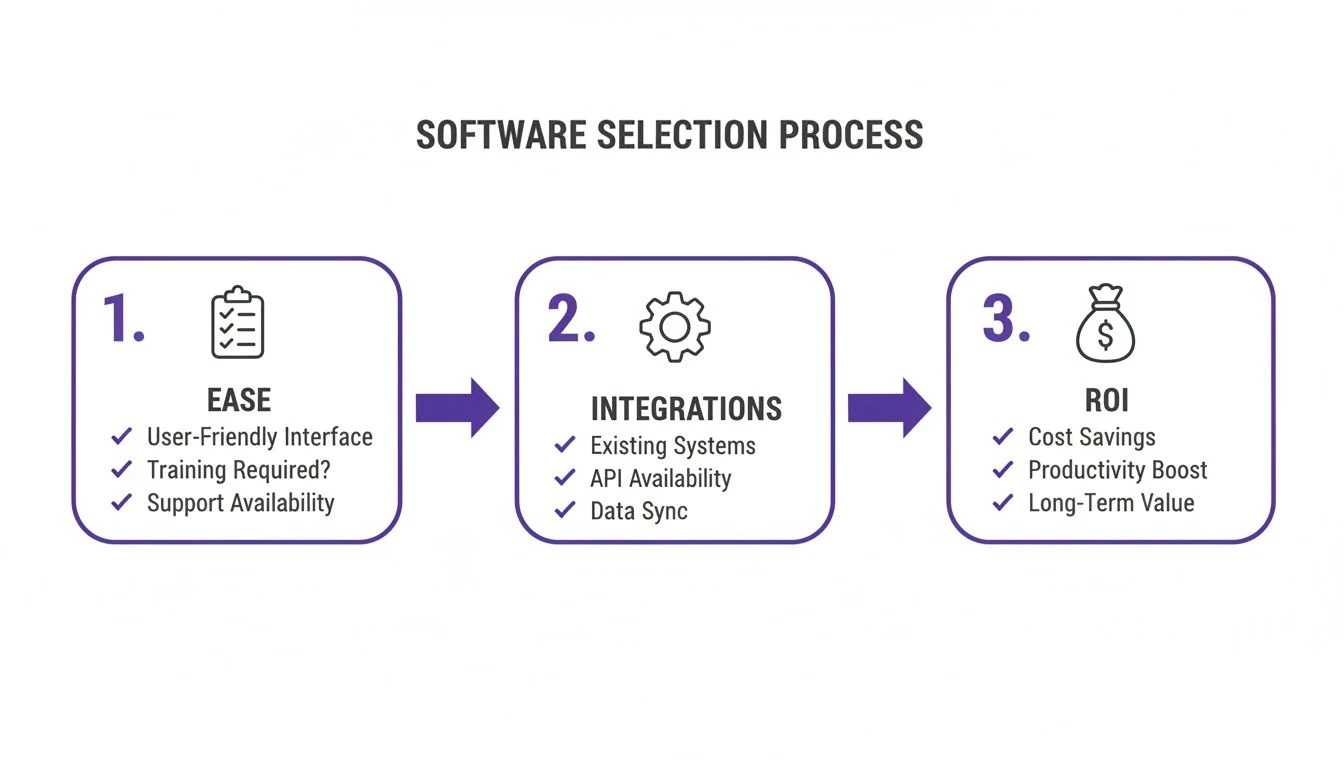
Picking the right retail customer management software can feel overwhelming. How do you find one that fits your business without breaking the bank or giving your team a headache? The secret is to ignore the flashy sales pitches and focus on what truly matters for your day-to-day operations.
This isn't about finding the software with the most features; it's about finding the one that solves your specific problems, simply and effectively. Let's walk through the essential checklist to guide your decision.
1. Prioritize Simplicity and Ease of Use
The most powerful software is useless if your team finds it too confusing. Your baristas, stylists, and cashiers are on the front lines-they don't have time to wrestle with a clunky interface. The best systems are so intuitive a new hire can master it in one afternoon.
When you're evaluating a platform, ask these critical questions:
- Can my team use it during a rush? How long does it take to sign up a new customer? If it slows down your checkout line, it's a non-starter.
- Is the dashboard clean and scannable? Can you find a customer's info in just a couple of clicks?
- Can I get a free trial? The only way to know if it works is to get your hands on it.
A solution like BonusQR is built on this principle. A simple QR code scan handles everything, eliminating any disruption to your workflow.
2. Ensure Seamless Integrations
Your new software has to play nice with the tools you already use, especially your Point of Sale (POS) system. A platform that syncs smoothly automates everything, ensuring customer visits and purchase details are logged accurately and instantly.
Before you commit, double-check that the software connects with your specific POS. This is a non-negotiable step that prevents massive headaches. When hunting for the right tools, you often end up comparing options like Jobber vs. QuickBooks to see which offers a better fit for your operational needs.
3. Plan for Scalability and Support
Your business is growing, and your software needs to grow with you. A system that’s perfect for one location should work just as well for three or ten. Look for a cloud-based solution that doesn’t demand complicated on-site hardware, making it easy to expand.
Just as important is customer support. What happens when you hit a snag during your busiest lunch rush? You need a responsive support team to get you back on track-fast. Ask potential vendors about their support channels and average response times.
4. Analyze Pricing and Return on Investment (ROI)
For a small business, this software is an investment, not a luxury. To get a clear return, look for transparent pricing without hidden setup fees. A straightforward monthly subscription is usually the most budget-friendly option.
To understand the value, focus on the potential ROI.
Think about it this way: if a simple loyalty program helps you keep just five extra customers each month, how much revenue does that add up to over a year? The software often pays for itself in just a few weeks.
Platforms like BonusQR offer a cost-effective starting point designed specifically for small businesses, making it easy to get a powerful system running without a big upfront cost. To learn more, explore our ultimate guide to customer loyalty program software. By focusing on these practical factors, you can choose a system that will genuinely help you grow.
Your 3-Step Plan for a Flawless Launch
Picking the right retail customer management software is step one. But a great tool is only as good as its rollout. A smooth launch ensures your team feels confident, your data is clean, and your customers feel the benefits from day one.
The goal isn't just to "install" software. It's about weaving it into your daily operations until it feels natural. Here's how to get there without the stress.
Step 1: Effortless Data Migration
Your existing customer information is a goldmine. The first step is moving that data into your new system without any drama. Whether it's a spreadsheet of emails or a list from an old tool, a clean import is crucial.
Look for software that makes this simple:
- Export Your Current List: Get your customer data into a standard CSV file.
- Clean Your Data: Take a minute to remove duplicates and fix obvious typos. A clean start prevents future headaches.
- Follow the Import Guide: Any modern platform will have simple, step-by-step instructions. A good system will even map the columns for you.
Getting this one-time setup right gives your team reliable info from the very beginning.
Step 2: Inspire Your Team Through Training
Your team is what makes this work. If they see it as another chore, it'll fail. But if they see how it makes their job easier, they'll become its biggest advocates. Frame the training around their benefits, not a dry list of features.
Team training shouldn't feel like a lecture. It should be an empowering session that shows staff how this tool makes their customer interactions faster, easier, and more rewarding.
Show them how the software helps them:
- Speed Up Checkout: With a system like BonusQR, a quick scan is all it takes. No more fumbling with plastic cards or slowly typing emails.
- Create Happier Customers: Give them the power to say, "Hey, you're just one visit away from your free coffee!" These small moments make a massive difference.
- Answer Questions Confidently: When a customer asks about their points, your team will have the answer at their fingertips.
Keep the training short, hands-on, and focused on the few key actions they'll perform daily. Role-playing a couple of common scenarios is a fantastic way to build confidence.
Step 3: Launch Your Loyalty Program with a Bang
Your data is in and your team is ready. A strong launch generates immediate buzz and gets customers signing up from day one. You don't need a huge marketing budget, just clear and consistent communication.
Here's a simple checklist for a high-impact launch:
- In-Store Signage: Place a small, clear sign right at your checkout counter: "Ask Us About Our New Rewards Program!"
- A Simple Social Media Post: Announce the new program on your social channels with a clear photo and explanation of the perks.
- The Personal Invitation: This is your most powerful tool. Train your staff to ask every customer, "Would you like to join our new loyalty program? It just takes a second."
When the system is genuinely user-friendly, like scanning a QR code, the barrier to entry vanishes, and your sign-up rate will skyrocket.
How to Know If It's Actually Working: Key Metrics to Track
You’ve launched your new system. Now comes the real test: is it actually working? Proving its value means looking past vanity metrics like total sign-ups and digging into the numbers that show you’re building loyalty and boosting your bottom line.
You need to track data that tells you if customers are coming back more often, spending more, and using the rewards you offer. This is how you make smarter decisions and know your investment is paying off.
Customer Retention Rate
This is the big one. Your Customer Retention Rate is the most direct measure of loyalty. In simple terms: are more of your customers choosing to come back?
Track how many of your existing customers make another purchase over a set period (like a month or quarter). Even a tiny bump in retention can have a huge effect on your revenue, since keeping a customer is far cheaper than acquiring a new one. If this number is climbing, your software is working.
Customer Lifetime Value (CLV)
Next up is Customer Lifetime Value (CLV). This metric estimates the total amount of money you can expect from a single customer over their entire relationship with your business. Are your regulars not just returning, but also spending more over time?
Your software should make this easy to track. Watch two things closely:
- Average Purchase Value: Is the amount people spend per visit going up?
- Purchase Frequency: Are your loyal customers visiting more often?
When your CLV trends upward, it’s a clear sign your loyalty program is encouraging more visits and bigger spends. It's the ultimate indicator of a healthy, growing customer base.
Loyalty Program Engagement
Finally, look at Loyalty Program Engagement. This tells you if your customers are actually using your rewards program. A high sign-up rate is a great start, but the real value is in consistent participation.
A program that customers actually use is one that changes behavior. Tracking engagement shows you whether your rewards are compelling enough to bring people back.
Keep an eye on these key numbers:
- Points Earned vs. Redeemed: Are people actively collecting points and cashing them in for rewards?
- Offer Redemption Rates: When you send an offer, what percentage of customers use it?
- Active Member Rate: Of everyone who signed up, how many have interacted with the program in the last 90 days?
These tools get results. The loyalty management market is on track to hit $16,953.4 million by 2033, and savvy small businesses are now getting in on the action. The ones who diligently track their success are the ones who will see those double-digit boosts in repeat business.
Common Questions (and Simple Answers) About Customer Management Software
Jumping into customer management software can feel like a big step. As a small business owner, you need to know any new tool is a smart investment of your time and money. We’ve gathered the most common questions from owners of cafes, salons, and shops just like yours to give you clear, straightforward answers.
Is this software too expensive for my small business?
Not anymore. While older systems were famously expensive, the new wave of software is built for small business budgets. Many platforms use a simple, transparent subscription model with no surprise fees.
Shift your thinking from cost to Return on Investment (ROI). Keeping an existing customer is 5 to 25 times cheaper than finding a new one. If your system helps you retain just a handful of extra customers each month, it almost always pays for itself-and then some.
Think of it this way: the software isn't another expense; it's an investment in your most valuable asset-your loyal customers. With affordable, high-impact tools like BonusQR, you can start building loyalty without a huge financial commitment.
Will this be too complicated for my team to learn?
Not at all. The best software for small businesses is built on simplicity. Developers understand that busy retail staff need tools that feel intuitive and require almost zero training. A system that slows down your checkout line is a failure.
When looking at options, always get a free trial. Look for a clean interface that doesn't overwhelm you. Modern systems built around familiar actions are the easiest to pick up.
- Quick Onboarding: Signing up a new customer should take seconds.
- Intuitive Actions: A process as simple as scanning a QR code is something everyone already knows how to do.
- Clear Dashboards: Your team should be able to find customer info or check a rewards balance in just a couple of taps.
The goal is to free up your staff to spend less time wrestling with tech and more time creating great customer experiences.
Does it integrate with my existing POS system?
This is a critical question. Many modern customer management platforms are designed to connect seamlessly with popular Point of Sale (POS) systems. This integration automates everything, tracking purchases and rewards without anyone lifting a finger.
Before you commit, you must confirm that the software plays nice with your tools. Most providers list their integrations on their website. However, a direct integration isn't always a deal-breaker. Simple and effective loyalty apps, like BonusQR, are designed to work perfectly well on their own, giving you flexibility without sacrificing results.
How is this better than using email or social media?
Email and social media are fantastic for broadcasting messages to a wide audience. But retail customer management software is built for a more profitable goal: building deep, personal relationships based on what your customers actually do.
Here’s the difference:
- Email & Social Media (Broadcasting): You send one message to everyone, hoping it connects. It’s a one-way street.
- Customer Management Software (Relationship Building): The system automatically tracks your best customers, what they buy, and how often they visit. This lets you create targeted, personalized rewards and messages that feel special.
Think of it like this: social media helps you get people in the door for the first time. A smart customer management system is what convinces them to come back over and over, turning casual visitors into your most valuable regulars. It transforms your marketing from shouting into listening.