As a small business owner, you're wearing a dozen hats, and "Chief Marketing Officer" is one of the toughest. You're fighting for every customer against bigger brands with deeper pockets. The core problem is a painful one: how do you get a steady stream of new, high-quality customers without pouring your limited budget into expensive ads that feel like a shot in the dark? You need growth that's predictable, affordable, and sustainable.
The answer isn't a new ad platform; it's already in your store. Your happiest customers are your most powerful, yet untapped, marketing asset. They trust you, love what you do, and are already talking about you. A referral program turns that casual, positive word-of-mouth into a reliable growth engine. It empowers your loyal fans to become your best salespeople, bringing you customers who are already primed to love your business. Before launching, it's vital to know your numbers by understanding your Customer Acquisition Cost. This baseline will prove just how cost-effective a referral system truly is.
This guide is your blueprint. We're not just sharing stories about tech giants; we're breaking down 10 legendary referral marketing examples into actionable strategies you can launch for your cafe, salon, or shop this week. You'll learn the exact incentives, mechanics, and messaging that drive success. We'll show you how to build a simple system that brings in new business and rewards both your loyal advocates and your new customers. Forget complex software; this is about getting results, fast.
1. Dropbox's Freemium Referral Program
The Dropbox referral program is a masterclass in creating a viral loop. Its genius lies in a simple, powerful exchange: reward both the referrer and the new user with more of the core product-free storage space. When a user referred a friend who signed up, both received an extra 500MB. This turned happy customers into a self-perpetuating marketing engine because the reward was intrinsically valuable to them.
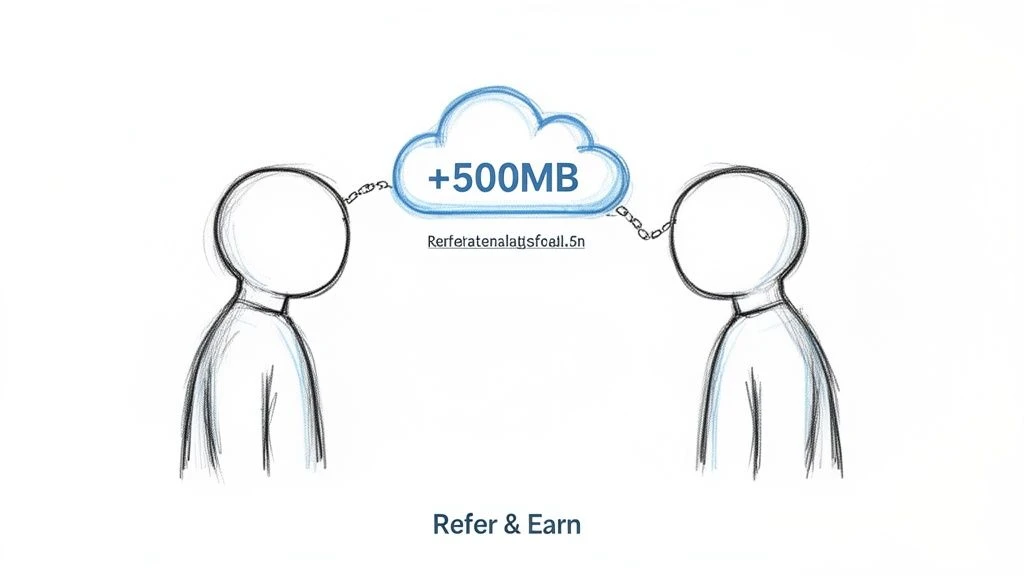
This dual-sided incentive is one of the most effective referral marketing examples because it makes the referrer feel generous, not greedy. They are giving a gift, not just chasing a reward. This simple psychological shift was so powerful it helped Dropbox grow from 100,000 to 4 million users in just 15 months-a staggering 3,900% increase.
How a Small Business Can Use This
You don't need a digital product. The key is offering a reward that aligns with your business and provides real value to both parties. This builds goodwill and encourages immediate participation.
Strategic Insight: A dual-sided reward makes the referrer feel generous. They are sharing a valuable offer with a friend, which dramatically increases their likelihood of participating.
A coffee shop can offer a free specialty coffee to both the referrer and their friend. A salon can provide a $10 credit to both the existing client and the new one. The reward is a taste of your best work.
Your Action Plan with BonusQR
- Campaign: "Give a Gift, Get a Gift"
- Mechanics: Use your BonusQR app to generate a unique referral link or QR code. When a friend signs up and makes their first purchase, a reward (e.g., 20 loyalty points, a free appetizer) is automatically applied to both of their accounts. It's simple, trackable, and instant.
- Messaging: "Love our coffee? Share the love! Refer a friend and you both get a free latte on us."
- KPIs: Track Referral Conversion Rate (new customers from referrals ÷ total referrals sent). You'll find referred customers often have a higher lifetime value.
For more inspiration, you can learn more about how other businesses have successfully implemented similar programs in our deep dive on referral programs that actually work for small businesses.
2. Uber's Ride Credit Referral System
Uber's referral program changed the game by offering a seamless, in-app system that felt more like a currency than a discount. The concept was elegant: give a ride, get a ride. When a user shared their code, both they and the new rider received a credit (e.g., $5) towards a trip. This strategy turned every passenger into a potential brand ambassador by directly lowering the barrier to entry for new users.
This is one of the most powerful referral marketing examples because the reward was instantly usable, creating a frictionless experience that fueled explosive growth. It was so effective that Uber found referred users had a 25% higher lifetime value than those acquired through other channels.
How a Small Business Can Use This
You don't need a massive app to replicate this. The core principle is offering store credit that customers can use on a future purchase. This not only drives referrals but also guarantees a repeat visit, boosting customer retention. It’s a self-funding marketing loop.
Strategic Insight: Offering store credit instead of a discount makes the reward feel more tangible. It acts like "money in the bank" for the customer, encouraging them to return and spend it.
For a local salon, this could be a $15 credit applied to both accounts. A restaurant could offer a $10 credit. This makes the reward a direct investment in future sales.
Your Action Plan with BonusQR
- Campaign: "Share the Credit"
- Mechanics: BonusQR makes this easy. Configure your program to issue a specific credit amount (e.g., $10) to a customer's account when their referred friend signs up and makes a purchase. The new customer also gets the credit instantly.
- Messaging: "Give $10, Get $10! Refer a friend to our salon and you both get $10 off your next service."
- KPIs: Monitor the Referral Participation Rate (customers who refer ÷ total customers) and the Redemption Rate of referral credits. A high redemption rate proves you're driving repeat business.
3. Airbnb's Referral Rewards Program
Airbnb’s program is a prime example of scaling trust and rewards. It offered valuable travel credits to both the referrer and the new user, whether they were booking a stay or hosting. The genius was in the tiered nature of the reward; it wasn't just a flat fee but was tied to the value of the booking, incentivizing high-quality referrals that led to significant transactions.
The dual incentive, perfectly aligned with their product, encouraged both parties to immediately re-engage with the platform, creating a powerful cycle of acquisition and retention. This strategy reportedly contributed to a massive surge in bookings, demonstrating how a well-designed program can become a core growth engine.
How a Small Business Can Use This
You don't need a global platform to implement a value-based reward system. The core principle is to reward bigger actions with bigger incentives. This encourages your best customers to refer other high-value customers, making them feel like true partners in your success.
Strategic Insight: Tying the reward value to the referred customer's first purchase incentivizes your advocates to bring in high-spenders. It shifts the focus from quantity of referrals to quality.
A boutique could offer a $10 credit for any referral, but increase it to $30 if the friend's first purchase is over $150. A restaurant could offer a free dessert, but upgrade it to a free entrée if the new customer books a table for four or more.
Your Action Plan with BonusQR
- Campaign: "The More They Spend, The More You Earn"
- Mechanics: With BonusQR, you can set up a tiered referral program. When a new customer signs up using a referral code and makes their first purchase, the system automatically triggers a reward for both parties based on the transaction amount.
- Messaging: "Share your love for our salon! When your friend gets a haircut, you both get $10 off. If they book a full color service, you both get $25 off!"
- KPIs: Monitor the Average First Purchase Value of referred vs. non-referred customers. Also, track the Referral Rate among your highest-spending customer segments.
To explore how to structure your incentives effectively, you can learn more about creating a rewards program that boosts loyalty.
4. Tesla's Referral-Based Sales Model
Tesla flipped traditional auto sales on its head by largely ditching paid ads for a high-stakes referral program. It transformed its passionate customer base into an elite sales force by offering extravagant, escalating rewards. Instead of a simple discount, Tesla offered free Supercharging miles, exclusive merchandise, and even the chance to win a new car, making advocates feel like brand insiders.
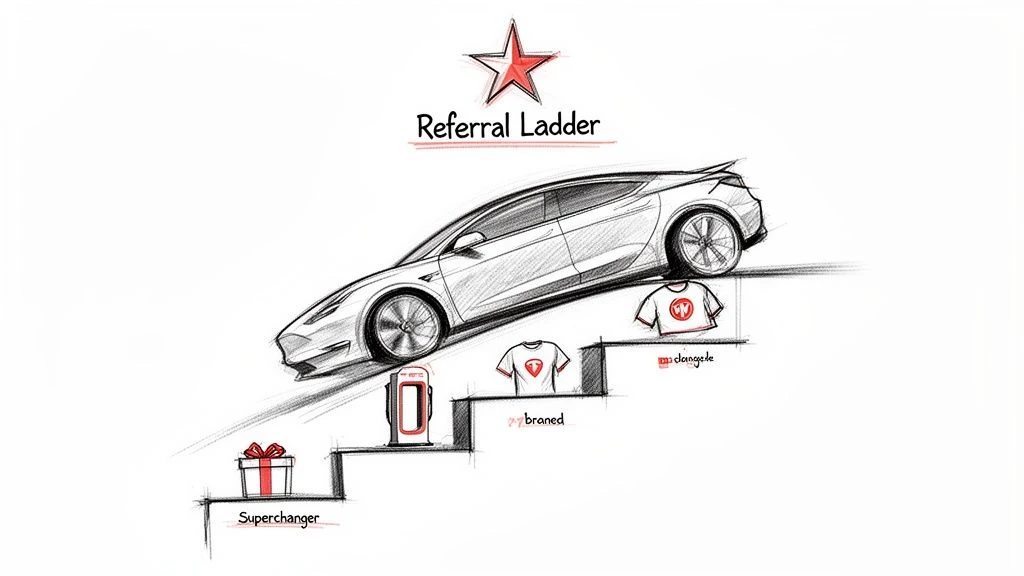
This gamified, tiered approach is one of the most powerful referral marketing examples because it taps into the human desire for status and achievement. By creating a "referral ladder," Tesla motivated its top promoters to keep pushing for the next prize, deepening community engagement and fueling explosive growth.
How a Small Business Can Use This
You don't need to give away a car. The key is to create a tiered rewards system that encourages repeat referrals. Gamifying the experience turns referring into a fun challenge rather than a one-off action.
Strategic Insight: A "referral ladder" motivates your best advocates to keep referring. It creates a sense of progress and exclusivity, turning loyal customers into super-fans who consistently drive new business.
A salon could offer tiered rewards: one referral gets a free conditioning treatment, five earn a complimentary haircut, and ten unlock "VIP status" with priority booking for a year. This creates a compelling reason to refer again and again.
Your Action Plan with BonusQR
- Campaign: "The VIP Referral Ladder"
- Mechanics: Set up a tiered program in BonusQR. It automatically tracks referrals and triggers escalating rewards as customers hit milestones (e.g., 1, 5, 10 referrals). You can even create achievement badges in the app to gamify the experience.
- Messaging: "Join our Referral Club! The more friends you bring, the better the perks. See how high you can climb and unlock exclusive rewards!"
- KPIs: Monitor your Referral Rate (the percentage of customers who make at least one referral) and identify your Top Referrers. Acknowledge these super-fans to inspire others.
5. LinkedIn's Professional Network Referral Program
LinkedIn’s referral program is a brilliant B2B example of offering rewards that deepen user engagement. Instead of cash, LinkedIn provides value directly related to its users' professional goals-premium features, job posting credits, or access to recruiter tools. This incentivizes users to invite colleagues who are most likely to become active, high-quality members.
This model thrives on professional credibility. A referral from a trusted colleague is far more powerful than a generic ad. By aligning the incentive with the user’s primary motivation for being on the platform, the referral feels both valuable and relevant.
How a Small Business Can Use This
You don't need a professional networking site. The core idea is to offer "insider" or premium-level rewards that enhance the customer experience. This creates a sense of exclusivity and makes your most loyal customers feel like VIPs.
Strategic Insight: Gated or premium features make for powerful referral incentives. They cost little to provide but have a high perceived value, making customers feel like they are unlocking a special status.
A salon could offer both the referrer and the new client priority booking access for a month. A coffee shop could provide both with an exclusive "members-only" monthly discount on specialty drinks or early access to new menu items.
Your Action Plan with BonusQR
- Campaign: "The Insider's Circle"
- Mechanics: Use BonusQR to create a premium tier or status. When a customer's referral signs up and makes a purchase, automatically upgrade both of their accounts to this VIP status for a set period (e.g., 30 days), unlocking special perks.
- Messaging: "Join the Club! Refer a friend and you both get a month of VIP perks, including priority booking and 15% off all services."
- KPIs: Monitor Referral Participation Rate and track the spend uplift from customers in the VIP tier. This shows the direct ROI of your exclusive rewards.
To see how this fits into a larger retention plan, explore our guide on a loyalty program strategy that actually works.
6. Slack's Workspace Referral Program
Slack redefined B2B referral marketing by focusing on organic advocacy. Instead of pushing users to refer individuals, Slack created a system where satisfied teams naturally recommend the platform to other companies. This approach relies on professional credibility, offering incentives like account credits that directly benefit the referring organization.
This model is a powerful example of how word-of-mouth can be a primary growth driver in a corporate environment. Slack’s success was built on a product so effective that it became an essential tool teams were eager to share with their peers, proving that a great product is the best marketing tool.
How a Small Business Can Use This
This B2B concept is valuable for any business that serves other businesses, like a coffee shop with a corporate catering service or a salon with a corporate wellness program. The goal is to incentivize a decision-maker to recommend your service to their counterparts. The reward should benefit the business, like a credit toward their next invoice.
Strategic Insight: In B2B referrals, the incentive often needs to benefit the company, not just the individual. Offering a credit for the referring business makes the recommendation feel professional and aligned with company interests.
A coffee shop providing corporate catering could offer a 10% credit to a referring office manager on their next bulk order.
Your Action Plan with BonusQR
- Campaign: "Partner for Perks"
- Mechanics: Use your BonusQR system to create a unique referral code for business accounts. When a new business signs up and meets a specific threshold (e.g., first catering order), apply a credit or bonus to the referrer's account.
- Messaging: "Help another business thrive. Refer a new corporate client and get a $100 credit on your next invoice. It's our way of saying thanks for being a great partner."
- KPIs: Track Business Referral Rate (number of new business accounts from referrals) and the Average Contract Value of referred businesses.
7. Groupon's Friend Referral Discount Program
Groupon's success was built on irresistible deals, and their referral program amplified this by turning deal-seekers into brand advocates. The model is simple: offer a direct monetary discount to both the referrer and the new customer who makes their first purchase. Instead of points, Groupon gave users what they valued most-a discount on their next deal.
This straightforward, cash-value approach taps directly into a price-conscious mindset. It rewards existing customers for recruiting new ones who are already primed to appreciate value-driven offers. This strategy was a key driver in Groupon's rapid acquisition of millions of new users.
How a Small Business Can Use This
You don't need a massive deal platform. The core principle is offering a simple, tangible discount that motivates both parties. This is one of the most effective referral marketing examples for businesses whose customers are highly motivated by value.
Strategic Insight: A direct discount is the most straightforward and universally understood reward. It removes any guesswork for the customer, making the decision to refer a friend quick and easy.
A local restaurant could offer a $10 discount to both the loyal customer and their referred friend. This not only drives two visits but also encourages the new customer to spend more than the discount amount, turning a marketing cost into a profitable sale.
Your Action Plan with BonusQR
- Campaign: "Share the Savings"
- Mechanics: Use BonusQR to generate and track unique referral codes. When a friend uses the code on their first purchase, a specific discount (e.g., $10 off a $30 purchase) is applied for them, and the same credit is automatically added to the referrer's account for their next visit.
- Messaging: "Love our deals? Refer a friend and you both get $10 off your next meal! It's our way of saying thanks."
- KPIs: Monitor your Referral Rate and the Average First-Order Value of referred customers. This shows how effectively the discount is converting new, high-value patrons.
For more ideas on structuring rewards, explore our guide on 10 types of loyalty programs for your small business.
8. Starbucks' Mobile Referral and Rewards Integration
Starbucks transformed its loyalty app from a simple payment tool into a powerful acquisition channel by seamlessly integrating referrals. This allows Rewards members to easily send digital gift cards and referral links directly from the app. By weaving referrals into an ecosystem already built around mobile ordering, Starbucks made sharing feel like a natural extension of the customer experience.
This integration is one of the most effective referral marketing examples for businesses with an existing loyalty program. Instead of creating a separate system, Starbucks leveraged its massive user base, making participation effortless. A customer can refer a friend while checking their points, turning moments of high engagement into opportunities for growth.
How a Small Business Can Use This
You don't need a multi-million-dollar app. The core idea is to embed your referral program within the tools your customers already use, like their loyalty account. This reduces friction and makes referring a seamless part of their interaction with your brand.
Strategic Insight: Integrating referrals into your existing loyalty system makes participation a low-effort, high-reward action. Customers are more likely to refer when the option is presented within a familiar environment they already trust.
A local cafe can use its loyalty app to prompt customers to refer a friend right after they've redeemed a reward.
Your Action Plan with BonusQR
- Campaign: "Share the Perks"
- Mechanics: Activate the referral feature within your BonusQR app. Customers get a unique link or QR code accessible from their digital loyalty card. When their friend signs up and makes a purchase, bonus points (e.g., 50 bonus points) are automatically credited to both accounts.
- Messaging: "Your friends deserve great coffee too! Give them a free drink on their first visit, and we'll add 50 bonus points to your account as a thank you." Use push notifications to remind users of their referral power.
- KPIs: Monitor your App-Based Referral Rate (number of referrals sent directly from the app) and the Activation Rate of new users who sign up via a mobile referral.
9. Amazon Prime's Referral Credit Program
Amazon Prime's referral program is a brilliant example of using store credit to fuel ecosystem growth. The model is simple: when a Prime member refers a friend who signs up, both receive an Amazon credit. This rewards loyal customers with something universally valuable within the Amazon ecosystem: more spending power.
This strategy is highly effective because the reward is directly tied back to the business. Instead of cash leaving the company, the credit encourages repeat purchases and deepens the customer's relationship with the brand. It transforms satisfied subscribers into active advocates, ensuring the reward money is spent back in-house.
How a Small Business Can Use This
This credit-based model is perfect for any business with a recurring revenue stream, but it also works for retailers. The key is to offer a reward that encourages a future purchase, creating a self-sustaining loop of engagement. This is one of the most powerful referral marketing examples for boosting repeat business.
Strategic Insight: Offering store credit instead of cash keeps the reward value within your business ecosystem. It not only incentivizes referrals but also guarantees a future sale, increasing the lifetime value of both customers.
A local gym could offer a $20 credit towards the next month's membership for both the referrer and their friend. A beauty salon could provide a $15 credit to both clients to use on any future service.
Your Action Plan with BonusQR
- Campaign: "Share the Perks, Get Credit"
- Mechanics: Use your BonusQR app to assign a unique referral code to each member. When a friend uses that code to sign up or make a qualifying purchase, a predefined credit (e.g., $10) is automatically added to both accounts.
- Messaging: "Love your membership? Refer a friend and you'll both get a $10 credit to use on your next visit. It's our way of saying thanks!"
- KPIs: Monitor your Referral Rate and the Redemption Rate of the issued credits. Also, track the average spend of customers who came in via referral.
This model shows how loyalty systems change customer behavior by turning advocacy into tangible value.
10. PayPal's Cash Referral Bonus Program
PayPal wrote the playbook for viral growth with its straightforward, cash-based referral program. In its early days, the company offered a direct cash bonus-typically $5 or $10-to both the referrer and the new user. This wasn't points or credit; it was real money deposited into their accounts, a powerful and universally understood incentive.
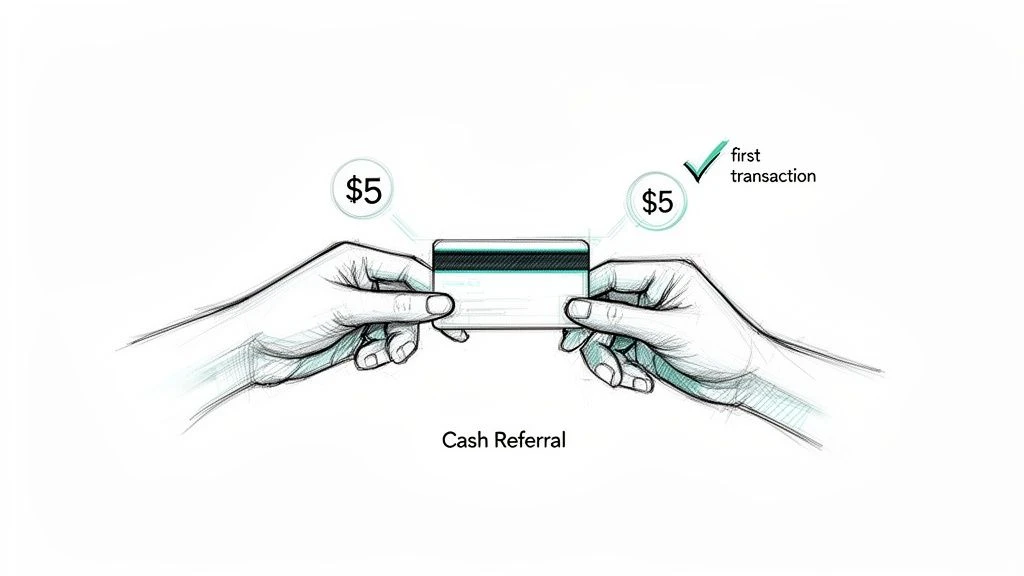
This strategy was critical in helping PayPal reach a critical mass of users. By directly paying for new users, they effectively turned their entire user base into a motivated, commission-based sales force. This created a powerful acquisition loop that made PayPal a household name and stands as one of the most successful referral marketing examples in history.
How a Small Business Can Use This
While most small businesses can't afford to give away cash indefinitely, the principle of a direct, tangible reward is highly adaptable. The key is to make the reward simple and desirable. Cash or a direct credit towards a purchase is the most direct way to motivate action.
Strategic Insight: A cash-like incentive is the most direct and universally appealing reward. It removes any guesswork about value and creates a powerful, immediate motivation for both the referrer and the new customer.
A boutique could offer a $10 credit to both the referrer and their friend. A local cafe could offer a $5 credit loaded onto their digital loyalty cards. This approach feels like finding money and directly encourages a return visit to spend it.
Your Action Plan with BonusQR
- Campaign: "Pay It Forward"
- Mechanics: Use the BonusQR wallet feature to distribute rewards. When a referred friend signs up via a unique QR code and makes their first purchase, a $5 credit is automatically added to the digital wallets of both the referrer and the new customer.
- Messaging: "Share us with a friend, and we'll share our thanks! You both get $5 in your account when they make their first purchase."
- KPIs: Monitor your Customer Acquisition Cost (CAC) to ensure the reward is profitable. Track the First Purchase Value of referred customers to see if they spend more than their initial incentive.
Top 10 Referral Programs Compared
| Program | Implementation Complexity | Resource Requirements | Expected Outcomes | Ideal Use Cases | Key Advantages / Tip |
|---|---|---|---|---|---|
| Dropbox's Freemium Referral Program | Low - simple dual-sided flow | Low - product credit (storage) & sharing UI | Viral growth; high conversion (rapid user base expansion) | Consumer apps; small retail (coffee, salons, restaurants) | Dual incentives drive word-of-mouth; make sharing frictionless |
| Uber's Ride Credit Referral System | Medium - automated tracking & geo controls | Medium - platform credits, margin to absorb costs | Strong acquisition and repeat usage; referred LTV ↑ | Service businesses with per-transaction credits | Monetary incentives drive participation; set thresholds and limits |
| Airbnb's Referral Rewards Program | Medium-High - tiered rules, separate tracks | Medium - credits scale with booking value | High-value referrals; aligns with revenue growth | Booking/booking-like services; fine dining, salons | Tiered rewards encourage quality referrals; communicate tiers clearly |
| Tesla's Referral-Based Sales Model | High - gamification, leaderboards, exclusives | High - expensive physical/digital rewards | Strong brand advocacy; reduces paid advertising need | Premium/high-margin brands (luxury salons, exclusive restaurants) | Builds passionate advocates; use tiered rewards and public recognition |
| LinkedIn's Professional Network Referral Program | Medium - integrate premium access & tracking | Low-Medium - feature access (low marginal cost) | High conversion in professional networks; targeted growth | B2B / professional services; VIP memberships | Rewards align with core product value; highlight premium benefits |
| Slack's Workspace Referral Program | High - enterprise tracking & sales integration | Medium - account credits, partner commissions | High-value enterprise deals; longer sales cycles | B2B software; multi-location businesses/franchises | Leverages customer advocacy; align with sales & CS teams |
| Groupon's Friend Referral Discount Program | Low - simple discount mechanics | Low - discount margin cost | Fast customer acquisition but lower LTV; deal-seekers drawn | Discount-driven retail & dining promotions | Simple to understand and launch; limit to first purchase to protect margins |
| Starbucks' Mobile Referral & Rewards Integration | Medium - app & loyalty integration, QR redemption | Medium - digital gift cards + loyalty point costs | Drives frequency and app adoption among existing users | Businesses with loyalty apps (coffee shops, chain restaurants) | Seamless digital delivery reduces friction; use push reminders |
| Amazon Prime's Referral Credit Program | Medium - subscription integration & tracking | Medium - account credits within ecosystem | High-value subscription growth; scalable across regions | Subscription/membership businesses (salons, dining clubs) | Aligns with subscription behavior; run seasonal referral campaigns |
| PayPal's Cash Referral Bonus Program | Low - simple cash-for-action model | Medium - direct cash payouts per referral | High participation; effective for reaching critical mass | Any transactional business (coffee, restaurants, salons) | Cash has universal appeal; require qualifying transaction and cap rewards |
Your Turn: Launch Your Customer Growth Engine in Minutes
You've seen how giants like Dropbox, Uber, and Starbucks turned happy customers into a powerful marketing force. These diverse referral marketing examples weren't magic; they were built on smart, replicable strategies that you can now make your own. The path from a single happy customer to a community of brand advocates might seem complex, but the core principles are refreshingly simple.
It’s not about having a Silicon Valley budget. It's about rewarding the fundamental human desire to share good experiences.
Key Takeaways for Your Business
Forget the complexity. Focus on these core pillars:
- Make it Effortless: The best programs remove all friction. Your referral process should be so simple it can be done in seconds.
- Reward Both Sides: A dual-sided incentive feels generous, not transactional. Rewarding the advocate and the new customer creates a win-win that dramatically increases participation.
- Integrate Seamlessly: Weave referrals directly into your existing loyalty program. It becomes a natural part of the customer journey, not a clunky add-on.
- Be Crystal Clear: Ambiguity kills action. "Give $5, Get $5" is powerful because it's instantly understandable.
Key Strategic Insight: The most successful referral programs are not marketing campaigns; they are product features. They are an integrated, valuable part of the customer experience that provides ongoing value to both the business and its customers.
From Inspiration to Implementation
Reading about these referral marketing examples is the first step, but growth comes from action. This is where most businesses falter, bogged down by technical hurdles or lack of time.
That's where the game has changed. You no longer need to build a complex system from scratch. BonusQR is designed to put this immense power directly into your hands, allowing you to launch a sophisticated, automated referral engine faster than you can brew a pot of coffee. It’s the simplest, most cost-effective solution designed specifically for the loyalty challenges small businesses face.
Stop leaving your most valuable marketing asset untapped. Your satisfied customers are a goldmine waiting to be activated. By giving them a simple tool and a compelling reason to share, you’re not just acquiring new customers-you’re acquiring the right customers, who arrive with built-in trust and are predisposed to become loyal patrons. It's time to turn passive satisfaction into active, profitable growth.
Ready to stop wasting money on ads and start empowering your loyal customers? BonusQR makes it incredibly simple to launch a custom referral program, just like the powerful referral marketing examples you've seen here, in minutes. See how easy it is to turn your best customers into your most effective marketing team. Visit BonusQR to start your free trial today.


