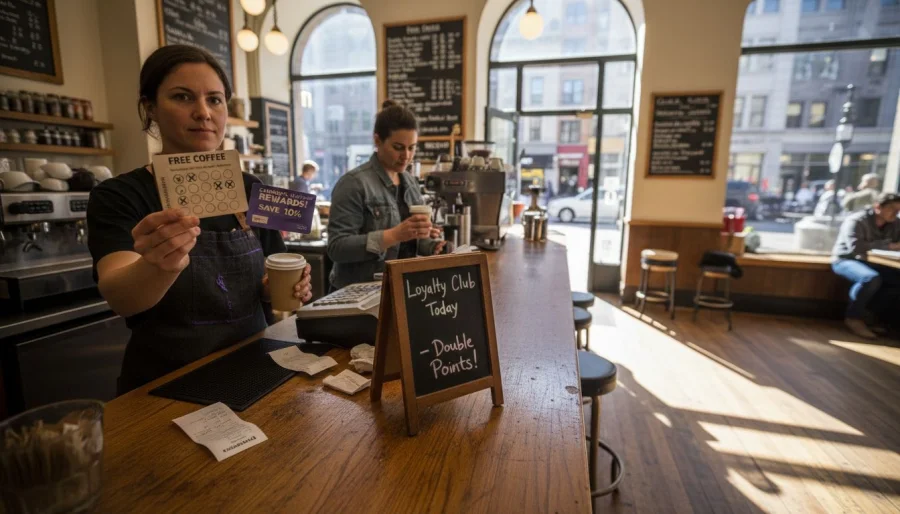
Choosing the right loyalty program can leave café owners weighing the value of simple rewards versus instant incentives. For many North American cafés and restaurants, the quest to drive repeat visits comes down to two popular models: stamp cards and cashback rewards. Understanding the unique mechanics behind each system helps clarify which approach genuinely fits your customers’ habits. This guide breaks down the essentials behind stamp and cashback programs to help you make a smart decision for growing loyalty and retention.
Stamp and Cashback Programs Defined
When you’re building a loyalty program for your cafe, you’re likely considering two primary models: stamp cards and cashback rewards. These aren’t interchangeable strategies, and understanding the distinction between them matters for your bottom line. Both programs operate as marketing mechanisms designed to increase repeat transactions, but they work through fundamentally different psychology and mechanics.
Stamp card programs follow a simple accumulation model. Your customers collect one stamp or point with each purchase, and after gathering a predetermined number (typically 10 stamps for a free coffee, for example), they redeem a reward. The physical or digital nature of the stamps creates a visible progress tracker that customers can see building toward their goal. This tangible progression appeals to many cafe-goers because it creates a satisfying completion moment when they finally reach their reward. A customer visiting twice weekly might need five weeks to earn a free drink, which encourages consistent return visits during that period. The model works particularly well for encouraging frequency rather than higher spending amounts.
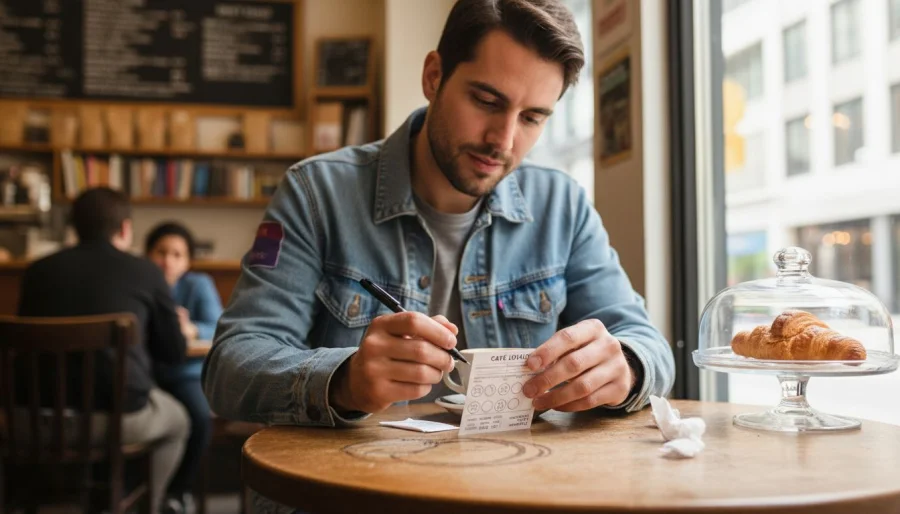
Cashback programs take a different approach entirely. These programs offer a percentage of purchases back in cash, creating immediate financial incentive with every transaction. Instead of collecting toward a distant reward, customers see direct monetary value returned from their spending. A 5 percent cashback offer means a customer purchasing a $5 coffee receives $0.25 back. This model rewards higher spending volumes more directly because larger transactions generate proportionally larger cashback amounts. Customers accumulate cashback balance over time and typically redeem it either as a credit toward future purchases or occasionally as actual cash withdrawal.
The key operational difference comes down to how they motivate behavior. Stamp programs emphasize frequency and habit formation through visible progress, while cashback programs emphasize spending value through immediate financial feedback. Your cafe’s customer base, average transaction value, and retention goals should guide which direction makes sense. Customers visiting daily for a standard coffee behave differently than those making occasional larger purchases for group meetings.
Pro tip: Start by analyzing your current customer patterns: if most transactions are under $6, a stamp card works better for driving frequency; if customers regularly spend $12 or more, cashback’s reward-per-dollar model generates stronger retention.
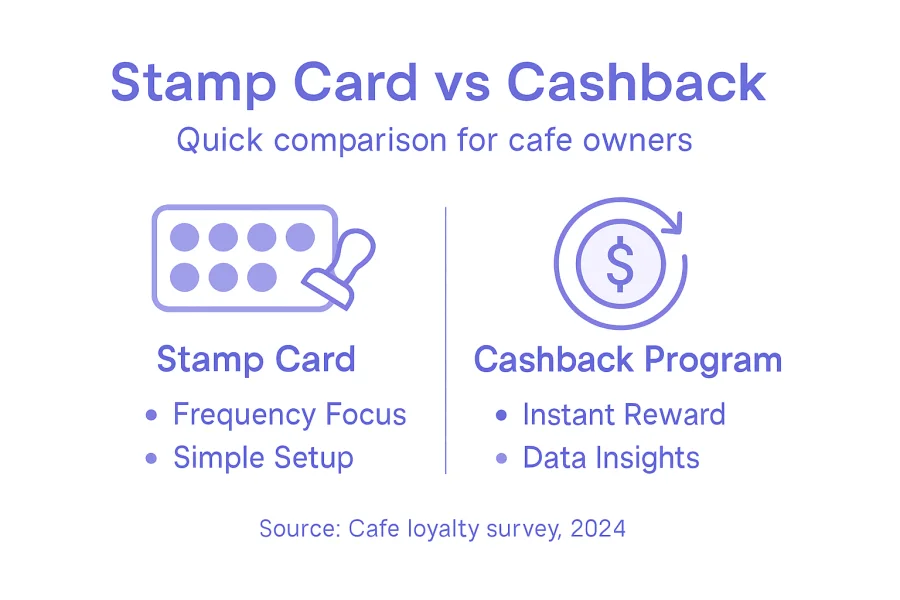
Here’s how stamp card and cashback programs compare in everyday café operations:
| Criteria | Stamp Card | Cashback Program |
|---|---|---|
| Reward Timing | After set number of visits | Instantly after each purchase |
| Spending Incentive | Encourages more frequent visits | Encourages larger transactions |
| Program Setup Cost | Low (printing/design) | High (technology, fees) |
| Data Insights | Minimal customer info | Detailed purchase tracking |
| Customer Appeal | Simple, familiar | Modern, convenient |
| Loss/Fraud Risk | High with lost cards | Low, mostly automated |
| Tech Requirement | None or minimal | Essential (app/online) |
| Margin Impact | Predictable, per reward | Ongoing percentage cost |
Digital vs Physical Stamp Cards Explained
The choice between physical and digital stamp cards represents one of the most practical decisions you’ll make for your cafe loyalty program. Physical cards are tangible, low-cost, and familiar to customers who have used them for decades. You print them, hand them out, customers carry them, and they bring them back when complete. The simplicity is appealing. But this simplicity comes with real operational costs that many cafe owners don’t anticipate until they’re dealing with them.
Physical stamp cards create several hidden friction points in your loyalty program. Customers lose them. They forget them at home. They accumulate wear and tear, becoming illegible or damaged. You have no tracking data about who your loyal customers actually are, which purchases generated stamps, or when someone was close to redemption. You can’t send reminders to customers who haven’t visited in weeks. You can’t offer personalized promotions based on their habits. When a customer comes in asking about a lost card from three months ago, you have no way to verify their claim. These operational challenges compound as your customer base grows, making physical cards increasingly difficult to manage.
Digital stamp cards solve these problems by moving the entire experience into your customers’ phones or online accounts. Digital loyalty cards enable automated tracking, customer communications, and data collection that physical cards simply cannot provide. When a customer makes a purchase, their stamp appears instantly in their digital wallet. You know exactly who they are, what they bought, and when they’re approaching their reward. You can send push notifications reminding them they’re three stamps away from a free drink. You can analyze purchasing patterns and identify your most valuable customers. You can run targeted promotions to customers who haven’t visited in a week. This data becomes the foundation for smarter business decisions.
The tradeoff involves adoption. Some customers, particularly older demographics, may hesitate with digital systems. Getting people to download an app or register online requires effort. However, most cafe customers are already using their phones constantly and appreciate the convenience of not carrying a physical card. Digital solutions also integrate seamlessly with payment systems, automatically crediting stamps when customers pay with a card. The initial friction of getting customers online pays dividends through better retention data and automated marketing capabilities that keep people coming back.
Pro tip: Launch with both options simultaneously if you can: offer physical cards for skeptical customers while prioritizing digital adoption through incentives like “first digital sign up gets 2 free stamps.” Most customers will choose digital once they experience the convenience, and you’ll have data to prove the program’s value.
Below is a summary of key advantages and drawbacks for digital vs physical stamp cards:
| Feature | Physical Stamp Card | Digital Stamp Card |
|---|---|---|
| Tracking Accuracy | Manual, prone to errors | Automatic, highly accurate |
| Customer Reminders | Not possible | Easy via notifications |
| Lost Card Issue | High likelihood | Cards cannot be lost |
| Personalized Offers | Not possible | Fully enabled |
| Setup Effort | Low | Moderate (app setup) |
| Appeal to Older Customers | High | Moderate to Low |
| Integration With Payments | No integration | Seamless with POS/app |
How Cashback Programs Work in Cafés
Cashback loyalty programs operate on a straightforward principle: customers receive a percentage of their purchase amount back as cash or credit toward future visits. Unlike stamp cards that require customers to reach a threshold before receiving any reward, cashback delivers immediate financial value with every transaction. When someone buys a $5 latte with a 5 percent cashback offer, they instantly see $0.25 credited to their account. This immediate gratification appeals to customers’ psychology and creates a tangible incentive to return. The speed of reward makes customers feel like they’re making smart spending choices, which reinforces loyalty.
Here’s how the mechanics work in practice at your cafe. A customer enrolls in your cashback program through your app or website, linking their payment method or digital wallet. When they purchase, the system automatically calculates the cashback percentage based on their total spend. That amount accumulates in their account balance, which they can either redeem as a discount on their next purchase or, in some cases, withdraw as actual cash. Direct financial incentives affect consumer buying behavior positively, increasing repeat purchases and sales. The key advantage here is automation: you don’t manually track anything. Your payment system handles the calculations, credit assignments, and redemptions without staff intervention. Customers see their balance growing with each visit, creating a visible incentive to keep coming back.
The data collection aspect differentiates cashback programs from older loyalty methods. Your system tracks which customers made purchases, how much they spent, what time they visited, and what they ordered (if integrated with your POS system). This information lets you identify your highest-value customers, understand purchasing patterns, and personalize marketing efforts. You might notice that certain customers consistently buy expensive drinks on weekday mornings. You can send targeted promotions to encourage them to visit on slower afternoons or weekends. You can segment customers by spending level and offer tiered cashback rates to heavy spenders. This data-driven approach transforms your loyalty program from a simple reward system into a strategic marketing tool.
One important consideration: cashback programs work best when the percentage and terms are crystal clear. Confusing rules about which purchases qualify, when cashback appears, or how redemption works frustrates customers and kills loyalty. Many cafe owners make the mistake of setting cashback percentages too low (like 1 percent), which feels insignificant to customers. A 5 percent cashback rate at typical cafe price points creates meaningful value. A customer spending $150 monthly receives $7.50 back, which feels worth the participation.
Pro tip: Implement a tiered cashback structure where customers earning higher monthly totals receive better cashback rates, like 3 percent for under $100 monthly spend, 5 percent from $100 to $300, and 7 percent above $300, incentivizing increased customer lifetime value.
Core Benefits and Drawbacks for Owners
Stamp cards and cashback programs create fundamentally different financial and operational impacts on your cafe business. Understanding these tradeoffs helps you choose the model that actually works for your situation rather than picking based on what sounds trendy. Stamp cards offer simplicity as their primary advantage. The upfront costs are minimal: you print cards, maybe design some templates, and hand them out. Staff training is straightforward because the process requires no technology integration. There’s no complex software to manage, no payment processing fees, and no ongoing subscription costs. For a cafe owner on a tight budget, this low-barrier entry point feels appealing. You can launch a stamp card program in days.
Cashback programs demand more investment but deliver stronger customer engagement. Cashback programs encourage higher spending, repeat visits, and customer loyalty through immediate financial rewards, creating measurable behavioral changes. The tradeoff comes in the form of real costs. You’re funding the cashback itself, which reduces your margins. A 5 percent cashback on a $100 weekly customer spend means you’re giving away $5 monthly to that customer. Multiply that across hundreds of loyal customers, and the expense becomes significant. You also need technology infrastructure: a platform or app that tracks purchases, calculates cashback, and manages redemptions. This typically costs money through subscription fees or development expenses.
The operational burden differs sharply between the two models. Stamp cards require minimal staff effort once distributed, but they create customer service headaches. Lost cards, disputed stamps, and fraud attempts consume time. A customer claims they had nine stamps on a card that got damaged. Do you replace it? You have no way to verify. With cashback, automation handles the grunt work. When customers purchase, the system instantly credits their account. No manual intervention needed. However, the complexity lies in system administration, troubleshooting technical issues, and ensuring the platform integrates smoothly with your payment processing. You’re trading physical management for digital management.
Data collection represents the most valuable but often overlooked benefit of cashback programs. Stamp cards give you almost no insight into customer behavior. You don’t know who your repeat customers are, what they buy, or when they visit. Cashback systems track everything. You can identify your top 20 percent of customers, see their purchasing patterns, and understand what drives their visits. This intelligence becomes the foundation for targeted marketing, personalized promotions, and strategic business decisions that actually increase revenue beyond what the loyalty program alone delivers.
Consider your specific situation. High transaction volume businesses with diverse customer bases benefit from cashback’s data insights and automation. Lower volume cafes or those serving price-sensitive customer bases might find stamp cards sufficient. The real question isn’t which program is better in general, but which one creates positive economics for your business model.
Pro tip: Calculate your maximum acceptable cost per retained customer by dividing your target loyalty program budget by your expected number of active members, then choose a program model that stays within that threshold while still providing meaningful rewards.
Comparing Customer Engagement and Costs
When comparing stamp cards and cashback programs, the engagement they generate tells a completely different story than their upfront costs suggest. Stamp cards create engagement through visual progress. Customers physically see stamps accumulating toward a reward, which triggers psychological completion bias. They want to finish collecting stamps because the endpoint is visible and close. This works particularly well for customers making frequent small purchases. A customer buying a $4 coffee daily needs only ten visits to earn a free drink, a two-week timeline that feels achievable. The engagement is consistent and habit-forming because customers return specifically to move closer to their reward.
Cashback programs generate engagement differently. Instead of working toward a distant reward, customers experience immediate positive reinforcement. Every purchase delivers instant financial value, which creates a different psychological trigger. The engagement is broader because it applies to all purchase amounts. A customer spending $25 on a group coffee order receives stronger cashback value ($1.25 at 5 percent) than a customer buying a single drink. This flexibility appeals to different customer segments and spending patterns. However, cashback engagement requires higher customer awareness. Customers must actively check their cashback balance and remember they have credits available. If the benefit isn’t visible, engagement drops.
Cost structures differ dramatically between these models. Stamp card costs are almost purely operational. You print cards at roughly $0.10 to $0.25 each, design templates, and occasionally deal with fraud or replacement requests. Total annual spending might run $200 to $500 for a typical cafe. Cashback costs are ongoing and percentage-based. A 5 percent cashback program on $50,000 annual customer spending through the program costs $2,500 annually. Add technology platform fees (typically $50 to $300 monthly for a loyalty platform), and your total reaches $3,100 to $3,600 yearly. The customer engagement from cashback must justify this multiplied cost.
The real comparison comes down to customer lifetime value. Stamp cards encourage repeat visits but don’t typically drive higher spending. Customers still buy their usual $4 coffee. Cashback programs encourage both repeat visits and higher spending because every dollar spent generates value back. A customer might upgrade from a $4 drink to a $6 drink because the additional cashback feels worthwhile. This spending increase compounds over time. A customer spending an extra $20 monthly generates $12 additional annual revenue, which at typical 70 percent margins creates $8.40 in additional profit. When you measure customer engagement for real growth, focus on behavioral changes, not just program participation numbers.
Consider also the cost of acquiring new customers versus retaining existing ones. Stamp cards work within your existing customer base but rarely attract new business. Cashback programs, when promoted effectively, attract price conscious customers who specifically seek reward value. This acquisition benefit can justify higher program costs if your cafe has capacity to serve additional customers.
Pro tip: Track the month-over-month spending increase of customers enrolled in your program compared to non-enrolled customers, then calculate whether increased spending covers your loyalty program costs plus generates profit before deciding to expand or switch programs.
Choosing the Right Loyalty Program Model
Selecting between stamp cards and cashback requires honest assessment of three core factors: your customer base, your operational capacity, and your financial runway. There’s no universally correct answer because different cafes operate under completely different constraints. A busy downtown cafe with high transaction volume and mostly younger, smartphone-carrying customers operates in a different world than a neighborhood cafe with regular older customers who value simplicity. Start by honestly evaluating who actually walks through your door. What’s their average age? How tech-savvy are they? Are they price-sensitive or convenience-oriented? Do they visit daily or weekly? These demographic realities determine which program will actually get used.
Your operational capacity matters enormously. Programs aligning rewards with customer preferences and providing seamless user experiences foster stronger loyalty, but seamless experiences require investment. If you’re already stretched thin managing daily operations, adding complex technology systems creates stress rather than value. Conversely, if you have capacity to manage platforms, integrate systems, and analyze data, cashback unlocks advantages stamp cards cannot deliver. Ask yourself honestly: do you have time to learn new software? Can you or a staff member dedicate even five hours monthly to loyalty program administration? These questions matter more than the programs themselves.
Financial runway determines feasibility more than preference. Stamp cards work on almost any budget. Cashback programs require commitment. If your cafe has irregular cash flow or you’re uncertain about revenue stability, stamp cards provide breathing room. You can launch with minimal investment and upgrade later if revenue improves. Cashback demands upfront commitment to ongoing costs. However, if you have stable revenue and customer base, the higher cost of cashback often pays dividends through increased spending and better data.
Consider also a hybrid approach. Many successful cafes use stamp cards as their primary program while maintaining a simple cashback option for customers wanting digital engagement. This accommodates different preferences without forcing all customers into one model. A customer uncomfortable with apps collects stamps. A customer preferring digital rewards uses cashback. You benefit from data on both segments and can gradually optimize your program based on actual participation.
Key Decision Factors
- Customer demographics: Age, tech comfort, frequency of visits
- Your resources: Time available for program management and data analysis
- Financial stability: Available budget for ongoing platform and reward costs
- Growth goals: Whether you’re seeking customer acquisition or retention focus
- Redemption preferences: What rewards your customers actually want
One critical insight: successful programs prioritize clear communication, reward relevance, and ongoing engagement. Whichever model you choose, the execution matters far more than the choice itself. A poorly-managed stamp card program performs worse than a well-executed cashback system, and vice versa.
Pro tip: Run a sixty-day test with a small customer segment using your preferred program model before full rollout; track participation rates, spending changes, and customer feedback to validate your choice before scaling investment across your entire customer base.
Elevate Your Cafe Loyalty Program with BonusQR
Choosing between stamp cards and cashback programs is a critical decision for your cafe that impacts customer engagement and operational efficiency. Whether you seek to reward frequent visits with visible stamp collection or offer immediate financial incentives with cashback, managing these loyalty methods manually or with limited tools creates challenges like tracking errors, lost cards, and lack of customer insights. The key pain points from the article include the need for seamless digital options, real-time analytics, and flexible reward structures that fit your unique customer base and business goals.
BonusQR.com offers a powerful solution that addresses these exact challenges. Our customizable SaaS platform lets you launch digital stamp cards and cashback programs without the complexity of POS integration. Enjoy features like automated points collection, mobile and web app access, push notifications to boost customer engagement, and detailed analytics to understand customer behavior. You can tailor your loyalty program with onboarding promos or special occasion offers that resonate with your audience and increase retention. Don’t settle for outdated physical cards or costly manual cashback management when you can transform your loyalty strategy with BonusQR’s flexible loyalty system.
Ready to shift from guesswork to data-driven loyalty management? Explore how BonusQR can help you choose and execute the best loyalty model that fits your cafe’s customers and goals. Start your free trial today at https://bonusqr.com and see why so many businesses trust BonusQR to simplify and supercharge their loyalty programs.
Frequently Asked Questions
What are the main differences between stamp card and cashback programs?
Stamp card programs reward customers after a set number of visits, encouraging frequency, while cashback programs provide immediate cash back on each purchase, promoting higher spending.
How do physical and digital stamp cards compare in terms of customer experience?
Physical stamp cards are tangible and familiar but prone to loss and lack tracking capabilities. Digital stamp cards offer automated tracking, personalized offers, and eliminate the risk of loss, enhancing the overall customer experience.
What are some benefits of implementing a cashback program in my cafe?
Cashback programs can increase customer engagement by offering instant rewards on every transaction, encourage larger purchases due to financial incentives, and provide valuable data insights for targeted marketing.
Which loyalty program model is better for my cafe: stamp cards or cashback?
The choice depends on your customer demographics, operational capacity, and financial stability. Consider customer spending habits, technology integration, and the potential for increased engagement when deciding between the two models.


