
 Deutsch
 Español
 Français
 Italiano
 Magyar
 Polski
 Slovenčina
 Čeština

Most small businesses still treat loyalty programs like static punch cards, missing the reality that loyalty members visit 2.5 times more frequently than non-members. Multi-module loyalty platforms flip this outdated model by combining points systems, coupon management, gamification, and wallet integration into customizable digital ecosystems. These platforms let you activate only the modules your customers actually want, creating programs that feel personal rather than generic. You’ll discover how composable loyalty architecture drives measurable retention gains, which modules deliver the highest ROI for different business types, and practical steps to launch systems that turn occasional shoppers into repeat revenue sources.
Key Takeaways
| Point | Details |
|---|---|
| Modular loyalty advantage | Choosing only the needed modules creates a more personal program that adapts as customer preferences change. |
| Rapid deployment | Platforms launch in days rather than months, enabling quick testing and seasonal adjustments. |
| Customizable modules enable testing | You can run A and B tests on rewards structures to measure what drives redemption and spend. |
| ROI and profit gains | Well designed programs can deliver a 4.8x ROI and profits rise as retention improves. |
Understanding multi-module loyalty platforms and their benefits
Multi-module loyalty platforms function as digital toolkits where you select and combine specific features rather than accepting a one-size-fits-all package. Think of them like smartphone apps: you download only what you need. A coffee shop might activate stamp cards and birthday rewards, while a boutique clothing store prioritizes points accumulation and VIP tiers.
This composable approach solves the core problem with traditional loyalty systems. Monolithic platforms force you to pay for features you’ll never use while lacking flexibility to adapt as customer preferences shift. Multi-module systems let you test individual components, measure their impact, and adjust your mix based on actual performance data.
The financial case is compelling. Businesses implementing well-designed loyalty programs achieve 4.8x ROI, with retention increases of 5% boosting profits between 25% and 95%. These aren’t marginal gains. They represent fundamental shifts in customer lifetime value.
Pro Tip: Start by mapping your three most common customer purchase patterns, then select modules that reward those specific behaviors rather than implementing every available feature.
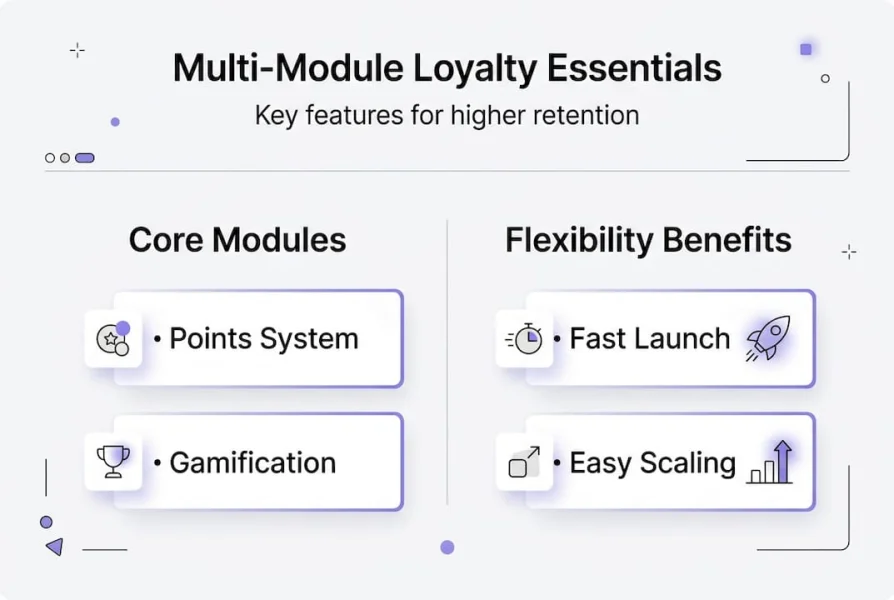
Flexibility extends beyond feature selection to implementation speed. Multi-module platforms typically launch in days rather than months because you’re activating pre-built components instead of custom-coding entire systems. This rapid deployment matters for seasonal businesses or those testing loyalty concepts before committing major resources.
The architecture also supports experimentation. You can A/B test different reward structures within the same platform, comparing how customers respond to points versus cashback or instant discounts versus delayed rewards. This data-driven approach eliminates guesswork from program design.
Customization depth varies significantly across platforms. Some offer simple on/off toggles for modules, while sophisticated systems let you adjust reward ratios, qualification thresholds, and redemption rules for each component. Evaluate how granular your control needs to be based on your customer segmentation strategy.
Integration capabilities determine practical utility. The best multi-module platforms connect seamlessly with your existing POS systems, email marketing tools, and customer databases. This connectivity enables automated campaigns triggered by specific customer actions, creating the personalized experiences that drive loyalty program modules for SMB success.
Key modules and features that drive results
Points systems form the foundation of most successful loyalty programs because they create clear value accumulation customers can track. Every purchase adds visible progress toward rewards, triggering the psychological satisfaction of advancement. Retailers using points-based programs report 5.7x higher spending by customers who redeem rewards compared to non-redeemers.
Coupon and promotion modules complement points by enabling tactical campaigns. Flash sales, limited-time offers, and personalized discounts keep your program dynamic rather than static. These modules excel at reactivating dormant customers or driving traffic during slow periods. The key is distribution precision: sending relevant offers to specific customer segments rather than blasting everyone with identical promotions.
Mobile and wallet integrations eliminate the friction that kills traditional loyalty programs. Customers forget physical cards but always carry smartphones. Digital wallet integration puts your loyalty program literally in their pocket, accessible at checkout without fumbling for separate apps or cards. Push notifications remind customers of available rewards exactly when they’re most likely to use them.

| Module Type | Primary Benefit | Best For |
|---|---|---|
| Points Systems | Clear value accumulation, encourages repeat purchases | Businesses with frequent, moderate-value transactions |
| Stamp/Visit Cards | Simple gamification, visual progress tracking | Coffee shops, quick-service restaurants, salons |
| Tiered VIP Programs | Status motivation, increasing engagement over time | Retailers with wide product ranges and price points |
| Cashback Rewards | Immediate perceived value, easy to understand | Service businesses, high-ticket retailers |
| Gamification Elements | Enhanced engagement, social sharing potential | Younger demographics, experience-focused businesses |
Gamification transforms transactional relationships into engaging experiences. Badges, challenges, leaderboards, and achievement unlocks tap into competitive and completion instincts. A fitness studio might award badges for workout streaks, while a bookstore could create reading challenges with exclusive rewards. These elements work particularly well for younger demographics who grew up with gaming mechanics.
Pro Tip: Layer modules strategically rather than activating everything simultaneously. Start with points and mobile access, then add gamification once you have baseline engagement data to optimize challenge difficulty.
The synergy between modules multiplies their individual effects. A customer earning points (module 1) receives a personalized coupon via mobile wallet (modules 2 and 3) when they’re near your location, triggering a visit where they complete a stamp card challenge (module 4) that unlocks VIP tier benefits (module 5). This orchestrated experience feels seamless to customers but requires sophisticated platform architecture.
Referral and social sharing modules extend your loyalty program’s reach beyond existing customers. Rewarding members for bringing friends creates viral growth loops. A salon offering both the referrer and new customer bonus services generates acquisition costs far below traditional advertising while building community around your brand.
Analytics modules transform raw transaction data into actionable insights. Track redemption rates by reward type, identify which customer segments engage most, and measure revenue lift from loyalty members versus non-members. These metrics guide program optimization and prove ROI to stakeholders. Understanding 7 loyalty program module types helps you select combinations that match your business model.
Choosing and customizing the right multi-module platform for your SMB
Platform selection begins with defining your non-negotiable requirements. List must-have modules based on customer behavior analysis, then identify nice-to-have features that could enhance engagement later. This prioritization prevents paying for enterprise capabilities you’ll never utilize while ensuring core needs are met.
Flexibility matters more than feature count. A platform offering 20 modules but limited customization within each often underperforms compared to systems with 10 highly configurable modules. Evaluate how deeply you can adjust reward ratios, qualification thresholds, and redemption rules. Can you set different point values for product categories? Offer time-based multipliers during slow hours? These granular controls enable precise program tuning.
The composable architecture beats monolithic systems for most SMBs because it supports phased rollouts and iterative improvement. You’re not locked into a rigid structure that requires expensive customization to modify. Composability also future-proofs your investment as new modules emerge to address evolving customer expectations.
Open-source platforms offer budget advantages and complete customization control but demand technical expertise for setup and maintenance. You’ll need development resources to configure modules, troubleshoot issues, and implement updates. Proprietary platforms cost more upfront yet include support, hosting, and automatic updates. Calculate total cost of ownership including staff time, not just licensing fees.
- Audit your current customer data to identify retention gaps and engagement opportunities
- Map customer journey touchpoints where loyalty interactions would add value
- Define success metrics: retention rate targets, visit frequency goals, revenue per member benchmarks
- Request demos from 3-5 platforms that match your module requirements and budget
- Test user experience from both business admin and customer perspectives
- Verify integration capabilities with your existing POS, CRM, and marketing systems
- Review contract terms for scalability: can you add modules or users without penalties?
- Check support quality through trial interactions and existing customer references
Integration complexity often determines implementation success more than feature richness. Platforms requiring extensive API development or custom middleware create ongoing maintenance burdens. Prioritize systems offering pre-built connectors for your existing technology stack. Seamless data flow between loyalty platform, POS, and marketing tools enables the automated campaigns that maximize program ROI.
Scalability considerations extend beyond user capacity to module expansion. Will adding new features trigger price tier jumps? Can you test modules temporarily before committing? Understanding cost structures prevents budget surprises as your program grows. Some vendors charge per active member, others per transaction, and some use flat monthly fees. Model your expected volume against each pricing approach.
Vendor stability and roadmap alignment matter for long-term partnerships. Research the company’s financial health, customer retention rates, and development velocity. A platform that hasn’t released new modules in two years likely won’t keep pace with evolving loyalty trends. Conversely, frequent breaking changes disrupt operations. Seek balanced innovation.
Understanding loyalty program benefits boost retention growth helps you set realistic ROI expectations during vendor evaluation and budget justification.
Best practices for implementing and optimizing multi-module loyalty programs
Successful launches start with soft rollouts to limited customer segments rather than company-wide announcements. Test your module configuration with 100-200 engaged customers, gather feedback on reward clarity and redemption ease, then refine before broader promotion. This approach identifies friction points when stakes are low.
Onboarding incentives accelerate initial enrollment. Offer immediate rewards for signup: bonus points, welcome discounts, or instant perks that demonstrate value before customers make additional purchases. The goal is converting skeptics into participants quickly enough that they experience the program’s benefits firsthand.
Communication cadence balances staying top-of-mind without becoming annoying. Weekly touchpoints work for high-frequency businesses like coffee shops, while monthly updates suit occasional-purchase retailers. Segment messaging by customer activity: re-engagement campaigns for dormant members, exclusive previews for top tiers, achievement celebrations for milestone completions.
Pro Tip: Set up automated campaigns triggered by specific behaviors like approaching reward thresholds or prolonged inactivity. These timely nudges drive action far more effectively than generic broadcasts.
Redemption optimization ensures customers actually use earned rewards. Complex redemption processes kill engagement even when rewards are generous. Make redeeming points as frictionless as earning them: one-tap mobile redemption, automatic application at checkout, or staff-initiated rewards that surprise customers.
Real-world results validate these approaches. Brass Armadillo achieved 35% visit increases and 50% retention improvements, while Motherswork generated 43% of revenue from loyalty members with strong redemption rates. These outcomes stem from continuous optimization, not set-and-forget implementations.
- Track enrollment conversion rates to identify signup friction
- Monitor redemption velocity: how quickly do customers use earned rewards?
- Measure incremental visit frequency comparing members to non-members
- Calculate revenue per member versus average customer spend
- Analyze module engagement to identify underperforming features
- Survey customers on reward relevance and program satisfaction
A/B testing reveals what actually drives behavior versus assumptions. Test reward denominations: do customers prefer 100 points worth $5 or 500 points worth $5? Compare immediate discounts against delayed rewards. Experiment with gamification difficulty: easy achievements that everyone unlocks versus challenging goals that create exclusivity.
| Metric | Calculation | Target Benchmark |
|---|---|---|
| Member Retention Rate | (Members at period end / Members at period start) x 100 | 15-25% higher than non-members |
| Redemption Rate | (Rewards redeemed / Rewards earned) x 100 | 60-80% for healthy engagement |
| Revenue per Member | Total member revenue / Active member count | 2-3x average customer value |
| Program ROI | (Revenue from members - Program costs) / Program costs x 100 | 300-500% in mature programs |
Common pitfalls include overcomplicating reward structures, setting thresholds too high, and neglecting member communication. If customers can’t quickly understand how to earn and redeem rewards, they won’t participate. If rewards require unrealistic spending, they won’t engage. If you don’t remind them of available benefits, they’ll forget.
Iteration based on data separates high-performing programs from stagnant ones. Review analytics monthly, identify the lowest-performing module, and test modifications. Perhaps your stamp card completion rate is 12% when industry average is 35%. Reduce required stamps, increase interim rewards, or adjust the final prize value. Measure impact, then move to the next optimization opportunity.
Expanding successful modules amplifies results. If birthday rewards generate 3x higher visit rates that week, consider adding anniversary rewards, milestone celebrations, or surprise-and-delight campaigns. Scale what works before adding unproven modules. This focused growth builds on validated engagement drivers rather than diluting efforts across too many initiatives.
Exploring loyalty program modules driving restaurant retention provides industry-specific optimization insights applicable across retail and service sectors.
Explore BonusQR’s customizable multi-module loyalty solutions
BonusQR delivers the composable architecture and module flexibility discussed throughout this guide, purpose-built for small and medium-sized businesses seeking measurable retention gains. Our electronic reward platform combines points systems, coupon distribution, and gamification into seamless digital experiences your customers actually use.
The mobile and web app feature eliminates the friction that kills traditional programs, putting loyalty access directly in customer pockets with wallet integration and push notifications. Start with our foundational points system loyalty feature, then scale by activating additional modules as your engagement grows. No POS integration required, rapid setup in days rather than months, and pricing tiers from free starter plans to enterprise solutions. The data-backed ROI and retention improvements detailed in this article become achievable outcomes when you implement the right platform architecture for your specific business needs.
FAQ
What are multi-module loyalty platforms?
Multi-module loyalty platforms combine distinct features like points accumulation, coupon management, gamification elements, and wallet integration into flexible systems you customize by activating only needed components. Unlike monolithic programs forcing you to accept entire pre-built packages, these platforms let you select and configure individual modules matching your specific customer behaviors and business model. This composable architecture supports starting small with core features, then expanding strategically as you gather engagement data and identify optimization opportunities.
How do multi-module loyalty platforms improve customer retention?
These platforms deliver personalized experiences by combining modules that reward your customers’ actual behaviors rather than generic actions. The variety of engagement options, from points to challenges to exclusive perks, keeps programs fresh and relevant over time. Empirical evidence shows properly implemented systems boost retention rates 10-50%, with even modest 5% improvements increasing profits 25-95% depending on industry. Members visit significantly more frequently than non-members because multiple reward pathways create ongoing reasons to return.
Can small businesses afford multi-module loyalty platforms?
Yes, through scalable pricing tiers and open-source alternatives that match various budget levels. Many platforms offer free starter plans with basic modules, letting you prove ROI before upgrading to premium features. The composable nature means you pay only for active modules rather than enterprise-level capabilities you don’t need. When implemented effectively, loyalty programs generate 4.8x ROI, making them self-funding investments rather than pure costs. Calculate total ownership expenses including setup time and support needs, not just licensing fees, to identify true affordability.
What modules should I prioritize when starting?
Begin with foundational points systems and mobile wallet integration because they deliver immediate value while establishing the infrastructure for expansion. Points create clear accumulation customers can track, while mobile access eliminates the friction of physical cards. Add coupon management next to enable tactical promotions that reactivate dormant customers and drive traffic during slow periods. Introduce gamification and tiered VIP programs once you have baseline engagement data showing which customer segments respond to competitive or status-based motivations. This phased approach builds proven engagement before adding complexity.