Are you struggling to keep customers coming back? For a small business, it can feel like an uphill battle against big chains with huge marketing budgets. The solution is simpler than you think: a smart loyalty program. It's not just another expense; it's a powerful tool for turning one-time buyers into devoted regulars and building a reliable path to growth.
Why a Loyalty Program is Your Secret Weapon
As a small business owner, you know every customer counts. The coffee shop owner who remembers a regular's order, the salon stylist who chats about a client's vacation-that personal connection is your greatest strength. But how do you scale that feeling into a strategy that actually boosts your bottom line?
That's where a loyalty program comes in.
It transforms casual transactions into genuine relationships. Instead of just hoping a customer returns, you give them a clear, compelling reason to choose you again and again. It’s not about just slapping a discount on something; it's about making your customers feel seen, valued, and like they're part of your brand's community.
The Real-World Impact on Your Business
The numbers don't lie. Loyalty programs directly tackle the pain points that keep small business owners up at night-unpredictable revenue and the high cost of constantly chasing new customers. The truth is, keeping an existing customer is far cheaper than finding a new one.
Let's break down what these programs really do for you.
Key Loyalty Program Benefits at a Glance
| Benefit | What It Means for Your Business | Supporting Statistic |
|---|---|---|
| Increased Retention | Customers have a tangible reason to return, reducing churn and creating a stable customer base. | A 5% increase in customer retention can boost profits by 25-95%. |
| Higher Customer Spend | Rewarded customers are happy customers, and they tend to spend more per visit. | Members of loyalty programs spend 12-18% more per year than non-members. |
| Stronger Relationships | You move beyond simple transactions to build a community and make customers feel valued. | 70% of consumers are more likely to recommend a brand with a good loyalty program. |
| Competitive Edge | A well-designed program gives customers a reason to choose you over a competitor, even if they're closer or cheaper. | 79% of consumers say loyalty programs make them more likely to continue doing business with brands. |
As you can see, the benefits are real and measurable. A loyalty program is more than just another marketing tactic; it's an engine for building strong customer relationships and a sustainable business. It shifts your focus from chasing short-term sales to creating long-term value.
Think of it this way: a loyalty program is a structured way to thank your best customers. That simple act of appreciation encourages them to visit more often and spend a little more when they do. It’s a win-win cycle. While a loyalty program is a fantastic tool for retention, don't forget that other efforts, like smart video marketing strategies for small businesses, can also play a huge role in attracting new faces and telling your brand's story.
Making Loyalty Simple and Accessible
Not too long ago, loyalty programs felt like something only big corporations with huge budgets could afford. They seemed complicated, expensive, and a technical nightmare to set up.
That’s all changed.
Modern tools have completely leveled the playing field, making it possible for any small business to launch an effective program without technical headaches or a massive investment.
For instance, BonusQR was designed specifically to solve this problem for businesses like yours. You can set up a digital punch card or a simple points system in just a few minutes, right from your phone. This accessibility means you can stop worrying about complex software and start focusing on what you do best: serving your customers and building a community around your brand. The path from struggling with retention to fostering a thriving, loyal customer base is more straightforward than ever before.
Choosing the Right Loyalty Program for Your Business
Picking the right loyalty program isn't about finding the flashiest option. It's about finding the perfect fit for your business, your customers, and your goals. What works wonders for a high-end salon might fall flat for a busy coffee shop.
The secret is matching the program's structure to your customers' buying habits and what truly motivates them to come back.
This decision tree nails it-a solid loyalty program can fix retention problems and pave a direct path to business growth.
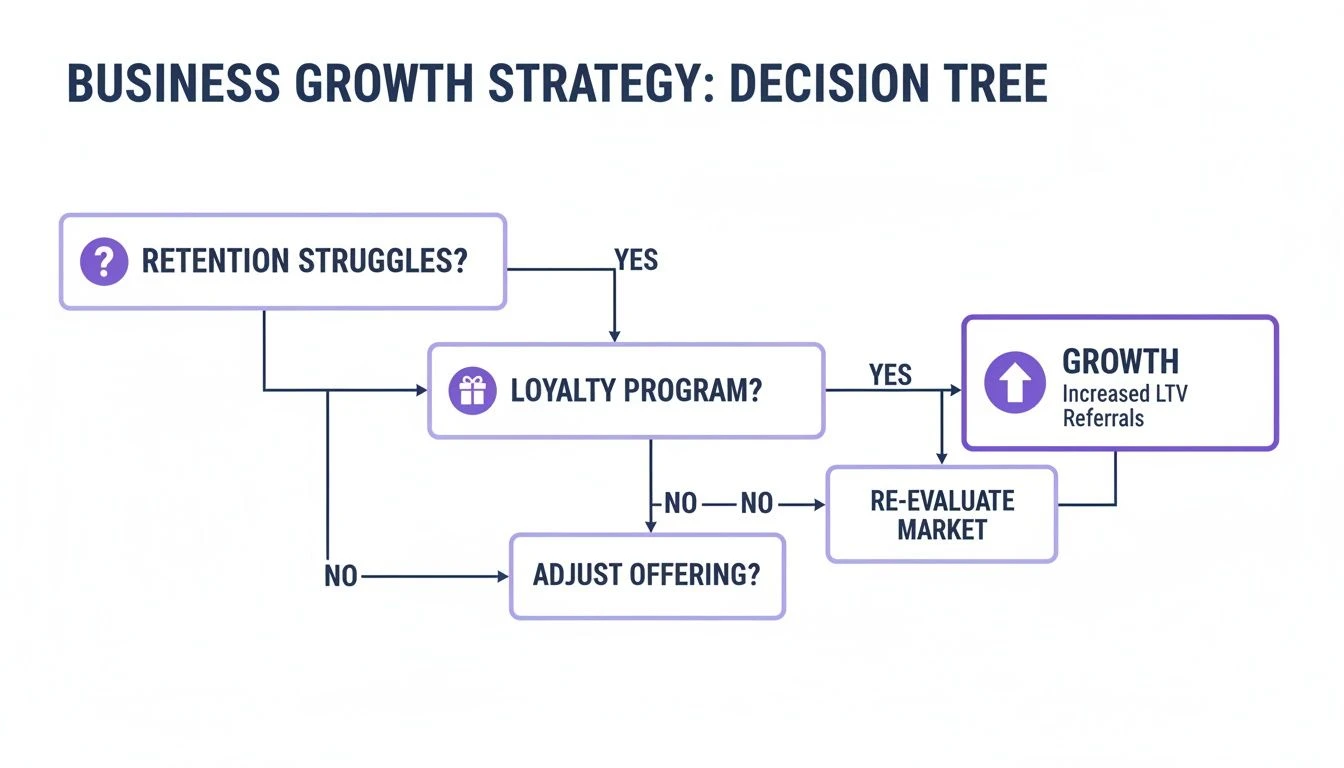
Think of your loyalty program as the bridge between keeping the customers you have and building a more profitable future. Let’s break down the most common types so you can see which path makes the most sense for you.
To make this even clearer, here's a quick comparison of the top loyalty models. It’s a great way to see, at a glance, which program might align best with your business type and customer base.
Which Loyalty Program Fits Your Business?
| Program Type | Best For | Pros | Cons |
|---|---|---|---|
| Points-Based | Retail, e-commerce, businesses with a wide product range | Flexible, encourages higher spending, can reward non-purchase actions (reviews, shares) | Can get complex to manage, rewards might feel too far away for casual shoppers |
| Tiered Programs | High-end brands (fashion, beauty), airlines, hotels | Creates exclusivity, motivates big spenders to reach the next level, fosters brand aspiration | May alienate casual customers, requires valuable high-tier perks that are still profitable |
| Paid/VIP | Established businesses with a strong value proposition | Generates predictable recurring revenue, identifies most committed customers immediately | High barrier to entry, requires a very strong and diverse set of benefits to justify the cost |
| Digital Punch Card | Coffee shops, cafes, salons, car washes, high-frequency businesses | Simple to understand, provides instant gratification, extremely cost-effective and easy to manage | Less effective for infrequent, high-value purchases; physical cards are easily lost (hence digital is better) |
Choosing the right model comes down to knowing your business inside and out. For most small businesses, simplicity wins. Now, let's dive a little deeper into each one.
Points-Based Programs
This is the classic "earn and burn" model. Customers rack up points for every dollar they spend or action they take, which they can cash in later for rewards. It's like a little savings account for future perks.
The upside? It's super flexible and naturally encourages people to spend a bit more to hit that next point threshold. You can even get creative and award points for things like social media shares or writing a review. The downside is that they can get complicated to track without the right software, and if the rewards feel impossible to reach, customers will just tune out.
Tiered Programs
Tiered programs are all about creating a sense of achievement and exclusivity. As customers spend more over time, they unlock better perks and climb the ranks from, say, "Bronze" to "Silver" to "Gold."
This model is fantastic for making your most valuable customers feel like true VIPs. The drive to reach that next tier can be a huge motivator for repeat business. But be careful-the top tiers can feel totally out of reach for casual shoppers, which might disengage a big chunk of your audience.
Paid or VIP Memberships
This is where you ask customers to pay an upfront fee for instant access to exclusive benefits. Think Amazon Prime-the annual fee unlocks a world of perks like free shipping and streaming.
A paid model generates predictable, recurring revenue and immediately tells you who your most die-hard fans are. Once they've paid, members are highly motivated to shop with you to get their money's worth. However, this is a tough sell. You need an incredibly strong value proposition to convince someone to pay, making it a high hurdle for most small businesses.
The Digital Punch Card: A Modern Classic
The old-school punch card-buy nine coffees, get the tenth free-is the OG loyalty program for a reason. It's simple, visual, and wildly effective for businesses that thrive on frequent, smaller purchases.
But today, flimsy paper cards are out. Digital is in.
Tools like BonusQR let you launch a digital punch card in minutes, straight from your phone. Customers just scan a QR code. There’s no app to download, no card to lose in a wallet, and no hassle.
For a small business, the digital punch card is often the perfect place to start. It keeps the beautiful simplicity of the original but ditches the headaches. It’s direct, customers get it instantly, and it’s incredibly affordable to run.
The data backs this up. A staggering 89% of consumers say loyalty programs make them more likely to be a repeat customer. Since many people are already using loyalty programs multiple times a week, a system that’s dead simple and always on their phone is a guaranteed winner.
Ultimately, the best loyalty programs for customer retention are the ones that fit your reality. For many small business owners, starting with a streamlined, easy-to-manage digital punch card delivers the biggest bang for your buck.
If you want to go even deeper, check out our complete guide to digital loyalty programs for small businesses.
Designing Rewards Customers Actually Want
A loyalty program is only as good as its rewards. Simple as that. If customers don't see the value in what you're offering, the whole effort is a wash. The secret isn't just about giving away free stuff; it’s about understanding what makes a reward feel special and motivating.
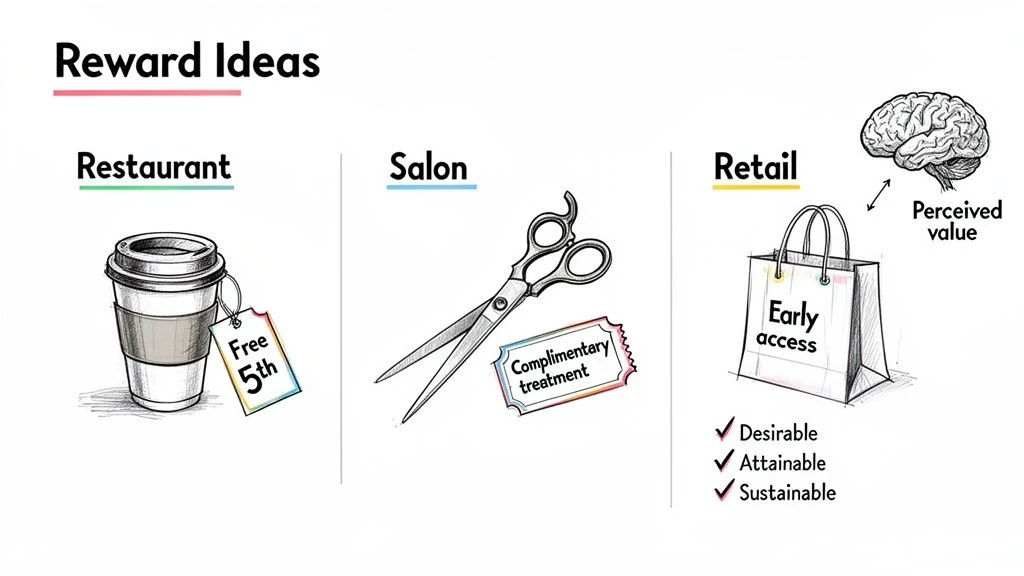
This is where you need to get smart about perceived value versus actual cost. A reward that feels like a premium indulgence to your customer might cost your business next to nothing. A great loyalty program lives in that sweet spot where desirability is high and your cost is low.
Think about it: a free coffee that costs you a dollar to make has a perceived value of $5 to your customer. That's a massive win. You want to design rewards that feel like a genuine treat, not just another routine discount.
Brainstorming Rewards That Excite
To build a reward structure that works, you have to put yourself in your customers' shoes. What would truly delight them? It's time to think beyond generic percentage-off discounts, which can sometimes devalue what you sell.
Here are a few creative, industry-specific ideas to get the ball rolling:
For Restaurants & Coffee Shops:
- Free Appetizer or Dessert: An appetizer often has a high menu price but a low ingredient cost. Perfect reward territory.
- "Skip the Line" Pass: For a busy cafe, the ability to jump the queue on a chaotic morning is a priceless, non-monetary perk.
- Free Flavor Shot or Milk Upgrade: A small add-on that elevates their usual order feels like a personalized bonus at a minimal cost to you.
For Salons & Spas:
- Complimentary Deep Conditioning Treatment: This is a fantastic add-on that takes little extra time for the stylist but feels like a luxury to the client.
- Free Brow Wax with a Haircut: Bundling a smaller service with a primary one is a great way to introduce customers to your other offerings.
- Priority Booking Privileges: Letting your most loyal clients get first dibs on peak appointment times is a powerful, cost-free reward.
For Retail & Boutiques:
- Early Access to New Products: Make your best customers feel like VIPs by letting them shop new arrivals 24 hours before anyone else.
- Free Gift Wrapping Service: A simple convenience that adds a touch of class and saves your customer time and hassle.
- A Branded Tote Bag: This reward is a walking advertisement for your business and gives customers a real sense of belonging.
Remember, the most effective rewards often provide an experience or a convenience, not just a discount. Exclusivity, recognition, and special treatment can be more powerful motivators than a simple 10% off coupon.
The Power of Non-Monetary Rewards
Don't sleep on rewards that have little to no direct cost. These experiential perks are fantastic for building an emotional connection and making your loyalty programs for customer retention more memorable.
Customers often value recognition and exclusivity more than you'd think. A "Customer of the Month" shout-out on your social media, for instance, can build a strong sense of community. Offering a one-on-one styling session or a private tasting event makes your most loyal patrons feel truly seen, cementing their relationship with your brand far more effectively than a transactional discount ever could.
Ultimately, designing rewards is a creative process. To make sure you're on the right track, run each idea through this quick checklist.
Reward Evaluation Checklist:
- Is it Desirable? Would my target customer genuinely want this?
- Is it Attainable? Can a regular customer realistically earn this?
- Is it Simple? Is the reward easy to understand and redeem? No hoops to jump through.
- Is it Sustainable? Can my business afford to offer this long-term without hurting my bottom line?
By focusing on high perceived value and mixing in both tangible and experiential rewards, you'll create a program that doesn't just keep customers around-it turns them into your biggest fans.
Launching and Promoting Your New Loyalty Program
You've nailed down the perfect rewards and chosen the right program type. Now for the fun part: bringing it all to life. A great launch isn't just about flipping a switch. It's about building excitement and weaving your new program into the customer experience right from the start.
The real goal here is to make joining feel totally natural and effortless. It shouldn't matter if they're standing at your counter, scrolling your website, or seeing your latest post on Instagram.
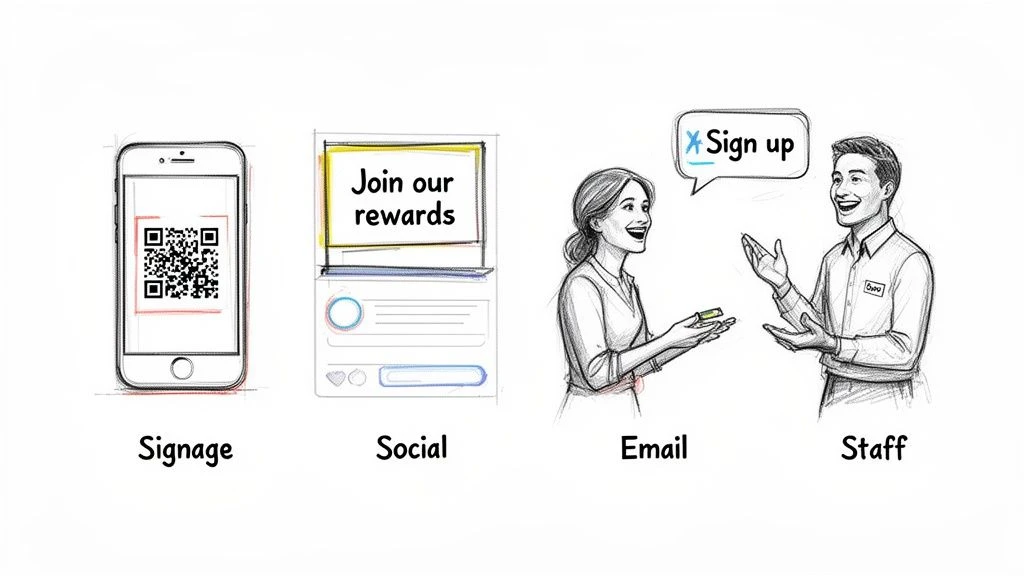
This might sound like a huge undertaking, but it doesn't have to be complicated or expensive. With the right game plan and a few simple tools, you can get your program off the ground smoothly and start seeing the results you're after.
Setting Up Your Program In Minutes
For a small business owner, time is everything. The last thing you need is for the tech setup of your loyalty program to become a massive headache that eats up your week. This is exactly why picking a dead-simple, user-friendly tool is so important.
A platform like BonusQR, for example, is designed so you can get the entire thing done on your smartphone in less than five minutes. Seriously. No clunky software, no hiring a developer. You just create a digital punch card, pick your reward, and it generates a unique QR code for you. That's it.
This kind of simplicity knocks down the biggest technical barrier, freeing you up to focus on what actually moves the needle: telling people about the program and engaging with your customers. You can literally go from a simple idea to a fully functioning loyalty program in a single afternoon.
Your Multi-Channel Promotion Checklist
Once you're live, you need to shout it from the rooftops. Using a mix of channels is the best way to make sure you catch your customers wherever they are. Here’s a quick checklist of some low-cost, high-impact tactics to get those sign-ups rolling in.
In-Store Signage: This is your front line. Get some clean, eye-catching signs up at your checkout counter, on the front door, and maybe on tables or menus. Keep the message short and sweet, focusing on the benefit.
- Example Text: "Ask us how to get a FREE coffee! Join our new loyalty club by scanning the QR code."
Staff Engagement: Your team members are your single most powerful marketing tool. Their genuine excitement is contagious and has a direct line to how many people sign up.
- Sample Talking Point: "Hey, before you go, would you like to get a stamp toward a free [product]? It just takes a second to scan this code, and you're already on your way."
Pro Tip: Train your staff to be your program's biggest cheerleaders. Explain why you're doing this-to build relationships and keep the business strong. You could even offer a small, fun incentive, like a weekly prize for the team member who signs up the most people, to keep things interesting.
Email Announcement: Send a dedicated email to your existing customer list. Make them feel like insiders who are getting the very first look.
- Email Script Snippet: "As one of our regulars, we wanted you to be the first to know about our brand-new loyalty program! Sign up today and get your first stamp on us as a little thank you."
Social Media Blitz: Announce the program across all your social media channels. A good visual and a clear call-to-action go a long way.
- Social Post Template: "BIG NEWS! 🎉 Our new loyalty program is finally here! Earn rewards on every purchase, starting right now. Scan the QR code in our bio to join the club and get earning!"
When you use these tactics together, they create a surround-sound effect that makes it incredibly easy and appealing for customers to join in.
Making It Stick With Consistent Promotion
A big launch is great, but what really builds a thriving loyalty program is sustained promotion. This isn't a "set it and forget it" kind of deal.
Start weaving mentions of your program into your regular marketing. Add a permanent link to your email signature. Print the QR code on receipts and menus. The more integrated it becomes, the more natural it will feel for customers to jump on board.
The good news? The effort is absolutely worth it. Globally, 90% of program owners see an average 4.8x ROI, with solid activity and redemption rates. The secret for a small business is an effective launch. With a simple tool like BonusQR, the setup is quick and scalable, removing the tech hurdles so you can focus on promotion and enjoy the benefits of keeping your customers coming back. You can explore the full findings on Access Development's blog to dig deeper into these loyalty program stats.
By combining a lightning-fast setup with a steady, multi-channel promotional strategy, you’re not just launching a program-you’re building a powerful engine for customer retention. You're giving people a compelling reason to choose you again and again, turning casual visitors into a community of loyal fans who are invested in your success.
Measuring Success and Optimizing for Better Results
Getting your loyalty program up and running is a fantastic first step, but the real work starts now. To build something that genuinely keeps customers coming back, you have to pay attention to what's working and what's falling flat. This isn't about drowning in spreadsheets; it's about listening to what your customers' actions are telling you.
By tracking a few simple but powerful numbers, you can turn your loyalty program from a good idea into a growth engine. Think of these metrics as your program's pulse-they show you where you're strong and where you can get even better.
Key Performance Indicators You Can Actually Use
You don't need a degree in data science to figure out how your program is doing. The most important metrics are refreshingly straightforward and easy to track, especially with a tool like BonusQR that lays it all out for you on a simple dashboard.
Let’s zero in on three core KPIs that tell you pretty much everything you need to know.
Enrollment Rate: This is the percentage of customers who actually sign up. It’s your first and most important signal-does your offer make sense and is it appealing right at that moment?
Redemption Rate: This shows you how many of the rewards people earn are actually being used. It’s a direct reflection of whether your rewards are desirable and feel achievable.
Repeat Purchase Rate: This one measures how many of your customers are coming back for a second, third, or fourth time. This is the ultimate test of retention and the clearest sign that you're building real loyalty.
Keeping an eye on these numbers gives you a clear, objective view of your program's health. For a deeper look at the numbers that really matter for small businesses, you might want to check out our guide on mastering customer retention metrics in our complete guide.
Turning Your Data into Actionable Improvements
The real magic isn't just knowing the numbers; it's using them to make smart, informed decisions. Your data tells a story about your customer experience. If you listen to that story, you can make small, targeted tweaks that make a huge difference.
The whole process is about asking "why?" and then testing a solution.
For instance, if your Enrollment Rate is high but your Redemption Rate is low, that’s a classic sign. It means people are intrigued by the idea of your program, but the rewards themselves aren't compelling enough to bring them back. The value just isn't there for them.
Let's walk through a few common scenarios and the simple, practical steps you can take to fix them.
Scenario 1: Low Enrollment Rate
- What It Means: Your customers either don't know the program exists, or the pitch isn't grabbing them. The value isn't clear when they're standing at the counter.
- How to Fix It:
- Boost Visibility: Put simple, eye-catching signs right at the checkout. Your QR code should be impossible to miss.
- Train Your Team: Give your staff a simple, one-sentence script they can use with every customer. Something as easy as, "Want to get a stamp toward a free coffee today?" works wonders.
- Offer an Instant Win: Give people a small bonus just for signing up, like "Get your first stamp free when you join now!" It removes all hesitation.
Scenario 2: Low Redemption Rate
- What It Means: Like we mentioned, the reward probably isn't exciting enough, or it feels like too much work to get there. The effort outweighs the prize.
- How to Fix It:
- Increase Reward Value: If a free coffee takes 10 purchases, try lowering it to 8. Or, instead of a regular coffee, make the reward a premium latte to make it feel more special.
- Keep It Simple: Make sure the reward is dead simple to understand. "Free Appetizer" is way more motivating than "15% Off Your Next Meal."
- Create a Little Urgency: Send a friendly nudge to members with points or rewards that are about to expire. It's often the push they need to come back in.
Scenario 3: Low Repeat Purchase Rate
- What It Means: People might be joining and even redeeming a reward, but they aren't forming a habit. Your program isn't creating that sticky connection.
- How to Fix It:
- Add Tiers or Surprises: Create a small "VIP" perk for customers who hit a certain number of visits, like early access to a new menu item. People love feeling special.
- Get Personal: Use your program to send targeted offers. For a coffee shop, you could offer a pastry discount to a customer who only ever buys drinks.
- Just Ask for Feedback: Talk to your most loyal members. Ask them what they love and what they wish you offered. Making them feel heard is one of the most powerful retention tools you have.
By regularly checking these key metrics and responding with thoughtful adjustments, you ensure your loyalty program stays relevant, continuously strengthening your customers' connection to your business.
Your Path to a More Loyal Customer Base
Building a successful customer retention strategy doesn't have to be a massive, expensive undertaking. You don't need a complex, enterprise-level system to see real results. Creating an effective loyalty program for customer retention is well within reach for any small business ready to focus on what their customers actually care about.
The path forward is clear:
- Choose the right program: Start simple with a model like a digital punch card that fits your business.
- Design desirable rewards: Focus on high perceived value, not just discounts.
- Launch and promote: Make it easy and exciting for customers to join.
- Measure and adapt: Use data to make smart tweaks that improve results.
At the end of the day, this whole process is about turning simple transactions into real, emotional connections. You’re not just handing out discounts; you’re showing people you appreciate them and making them feel like a valued part of your brand’s community.
To really nail this and establish a truly dedicated customer base, you need to think long-term and build customer loyalty that lasts. It’s about creating a sustainable cycle of appreciation that keeps great customers coming back.
Stop waiting for loyalty to just happen. You have the tools and the strategy to start building it intentionally, today. And the simplest first step is with a platform designed specifically for businesses like yours.
With BonusQR, you can get your own digital loyalty program up and running in just a few minutes, right from your phone. It’s the most straightforward, cost-effective way to put all these ideas into action immediately. Start your free trial today and begin turning your one-time buyers into your most valuable, loyal fans.
Common Questions About Loyalty Programs
After diving into the details of creating a loyalty program, a few practical questions usually come up. Let's tackle the ones I hear most often from small business owners right before they take the leap.
How Much Does a Loyalty Program Cost?
This is the big one, and the answer can range from almost nothing to a small fortune. But it absolutely doesn't have to be expensive.
Old-school paper punch cards might only cost a few hundred dollars for design and printing. However, the real value today is in digital, and it’s surprisingly affordable.
Platforms like BonusQR are built specifically for small businesses, with low monthly fees that are a fraction of what you’d spend on a single local ad. This route completely sidesteps the massive costs of custom app development, which can easily run into thousands of dollars, making powerful loyalty tools accessible to everyone.
When Is the Right Time to Start?
Honestly? As soon as you have a stable product and customers are walking through the door. You don’t need a huge following to get started.
In fact, starting early is a huge advantage. It lets you build loyalty habits with your very first regulars and gather priceless feedback while you're still small and agile.
If you wait until you're "bigger," you’re just missing out on the chance to turn today's new faces into tomorrow's die-hard fans.
What If My Customers Don't Use It?
If you build it and they don't come, it's almost always a sign of one of three things: nobody knows about it, the rewards aren't exciting, or it’s a pain to sign up.
The secret is to make joining ridiculously easy and instantly rewarding. Offer a small bonus just for signing up. Train your staff to mention it at every single checkout. And make sure your rewards are things people actually want. A simple, visible QR code right by the register can work wonders.
By getting these common worries out of the way, you can move forward and launch a program that actually builds a stronger, more resilient business.


