Customer loyalty isn't just about repeat business-it's the bedrock of a predictable, profitable, and resilient company. Are you tired of the constant, expensive chase for new customers? It's like building on sand. One-time buyers create unstable cash flow and drain your marketing budget.
Loyal customers are the foundation you can build on. They transform inconsistent sales into sustainable growth, becoming your most valuable asset and shielding your business from market unpredictability.
Why Loyalty is the Foundation of a Thriving Business
So, why is loyalty so important, especially when you're a small business owner juggling a million tasks? Simple: It's the most direct path to boosting revenue while slashing your marketing costs.
Instead of constantly feeding the ad machine to attract new faces, you can focus on strengthening relationships with people who already know and trust you. This shift creates a powerful, self-sustaining cycle of growth, turning your business from a leaky bucket into a fortress.
This isn't just a feel-good strategy; it's a financial one. Loyal customers are your best customers for a few key reasons:
- They spend more. A repeat customer is likely to spend a whopping 67% more than a brand-new one.
- They buy more often. When visiting your business becomes a habit, you create a predictable revenue stream you can actually count on.
- They trust you with new products. Launching a new menu item or service? Your loyal fans will be the first in line to try it and give you the honest feedback you need.
- They become your best marketers. Happy, loyal customers can't help but spread the word. Their authentic recommendations are a form of marketing that money simply can't buy.
To really dig into what makes this work, it’s worth exploring various 10 Proven Customer Retention Strategies. These methods are fantastic for turning casual buyers into your most dedicated advocates.
Before we go further, let's break down the core benefits in a simple table. Think of these as the pillars holding up your business.
The Core Pillars of Customer Loyalty
| Benefit Area | Impact on Your Business |
|---|---|
| Increased Revenue | Loyal customers spend more and buy more frequently, directly boosting your bottom line. |
| Reduced Costs | It's far cheaper to keep a happy customer than to acquire a new one. |
| Predictable Sales | A loyal base creates a stable and forecastable income stream, month after month. |
| Authentic Marketing | Word-of-mouth from happy customers is the most trusted and effective advertising there is. |
| Valuable Feedback | Your regulars provide honest insights to help you improve and innovate. |
See the pattern? Investing in loyalty is about creating a more stable, profitable, and defensible business.
For any small business, focusing on your existing customer base isn't just one strategy-it's the single most powerful and cost-effective way to thrive in a competitive market.
Ultimately, when you invest in loyalty, you're investing in stability. Building a community around your brand creates a powerful buffer against market swings and fierce competition.
A simple, effective loyalty program, like one managed through a tool like BonusQR, is what helps you build that invaluable foundation. It’s all about making your customers feel seen, appreciated, and part of something special.
The Financial Payoff of Loyal Customers
Customer loyalty isn't a fluffy, feel-good idea; it's a cold, hard financial lever that directly cranks up your bottom line. Once you grasp the numbers, you'll understand why building a loyal following is non-negotiable for any small business serious about growth. This is where appreciating your customers translates directly into measurable profit.
It all boils down to two key metrics that determine your business's health: Customer Acquisition Cost (CAC) and Customer Lifetime Value (CLV).
Simply put, CAC is the money you spend to get a new person in the door. CLV is the total revenue you can expect from that person over their entire relationship with you. A healthy, growing business has a low CAC and a high CLV. Loyalty is the engine that drives both in the right direction.
This chart drives the point home, showing how focusing on loyalty gives you a nice boost in revenue while cutting down on costs.
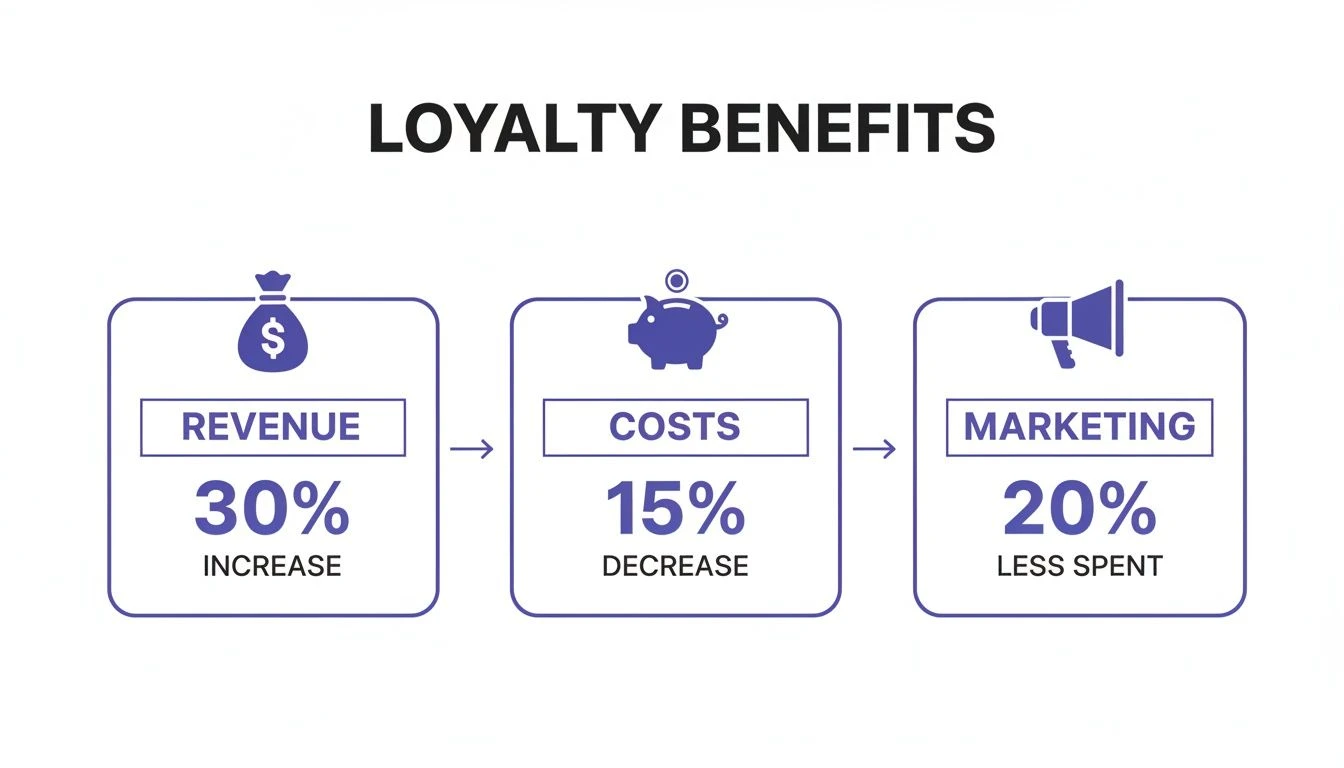
As you can see, a happy, returning customer means more money in your pocket, partly because you're not constantly bleeding cash on expensive marketing campaigns to replace them.
Slashing Your Customer Acquisition Cost
How much are you spending on ads, social media campaigns, and first-timer promotions? Now, compare that to the cost of keeping a current customer happy. The difference is staggering-it's five times cheaper to retain an existing customer than to acquire a new one.
When a customer returns on their own, your acquisition cost for that visit drops to zero. That’s the core financial argument for why loyalty is important; it plugs a massive hole in your budget and brings stability to your income stream.
Investing in your existing customers is like fixing a leak in a bucket. Before you spend more time and money trying to fill it, you have to stop what you're losing first.
By building those solid relationships, businesses can dramatically increase customer lifetime value, which is the bedrock of long-term, sustainable profit.
Maximizing Your Customer Lifetime Value
But loyal customers don't just save you money-they make you more of it. They return more often, are eager to try your new offerings, and typically spend more each time they visit. This steady, reliable spending is what inflates a customer's CLV.
A simple loyalty program is one of the most effective tools to make that happen.
For instance, studies show that the lifetime value of a customer who actively uses their points in a loyalty program is a whopping 6.3x higher than a non-member. That's a massive lift without pouring more cash into marketing. You can discover more loyalty program benefits for your small business in our full guide.
This is exactly where a simple tool like BonusQR comes in. It helps you tackle both goals at once, giving you an affordable and dead-simple platform to slash acquisition costs and multiply the value of every single person who walks through your door.
How Real Businesses Win with Simple Loyalty Programs
Theory is great, but seeing it work in the real world is what truly matters. When you see how other small business owners solve their day-to-day problems with loyalty programs, you start to understand why it’s so important. The best programs aren't about complex tech; they’re about fixing common pain points.
Let's look at how different small businesses use simple loyalty solutions to turn one-time visitors into regulars, boosting their bottom line and building a real community.
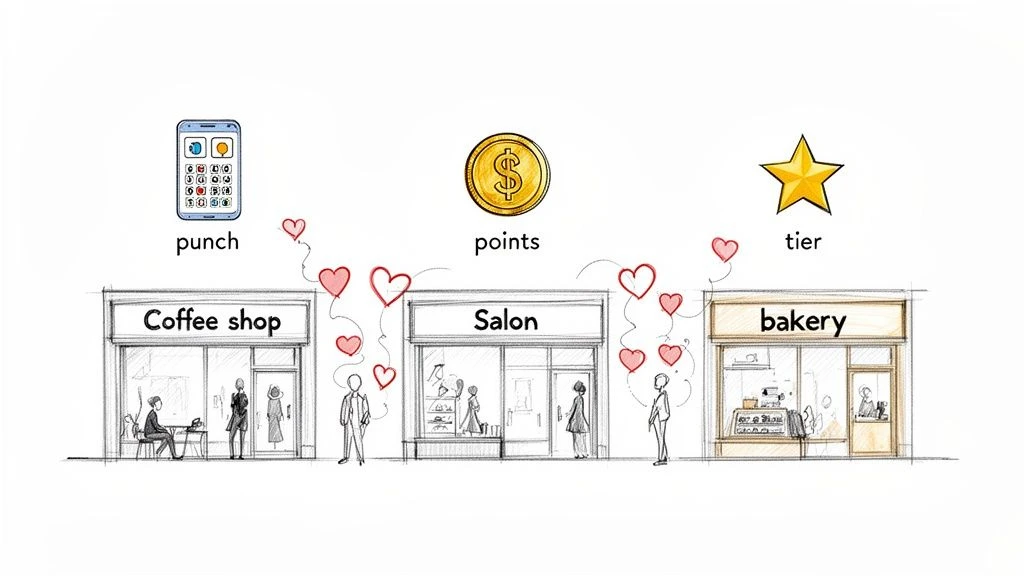
These stories prove that a simple scan of a QR code can completely change how customers behave.
The Neighborhood Coffee Shop
Imagine a local coffee shop owner struggling with ghost-town Tuesday mornings. She implements a digital punch card using an easy app like BonusQR. The deal is simple: buy five coffees, and the sixth one is free. Suddenly, those quiet mornings aren't so quiet anymore.
- The Problem: Inconsistent foot traffic, especially during slow off-peak hours.
- The Solution: A straightforward "Buy 5, Get 1 Free" digital punch card.
- The Result: Customers now have a tangible reason to choose her shop over a competitor. That achievable reward is enough to nudge them into an extra trip during the week, helping to stabilize the shop's cash flow.
This is loyalty in its purest form. It’s not about slashing prices; it’s about creating a small goal that makes customers feel rewarded for their daily habit.
The Independent Hair Salon
A salon owner wants to encourage clients to book higher-value services, like color treatments, instead of just standard cuts. She rolls out a points-based system. A basic haircut might earn 50 points, but a full color treatment gets you 200.
Once a client hits 500 points, they can redeem them for a free deep-conditioning treatment or a discount on their next visit.
This is a clever way to guide customers toward higher-value services without being pushy. It changes the dynamic from a one-off transaction to a rewarding journey, making clients feel genuinely valued for sticking around.
This approach doesn't just increase the average spend per visit; it builds a stronger bond with the client, making them far less likely to be tempted by a new salon down the street.
The Local Boutique Retailer
A small clothing boutique has a common problem: a customer buys a dress for a special occasion and then disappears for months. The owner needs to give people a reason to return more often, so she introduces a tiered loyalty program.
- Tier 1 (Bronze): All members get early access to sales.
- Tier 2 (Silver): Spend a certain amount to unlock a birthday discount and first dibs on new arrivals.
- Tier 3 (Gold): The shop's biggest fans are invited to private styling events and receive a special annual gift.
This model creates a sense of belonging and exclusivity. Customers feel like they're part of an inner circle, forging a much deeper emotional connection to the brand. Suddenly, they have a reason to pop in that goes beyond just needing a new outfit.
Each example highlights the same truth: the most effective loyalty programs are simple, relevant, and designed to solve a real business challenge. They show customers you value their business, turning casual shoppers into a loyal community.
Choosing the Right Loyalty Program for Your Business
Okay, you’re sold on the why of customer loyalty. The next question is, how? Choosing the right tool is a critical decision that can make or break your program's success.
Not all loyalty programs are created equal. The best choice connects to your business model, your goals, and what actually excites your customers. A program that works wonders for a bustling coffee shop might fall flat for a high-end salon.
The goal is to pick a model that feels natural and easy for both you and your customers-one that directly encourages the behaviors you want to see more of.
Finding Your Perfect Fit
Most small businesses find their sweet spot with one of three models: digital punch cards, points-based systems, or tiered programs. Each one serves a different purpose. Understanding their strengths will help you match your program to your goals, making it feel like a genuine thank-you, not a chore.
Let’s break them down.
Digital Punch Cards: This is simplicity at its best. Think "buy nine coffees, get the tenth free." It's perfect for businesses with frequent, smaller purchases. Its appeal is instant gratification and how easy it is to understand. If you run a coffee shop, bakery, car wash, or quick-service lunch spot, this is your ideal starting point.
Points-Based Systems: This model offers more flexibility, making it a great fit for businesses with a wider range of products and price points. Customers earn points for every dollar spent, which they can redeem for rewards. This naturally encourages larger purchases and is a fantastic match for retail stores, salons, and full-service restaurants.
Tiered Programs: If you want to make your best customers feel like VIPs, tiers are the way to go. This model creates a sense of exclusivity and achievement. As customers spend more, they "level up" to unlock better perks, like early access to sales or exclusive events. It's a powerful way to build a community and reward your top spenders.
The most effective loyalty programs are simple and transparent. If a customer can't figure out how to earn a reward in five seconds, they're not going to bother.
Fight the urge to overcomplicate things. For most small businesses, a straightforward digital punch card or simple points system delivers the best results with the least friction. This is precisely where a tool like BonusQR shines. It was designed to make these proven models incredibly easy and affordable, so you can skip the technical headaches and get straight to rewarding your customers.
To help you visualize where your business fits, here's a quick side-by-side look.
Which Loyalty Program Fits Your Business?
Choosing the right loyalty program model is a foundational step. Each type caters to different customer behaviors and business structures. This table breaks down the most common options to help you see which one aligns best with your goals.
| Program Type | Best For | Key Benefit | Potential Drawback |
|---|---|---|---|
| Digital Punch Card | Coffee shops, quick-service restaurants, car washes, bakeries. | Dead simple for customers to understand. Instant gratification drives repeat visits. | Doesn't directly incentivize customers to spend more per visit. |
| Points-Based System | Retail stores, salons, full-service restaurants, pet groomers. | Flexible and encourages higher spending to earn points faster. | Can be slightly more complex to manage and explain than a punch card. |
| Tiered Program | Boutiques, businesses with a strong community, brands wanting to reward top spenders. | Creates aspirational goals and makes your best customers feel like VIPs. | Might feel out of reach or intimidating for more casual shoppers. |
Ultimately, the best program is the one your customers will actually use and enjoy. Start simple, listen to their feedback, and don't be afraid to adjust as you learn what works.
Okay, you know why loyalty is so important, but how do you actually put it into practice? That’s where most small business owners get stuck. The good news? Starting a loyalty program isn't the complex, budget-draining monster it used to be.
Forget the old days of expensive software and IT headaches. Modern tools have completely changed the game, letting you roll out a simple, effective program in minutes. You don’t need a giant marketing team to start building real connections with your customers today.
This new simplicity is exactly why the payoff is so huge. Think about this: 90% of businesses with a loyalty program report a positive return on their investment. That's not a small win. The average ROI hits an incredible 4.8x, meaning for every dollar you invest, you can expect to get almost five back. It’s one of the smartest, most reliable ways to fuel your growth.
Your Quick-Start Guide to Launching
Getting started is genuinely easier than you think. With a tool like BonusQR, the complicated setup is already handled. You just need to focus on a few simple steps that make all the difference.
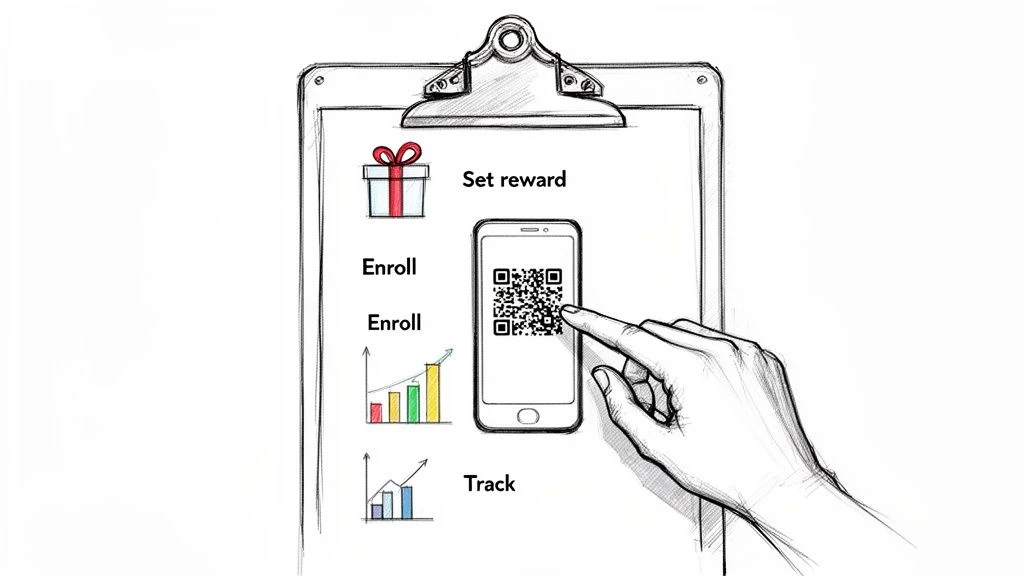
Define Your Reward: What's something your customers would actually get excited about? A free coffee after five visits? A discount on their next haircut? Keep it simple, desirable, and easy to understand.
Set Up Your Program: Hop into an app like BonusQR and create your digital punch card. You just plug in your reward details, and the system instantly generates a unique QR code for your business. It takes just a few minutes.
Enroll and Promote: Stick that QR code right at your checkout counter. Customers just scan it with their phone-no clunky apps to download, no annoying forms to fill out. Then, get your staff on board with a simple line: "Want to join our rewards program? You'll get your first stamp today!"
This no-fuss approach eliminates all the friction that makes people give up on traditional programs.
Making Your Launch a Success
Once you're live, getting the word out is everything. This doesn't mean you need a big, flashy campaign-just a little consistent effort.
The goal isn't just to have a loyalty program; it's to make your customers feel seen and appreciated. A simple "thank you for being a regular" goes a long way, and your program is the perfect tool to deliver that message.
Here are a few quick tips to make sure your program gets traction from day one:
- Announce it on social media: Snap a quick photo of your new QR code sign and tell your followers about the reward. Simple and effective.
- Use in-store signage: A small, clear sign on your counter or front door is often all you need to get people curious.
- Empower your staff: Make sure every employee knows how the program works and can explain the benefits in ten seconds or less. They're your front line.
By following these straightforward steps, you can start building real, measurable loyalty almost immediately. For a more detailed guide, check out our walkthrough on how to start a loyalty program customers will love.
Common Loyalty Mistakes You Can Easily Avoid
Launching a loyalty program is a huge step. But a great customer experience is about more than just dangling a reward. I’ve seen countless well-intentioned programs fall flat-not because the idea was bad, but because of small, avoidable mistakes in execution.
Getting these details right from the start is how you build genuine trust and ensure your program actually delivers results.
The biggest mistake? Creating a program that feels impossible. If your customers have to spend a small fortune just to earn a free coffee, they won’t bother. The reward must feel achievable and worth the effort. Otherwise, you’re not motivating them; you’re discouraging them.
Another classic blunder is a complicated sign-up. Nobody wants to download a clunky app or fill out a long form at the counter while a line builds up behind them. The process needs to be instant and effortless-think a simple QR code scan, and they're in.
Don’t Hide It, and Keep It Simple
Even the world's best loyalty program is useless if nobody knows it exists. You can't just set it and forget it. You have to be its biggest cheerleader. A small sign at the checkout or a quick, friendly mention from your staff can make all the difference in getting people on board.
This is more important than ever. Today, 77% of consumers say they pull their loyalty much faster than they did just three years ago. The pressure is on to keep people engaged, which means your program needs to be constantly optimized.
It's no wonder that nearly 79% of companies with loyalty programs are already planning to revamp them with better rewards and simpler tech. You can check out more loyalty program statistics to see just how quickly things are changing.
The secret to a successful loyalty program isn't complexity-it's consistency and simplicity. The easier it is for customers to join and earn, the more likely they are to participate and come back.
When you boil it down, avoiding these mistakes comes down to one core principle: respect your customer's time and effort. A program that is simple, attainable, and a breeze to join will always win against a complicated one. This is exactly what modern tools like BonusQR are built for-they get rid of the friction so you can focus on the fun part: rewarding the people who keep your business thriving.
Got Questions About Customer Loyalty? We’ve Got Answers.
You’ve seen the "why," but you might still be wondering about the "how." That’s completely normal. Let's tackle some of the most common questions we hear from small business owners who are thinking about taking the next step.
"Is My Business Too Small for This?"
Absolutely not. In fact, you could argue loyalty programs are even more powerful for small businesses.
This is your secret weapon. You can build genuine, personal connections that the big-box stores only dream of. A simple loyalty program turns a first-time visitor into a regular, and a regular into a fan. Digital tools like BonusQR are built specifically for businesses like yours-they’re affordable, easy to set up, and give you a real competitive edge.
"How Fast Will I See Results?"
Building true, lasting loyalty is a marathon, not a sprint. But you can start seeing the first signs of success-like your best customers stopping by a little more often-within just a few weeks.
The trick is to be consistent. Promote your program, talk about it, and make sure the rewards are something your customers actually want. Most businesses start seeing a clear, positive return on their investment within the first couple of months.
"Will This Be a Headache for My Staff to Manage?"
That's a very common fear, but modern loyalty apps are designed to be incredibly simple. Forget clunky hardware or complicated training manuals. The process is usually as straightforward as a customer scanning a QR code with their phone.
Training your team often takes just a few minutes. The app handles all the heavy lifting-tracking points and managing rewards automatically-so your staff can stay focused on what they do best: taking care of your customers.


