Every customer who walks out your door and never comes back is a missed opportunity. But what if you could turn casual visitors into loyal regulars who choose you over the competition, every single time? A powerful customer retention program isn't just about damage control; it's your single best strategy for building sustainable, predictable growth.
These programs are more than just discounts. They are a deliberate system for making your best customers feel seen, appreciated, and connected to your brand. For a small business, this isn't a "nice-to-have"-it's the foundation of a healthy bottom line.
Why You're Losing Money by Ignoring Customer Retention
Let's be honest. The daily chaos of running a small business is overwhelming. You're juggling inventory, managing staff, and constantly trying to attract new customers. It's easy to assume that if you provide a good product or service, people will just come back.
But this "build it and they will come" mindset is a silent profit killer. While you're busy chasing new leads, your hard-won existing customers are quietly slipping away to competitors.
It’s not just a feeling; it's a harsh financial reality. The cost to acquire a new customer has skyrocketed, making every dollar spent by a returning customer exponentially more valuable. Focusing only on acquisition is like trying to fill a leaky bucket. You can pour endlessly, but you’ll never get ahead until you plug the holes.
The Sobering Numbers Behind Customer Churn
The financial gap between acquiring a new customer and retaining an existing one is no longer a gap-it's a chasm. U.S. brands lose a staggering $168 billion annually simply because customers don't stick around.
How does this affect you directly? Acquiring a single new e-commerce customer can now cost up to $29, a 222% increase in just a few years.
Meanwhile, your existing customers are your most profitable asset. They spend 67% more than new ones. It’s no surprise that 59% of sales leaders identify loyalty programs as their number one retention strategy.
The most expensive customer isn't the new one you're trying to win; it's the one you have to win back after they've left. A simple, proactive loyalty program prevents that loss before it happens.
This isn't just theory. Let's look at the direct impact on your marketing budget and profit margins.
The High Cost of Losing Customers vs. The Value of Keeping Them
| Metric | Cost of Customer Loss | Benefit of Customer Retention |
|---|---|---|
| Marketing Spend | High acquisition costs (ads, promotions) for one-time sales. | Lower marketing spend; loyal customers buy repeatedly. |
| Purchase Value | New customers tend to spend less on their first purchase. | Repeat customers spend 67% more on average. |
| Profit Margin | Lower, due to the high cost of winning them over. | Higher, as you're not paying to acquire them again. |
| Referrals | Unlikely to refer others after just one visit. | Happy, loyal customers become your best advocates. |
| Predictability | Unpredictable revenue stream. | Stable and predictable income from regulars. |
Seeing it laid out like this makes the path forward clear. Investing in the customers you already have isn’t just good service; it's the smartest financial decision you can make.
From Theory to Your Till: A Real-World Example
Let's translate these percentages into your daily cash flow. Imagine you run a local coffee shop. A new customer wanders in and spends $5. Great.
But a loyal regular? They visit three times a week, spending $15. Over a year, that single loyal customer is worth $780. The one-time visitor? Still just $5.
Now multiply that by 20, 50, or 100 loyal regulars. The financial impact is transformative. This is the core of customer retention, a principle that applies across industries, from coffee shops to service businesses like these Client Retention Strategies For Home Cleaning Businesses. It’s about unlocking the immense long-term value hidden in plain sight.
The Simple Shift to Profitability
The best part? You don’t need a massive budget or a marketing degree to plug the leak. The solution is often simpler and more affordable than you think. For busy entrepreneurs, modern tools like BonusQR offer the most cost-effective way to solve this common-and costly-problem.
Forget complicated software or ordering boxes of plastic cards that get lost. A simple QR-code-based system can be launched in minutes. It transforms every transaction into an opportunity to build a relationship, rewarding customers for their loyalty without adding another complex task to your plate.
To dive deeper into the specific costs and returns, check out our guide on unlocking the cost of customer retention. This simple shift in focus-from constantly chasing the new to celebrating the familiar-is how you stop the financial leaks and build a more profitable, resilient business.
Designing a Loyalty Program Customers Will Actually Use
A loyalty program that nobody uses is worse than having no program at all-it's a wasted effort. To build something that genuinely keeps customers coming back, you must think beyond discounts. Your program needs to be a seamless, valuable extension of the customer experience.
The secret weapon? Simplicity. If a customer has to download an app, remember a password, or do mental math to figure out their reward, they'll abandon it. The best programs are intuitive, immediately rewarding, and require almost zero effort from the customer. They should feel seen and appreciated, not burdened.
Remember, retaining a customer is a journey. This visual breaks down how the costs evolve, showing exactly why a smart program is such a good investment over time.
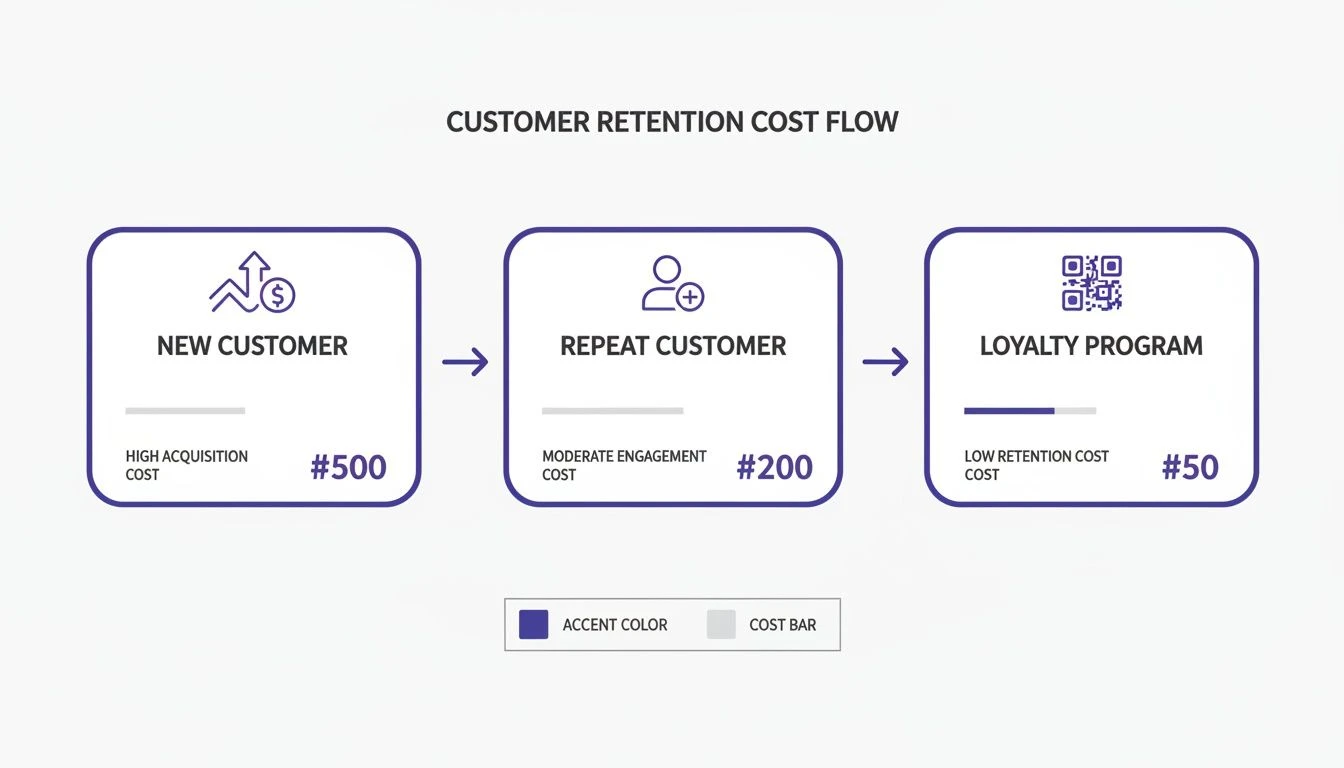
As you can see, acquiring a new customer is the most expensive step. But as they become a repeat buyer and join your loyalty program, the cost to retain them plummets, directly boosting your profit margins.
Choosing the Right Reward Structure for Your Business
Not all rewards are created equal. A one-size-fits-all approach is a recipe for an unused program. The right structure depends on your business model, purchase frequency, and what your customers actually find valuable.
Here are a few proven models perfect for small businesses:
- Digital Punch Cards: The classic "buy X, get one free" model, modernized. It's perfect for businesses with frequent, low-cost purchases like coffee shops, car washes, or bakeries. The goal is simple, visible, and instantly gratifying.
- Points-Based Systems: Ideal for businesses with a wider range of products or services, like retail boutiques or salons. Customers earn points for every dollar spent, which can be redeemed for various rewards. This encourages larger and more frequent purchases.
- Tiered Rewards: This is your long game for building true brand advocates. As customers spend more, they "level up" to unlock exclusive perks like bigger discounts, VIP access, or special services. This gamifies loyalty and creates a powerful sense of status.
Actionable Tip: Make the first reward incredibly easy to get. Offer bonus points just for signing up or a small reward after their very first repeat visit. That initial dopamine hit provides immediate buy-in and proves the program's value from day one.
Crafting Rewards That Create an Emotional Connection
The most successful programs do more than offer discounts; they forge an emotional bond. A reward should feel like a special perk, not just another coupon. It's about making your customers feel like insiders.
Think beyond monetary value and get creative with experiential rewards:
- For a restaurant: Instead of 10% off, offer a complimentary appetizer or a special dessert from the chef that isn't on the menu.
- For a salon: A free deep-conditioning treatment with their next service feels far more special than a simple dollar-off coupon. It enhances their experience without deeply cutting into your margins.
- For a retail store: Grant early access to new arrivals or an invitation to a members-only shopping event. Exclusivity is a powerful motivator.
These rewards often have a high perceived value but a low actual cost to you. More importantly, they make the customer feel special-and that's the real currency of loyalty.
Simplicity Is Your Superpower
In a world of forgotten passwords and unused apps, simplicity always wins. Your loyalty program must be effortless for both you and your customers. This is where modern tools built for small businesses truly shine.
With a platform like BonusQR, you can launch your program in minutes. Customers don't need another app or card. They simply scan a QR code with their phone, and the system handles everything-tracking points, notifying them of rewards, and making redemption a breeze.
This removes the single biggest obstacle to participation. When a program is that easy, customers will actually use it, turning one-time visitors into loyal fans, one scan at a time.
Launching Your Program for Maximum Impact
You've designed a fantastic customer retention program. But even the best ideas fail without a strong launch.
A successful launch isn't about a big marketing budget. It's about building immediate momentum and making it incredibly easy for your best customers to join from day one. Your goal is to get noticed, drive initial sign-ups, and instantly demonstrate the program's value.
The key is a simple, multi-channel approach using the assets you already have: your physical space, your team, and your existing customer relationships. When done right, your program feels like an exciting new benefit, not just another sales pitch.
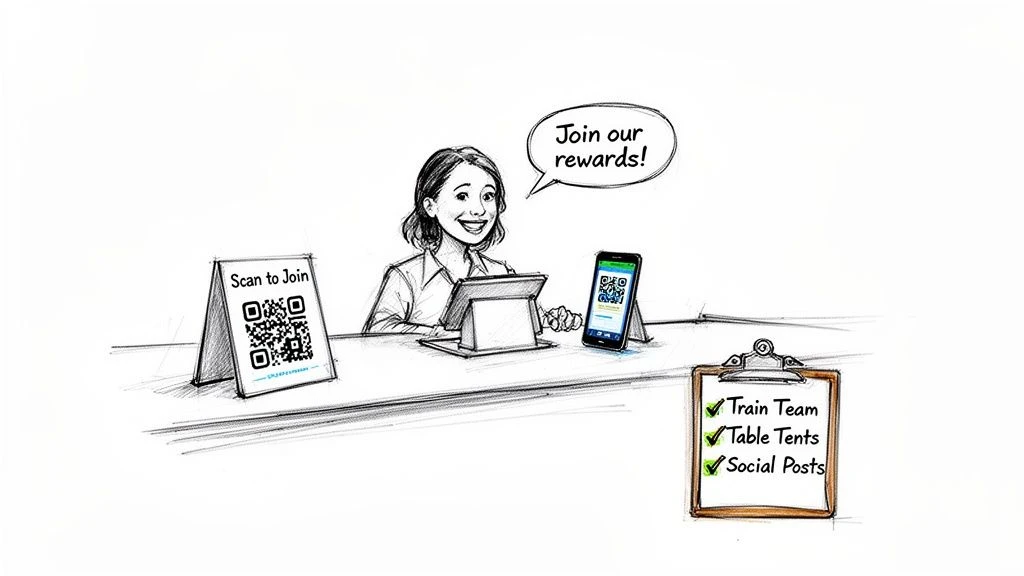
Empower Your Team to Be Program Champions
Your frontline staff are your most powerful promotional tool. They interact with every customer and have the perfect opportunity to introduce the program naturally. But they need to feel confident and equipped.
Effective team training is about simplicity, not memorizing robotic scripts. Arm them with a few key talking points that feel authentic.
Simple & Effective Checkout Scripts:
- For a Coffee Shop: "Are you on our rewards list yet? You get a point for every coffee, and your fifth one is free. Just scan this QR code to join!"
- For a Salon: "Before you go, do you want to join our VIP list? It's free, and you'll get 50 bonus points just for signing up today. It only takes a second!"
- For a Retail Boutique: "We just launched our new loyalty program. If you scan here, you can get 10% off your next purchase. Would you like to join?"
The goal is to frame it as an immediate benefit to the customer. When your team is enthusiastic, that energy is contagious.
Make It Impossible to Miss In-Store
Your physical location is prime real estate. You want customers to see the program, understand it, and sign up instantly. This is where simple, well-placed visual cues make all the difference.
Modern tools like BonusQR make this incredibly easy. Since the entire program runs off a single QR code, you can place it anywhere a customer might have a spare moment.
Low-Cost In-Store Promotional Ideas:
- Table Tents & Counter Signs: Place a small, eye-catching sign with the QR code and a clear call-to-action (e.g., "Scan to Earn Free Coffee!") right at the checkout counter or on every table.
- Stickers on Takeout Bags/Cups: Add a branded sticker with the QR code to your packaging. This catches their attention later, prompting them to sign up before their next visit.
- Receipt Footers: A small message and the QR code at the bottom of every printed receipt is an easy, no-cost win.
These tactics integrate the promotion into the natural flow of the customer's visit, making sign-up feel seamless.
Create Buzz with a Simple Social Media Push
You don't need a complex social media campaign. A few well-timed, engaging posts are all it takes to create excitement and inform your followers.
The focus should always be on clear, benefit-driven messaging. Show them what’s in it for them.
A successful launch isn't a one-day event; it's the beginning of an ongoing conversation with your customers. Keep the momentum going by celebrating members, highlighting rewards, and consistently reminding people how much you appreciate their loyalty.
Here’s a simple schedule you can adapt for your channels:
- The "Coming Soon" Teaser (3-5 days before launch): Post a simple graphic that says something like, "Something rewarding is coming..." to build anticipation.
- The Official Launch Day Announcement: Share a clear, exciting post explaining the program. Use a photo of your new in-store signage and spell out the benefits. Pin this post to the top of your profile for a week.
- The "How It Works" Follow-Up (2 days after launch): Post a short video or a simple carousel of images showing just how easy it is to scan the QR code and sign up. Keep it quick and to the point.
- The First Member Spotlight (1 week after launch): With their permission, feature a photo of your first customer to redeem a reward. This provides powerful social proof and shows the program in action.
This focused approach gets the message out without overwhelming your followers or your schedule.
Making Communication Personal to Drive Repeat Visits
A generic, one-size-fits-all message is a surefire way to get ignored. To build real loyalty, your communication must feel personal. It needs to show customers you see them as individuals, not just numbers on a spreadsheet.
This sounds complex, but it's simpler than you think. The key is to segment your members into a few powerful groups. This allows you to send the right message to the right person at the right time-transforming your marketing from a promotion into a helpful conversation.
Grouping Your Customers for Smarter Outreach
You don't need dozens of complicated categories. For most small businesses, three core segments will cover nearly every customer behavior, transforming your ability to send relevant offers that people act on.
Start with these three essential groups:
- New Members: Customers who have just signed up, typically after their first or second visit. Your goal is to make a killer second impression and bring them back quickly.
- Loyal Regulars: Your VIPs. They visit frequently, spend consistently, and are the lifeblood of your business. Your goal is to acknowledge their loyalty and make them feel special.
- At-Risk Customers: Members who used to visit regularly but haven't been back in a while (e.g., 60-90 days). Your goal is to proactively re-engage them with a compelling offer before they're gone for good.
With a tool like BonusQR, this segmentation is automated. The system tracks visit frequency, so you can easily identify who falls into each group without digging through spreadsheets, freeing you up to focus on crafting the perfect message.
Actionable Campaigns for Each Customer Group
Once segmented, you can create targeted campaigns that speak directly to their relationship with your business. Building genuinely strong relationships starts with understanding your customers; explore how cultivating empathy in customer service can deepen this connection.
Here are real-world examples to get you started:
Scenario 1: The Local Restaurant
- For New Members: A week after their first visit, an automated message says: "Thanks for joining us last week! Come back for dinner this week and enjoy a complimentary appetizer on us." This is a low-cost, high-value offer encouraging a quick return.
- For Loyal Regulars: An exclusive message like: "You're one of our best customers! As a thank you, get early access to our new seasonal menu this Friday before anyone else." The reward is status and exclusivity, not just a discount.
- For At-Risk Customers: If a regular hasn't visited in 60 days, a friendly nudge can work wonders: "We've missed you! Here’s a 15% off voucher for your next meal. We hope to see you soon!" This shows you noticed their absence and provides an incentive to return.
The power of personalization is undeniable. Research shows 48% of business leaders confirm that tailored outreach is a key factor in boosting retention. Furthermore, proactively following up can increase retention by 35%, and offering loyalty discounts can spike repeat visits by as much as 22-36%. Discover more insights about customer retention statistics on semrush.com.
Making Personalization Feel Effortless
This strategy might sound time-consuming, but the right platform makes it a "set it and forget it" process. With a solution like BonusQR, you can create automated campaigns based on customer behavior. You define the rules and write the messages; the system does the rest.
Scenario 2: The Retail Boutique
- For New Members: After their first purchase, send a message: "Welcome to the club! Thanks for shopping with us. Enjoy $10 off your next purchase of $50 or more." This encourages a larger second purchase.
- For Loyal Regulars: "As a thank you for being a VIP, we've added 100 bonus points to your account! Come treat yourself to something new." A surprise-and-delight tactic that builds an emotional connection.
- For At-Risk Customers: "Is your wardrobe missing something? It’s been a while! Here's a special 20% off just for you to come find your next favorite piece."
Personalized communication is the engine of an effective customer retention program. It moves your efforts from a passive points system to an active relationship-building tool, keeping your business top-of-mind.
Tracking Metrics That Actually Matter
So, your program is live. How do you know if it's actually working?
Getting a loyalty system running is one thing; proving its value is what really counts. You don't need a data science degree-you just need to focus on a few key metrics that show the real health of your customer relationships.
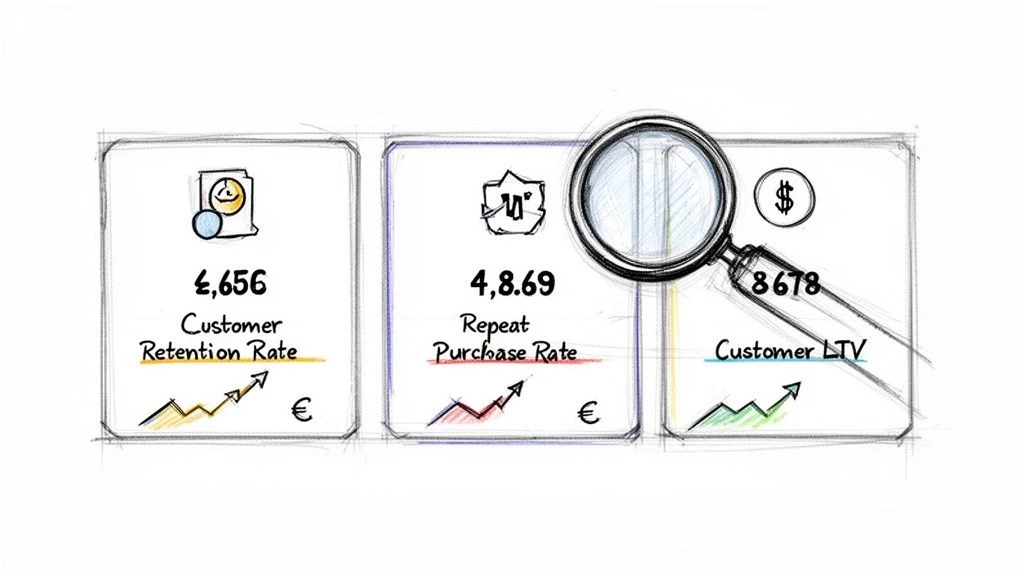
Watching these numbers is the clearest way to make smarter business decisions. It tells you what’s resonating with customers, what isn't, and where your biggest growth opportunities are hiding.
The Metrics That Move the Needle
Forget wading through dozens of confusing data points. For most small businesses, the success of your retention strategy can be measured with three powerful key performance indicators (KPIs). These numbers directly connect your loyalty efforts to your bottom line.
Key Loyalty Program KPIs and How to Track Them
This simple guide covers the essential metrics that provide a powerful snapshot of your program's performance.
| KPI (Key Performance Indicator) | What It Measures | Simple Calculation |
|---|---|---|
| Customer Retention Rate (CRR) | The percentage of customers who stick with you over a specific period. | [(Ending Customers - New Customers) / Starting Customers] x 100 |
| Repeat Purchase Rate (RPR) | How many of your customers come back to make a second purchase. | (Number of Return Customers / Total Customers) x 100 |
| Customer Lifetime Value (LTV) | The total revenue you can expect from a single customer over their entire relationship with you. | (Average Purchase Value) x (Purchases Per Year) x (Average Customer Lifespan) |
These aren't just abstract figures; they are direct measures of customer happiness and business stability. A rising LTV is one of the strongest signs that your program is creating real, long-term value.
Want to go deeper? Our guide on mastering customer retention metrics breaks these concepts down even further.
From Complex Formulas to Clear Dashboards
Let's be honest: calculating these metrics manually is a pain.
This is where a modern loyalty tool like BonusQR becomes indispensable. Instead of wrestling with spreadsheets, you get a simple, visual dashboard that presents this data in an easy-to-understand format.
You can instantly see the direct financial return of your efforts. Watch your repeat purchase rate climb after launching a new reward, or see your customer retention rate improve month-over-month.
Data is your best friend. It replaces guesswork with certainty and allows you to confidently invest your time and resources into strategies that are proven to work.
Understanding What 'Good' Looks Like
So, you have the numbers-but what do they mean?
While benchmarks vary by industry, the most important comparison is always against your own past performance. Is your retention rate higher this quarter than last? That’s a win.
For context, a good repeat purchase rate for an e-commerce store might be around 30%, while a local coffee shop would aim for much higher. The goal isn't to hit a magic number overnight but to see consistent, positive trends.
Ultimately, a strong customer retention program gives you control over your revenue. By tracking these core KPIs, you turn customer loyalty from a vague concept into a predictable, measurable engine for growth.
Still Have Questions? Let's Clear Things Up.
Launching a loyalty program for the first time can feel like a big step. As a small business owner, you need to know that any new initiative is a smart use of your limited time and money. It's natural to have questions.
Let's tackle the most common concerns I hear from owners just like you, so you can move forward with confidence.
What's This Actually Going to Cost Me?
A lot less than you think. Gone are the days of expensive plastic cards and clunky software. Modern digital solutions like BonusQR were built specifically for small business budgets. The monthly cost is often less than what you’d spend trying to acquire one or two new customers.
More importantly, you should view it as an investment, not a cost. A well-run program will pay for itself many times over by increasing visit frequency and customer lifetime value.
Will My Customers Even Bother With a Digital Program?
Absolutely. Nobody wants another paper punch card in their wallet. Your customers crave convenience. A QR code program is ridiculously easy; they just scan it with the phone that’s already in their hand.
The key to adoption is a frictionless sign-up (under 30 seconds) and a small, instant reward for joining. Customers are already accustomed to loyalty programs from big brands; when their favorite local spot offers an easy-to-use one, they genuinely appreciate it.
How Much Time Will I Spend Managing This Thing?
As a busy owner, your time is your most valuable asset. The right tool should save you time, not create another chore. Platforms like BonusQR are designed to be almost entirely automated.
Once you’ve set up your rewards, the system handles the rest-sign-ups, point tracking, and even sending automated messages to bring back at-risk customers. Your main job is simply encouraging your staff to mention it at checkout. The ongoing time commitment is minimal, but the payoff in loyalty is huge.
The purpose of a modern loyalty program isn't to add to your to-do list. It's to put customer retention on autopilot, building relationships and driving sales in the background so you can focus on running your business.
I'm on a Tight Budget. What Kind of Rewards Can I Offer?
Great rewards don't have to be expensive. The key is to offer things that have a high perceived value but a low actual cost to you. You're trying to make your customers feel special, and that emotional connection is often more powerful than a simple discount.
Here are a few budget-friendly ideas that work wonders:
- For a coffee shop: A free coffee is perfect. Your margin on it is high, so it costs you very little, but to a customer, it feels like a real treat.
- For a service business: Offer a complimentary add-on. A deep-conditioning treatment at a salon or a free product sample costs you next to nothing but adds significant value to their visit.
- For any business: Never underestimate non-monetary perks. "Skip-the-line" privileges or early access to a new product shipment can make your best customers feel like true VIPs without costing you a dime.
Starting a customer retention program is one of the single most effective things you can do to build a stable, profitable business. By getting these common questions answered, you can move forward with a clear plan and the right tools-like BonusQR-to turn first-time visitors into fans for life.


