
 Deutsch
 Español
 Français
 Italiano
 Magyar
 Polski
 Slovenčina
 Čeština
Losing a customer who already knows and trusts your business is one of the most avoidable costs in small business ownership. Yet most businesses focus their energy and budget on finding new customers rather than keeping the ones they already have. Research shows that acquiring new customers costs more than retaining existing ones, and that increasing retention by just 5% can boost profits by 25% to 95%. A clear, intentional retention workflow is the difference between customers who visit once and customers who come back, spend more, and tell their friends.
Key Takeaways
| Point | Details |
|---|---|
| Retention boosts profits | A small increase in retention rates can deliver substantial profit improvements for small businesses. |
| Preparation is critical | Clarifying tools, data, and goals before launching your workflow saves time and improves outcomes. |
| Simple wins | The most effective retention workflows are usually straightforward and easy for staff and customers to use. |
| Measure and adapt | Tracking key metrics and regularly refining your workflow leads to ongoing customer engagement and business growth. |
Why customer retention matters for your business
Customer retention is not just about warm feelings and loyalty points. It directly affects your bottom line in ways that new customer acquisition simply cannot match. When you retain existing customers, you spend less on marketing, reduce your sales cycle, and benefit from customers who already trust your products and services.

The benefits of customer retention go beyond repeat purchases. Loyal customers tend to spend more over time, are more forgiving of occasional mistakes, and are more likely to recommend your business to others. Word-of-mouth referrals from existing customers cost you nothing and often convert at a higher rate than paid advertising.
Here is what retention directly delivers for your business:
- Lower cost per sale: Existing customers already know your business, so you spend less time and money convincing them to buy.
- Higher average order value: Loyal customers trust you more and are more willing to try new products or upgrade to higher-priced options.
- Built-in advocacy: Satisfied repeat customers become vocal promoters of your brand, especially through online reviews and personal referrals.
- Competitive edge: Businesses with strong retention systems are harder to displace, even when competitors offer similar products at lower prices.
A 5% increase in retention can boost profits by 25% to 95%. That is not a marginal improvement. That is a fundamental shift in how profitable your business can be without adding a single new customer to your list.
“Retaining customers is not just about saving money. It is about building a business that grows steadily because its foundation of loyal buyers keeps expanding.”
With the high stakes made clear, let’s get practical about how to set your retention efforts up for success.
Preparing your retention workflow: Tools and requirements
Before you build anything, you need the right foundation. A retention workflow without proper data and tools behind it is just a series of good intentions. Proper preparation ensures your loyalty strategy is actionable and measurable from day one.
Here is what you need to gather and set up before you start building your workflow:
- Customer data: Collect and organize contact information, purchase history, visit frequency, and preferences. Even basic data like email addresses and purchase dates gives you a strong starting point.
- A platform or tool: Choose between a dedicated loyalty app, a point-of-sale system with built-in loyalty features, or a manual tracking method. Your choice depends on your business size and budget.
- Assigned responsibility: Designate a staff member or manager to own the retention program. Without clear ownership, workflows stall quickly.
- Defined KPIs: Know what success looks like before you start. Common metrics include repeat purchase rate, average visit frequency, and customer lifetime value.
| Requirement | What it means | Why it matters |
|---|---|---|
| Customer contact data | Emails, phone numbers, opt-in consent | Enables personalized outreach |
| Purchase history | Transaction records per customer | Drives targeted offers |
| Platform or tool | Loyalty app, POS, or spreadsheet | Automates or organizes workflow |
| Assigned staff role | Named person responsible for program | Ensures accountability |
| KPIs set in advance | Clear success metrics defined early | Measures real results |
Pro Tip: Start small. You do not need a perfect database or an enterprise platform to begin. Even tracking your top 20 repeat customers manually gives you enough data to test and refine your first retention workflow. Review actionable retention strategies to find the right starting approach for your business type.
Following loyalty stamp best practices can also be useful if your business model lends itself to physical or digital stamp-based rewards. The key principle is the same across formats: keep the program easy to understand and easy to use.
Step-by-step: Building your customer retention workflow
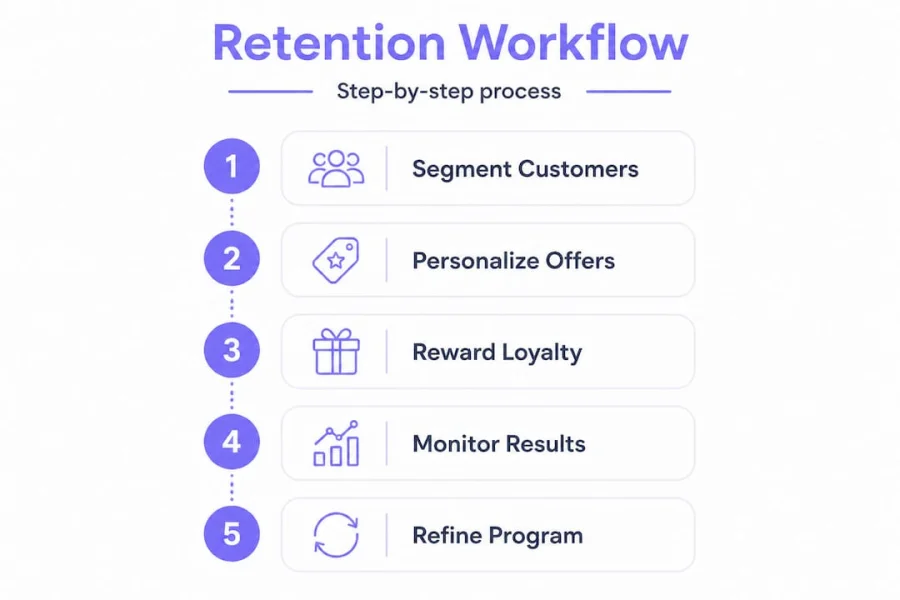
Armed with the right tools, you are now ready to create your step-by-step retention workflow. Automated retention workflows streamline loyalty efforts significantly for small and medium businesses, reducing the manual work involved in staying connected with customers.
Here is a practical numbered workflow you can follow:
-
Segment your customers. Divide your customer base into groups based on purchase behavior. For example, “loyal buyers” (purchased 3 or more times in the last 90 days), “lapsed customers” (no purchase in 60 to 90 days), and “new customers” (first purchase in the last 30 days). Each group needs a different message.
-
Map out your communication schedule. Decide when and how you will contact each segment. New customers might receive a welcome message within 24 hours of their first purchase. Loyal buyers might get an exclusive offer every 30 days. Lapsed customers receive a re-engagement offer at the 60-day mark.
-
Set milestone triggers. Automate messages or rewards tied to specific events. Birthdays, purchase anniversaries, and milestone spending thresholds (for example, reaching $200 in total purchases) are all proven triggers that drive engagement. You can learn more about building a workflow for loyalty program success that uses these triggers effectively.
-
Choose your reward types. Match rewards to your business model and customer preferences. Options include points redeemable for discounts, digital stamp cards for free products, cashback, exclusive coupons, or tiered membership benefits. See digital reward system examples for inspiration on what works across different business types.
-
Build in a feedback loop. Ask customers for input after key interactions. A simple one-question survey sent after a reward redemption gives you data to improve the program. Act on the feedback. Customers notice when their input leads to real changes.
-
Automate where you can. Once your workflow is mapped, use your chosen platform to automate loyalty campaigns so that emails, push notifications, and reward triggers run without manual effort every time.
| Feature | Basic workflow | Advanced workflow |
|---|---|---|
| Customer segmentation | Manual, 2 to 3 segments | Automated, dynamic segments |
| Communication | Email only, scheduled manually | Email, SMS, push notifications |
| Reward types | Single reward (e.g., stamp card) | Multi-tier points, coupons, gifts |
| Triggers | Time-based (monthly) | Behavior-based (purchases, visits) |
| Feedback collection | Occasional surveys | Automated post-interaction feedback |
| Analytics | Spreadsheet tracking | Real-time dashboard reporting |
Pro Tip: Do not try to build the advanced workflow on day one. A basic workflow that actually runs consistently beats a complex system that gets abandoned after two months.
Common mistakes and troubleshooting tips
Once your workflow is live, it is important to watch for common pitfalls. Even well-designed programs can lose steam if these issues go unaddressed.
Here are the most frequent mistakes small business owners make with retention workflows:
- Overcomplicating the reward structure. If customers cannot quickly understand how to earn or redeem rewards, they disengage. Keep the value exchange clear. “Spend $10, earn 1 point, redeem 10 points for $5 off” is simple. A tiered structure with five levels, expiring points, and category restrictions is not.
- Skipping onboarding communication. Many businesses set up a loyalty program and then fail to tell customers about it properly. Your onboarding message should explain the program in plain language and show the customer exactly what they stand to gain.
- Ignoring results. Launching a workflow without reviewing the data is like driving without looking at the road. Check your KPIs monthly, at minimum. Monitoring and adapting retention efforts consistently is what drives ongoing success.
- Letting the program go stale. A program that never changes loses customer interest. Introduce seasonal promotions, limited-time bonus point events, or new reward options to keep things fresh.
- Failing to act on feedback. Collecting customer feedback and not using it sends the message that their opinion doesn’t matter. Even a small change based on a common complaint shows customers you are listening.
“The programs that fail are rarely the ones with bad ideas. They are the ones where no one took ownership after launch.”
Pro Tip: Before rolling out your retention workflow to all customers, test it internally with your team. Have staff sign up as mock customers, complete a purchase, and follow the workflow through to reward redemption. You will catch friction points before real customers experience them.
For businesses looking to go beyond the basics, explore proven customer retention approaches that address the full customer lifecycle from acquisition through to long-term loyalty.
What success looks like: Measuring and optimizing your workflow
With your workflow running and common errors addressed, you will want to measure success and continually improve. Improved retention delivers measurable profit increases for small and medium businesses, but only if you are tracking the right numbers.
Focus on these core metrics:
- Repeat purchase rate: What percentage of customers make a second purchase within 90 days? A rising repeat rate is the clearest signal your workflow is working.
- Customer lifetime value (CLV): How much does an average customer spend with you over their full relationship with your business? CLV growth means you are deepening relationships, not just generating one-time sales.
- Customer churn rate: What percentage of active customers stop buying in a given period? A declining churn rate means your retention efforts are having real impact.
- Reward redemption rate: Are customers actually using their rewards? Low redemption often signals that the reward isn’t compelling or the process is too complicated.
| Metric | What to measure | Review frequency |
|---|---|---|
| Repeat purchase rate | % of customers who buy again within 90 days | Monthly |
| Customer lifetime value | Total spend per customer over their relationship | Quarterly |
| Churn rate | % of active customers lost in a period | Monthly |
| Reward redemption rate | % of earned rewards actually redeemed | Monthly |
| Net Promoter Score | Customer likelihood to recommend your business | Quarterly |
Set a review schedule and stick to it. Monthly reviews catch small issues before they become large problems. Quarterly reviews give you enough data to see meaningful trends and make program-level decisions.
Pro Tip: Ask customers directly what they think of your loyalty program. A short survey with two or three questions, sent after a reward redemption, often reveals insights your analytics alone cannot show. Learn from service retention strategies that combine data tracking with genuine customer conversations for the best results.
The overlooked step: Workflow simplicity wins
Here is a perspective that runs counter to what most loyalty program guides will tell you: more features do not equal better results. In fact, the most common reason retention workflows underperform is not that they are too basic. It is that they are too complicated.
When businesses add tier after tier, stack multiple reward types, attach expiry conditions, and layer in category restrictions, they create a program that even motivated customers find confusing. Confusion kills engagement. And once a customer loses track of where their points stand or how to redeem a reward, they stop trying.
The danger of what is often called “feature creep” is real. A business starts with a clean stamp card idea, then adds points because a competitor has them, then adds a VIP tier because it sounds appealing, and before long the program has become something the staff themselves cannot explain in 30 seconds. If your team needs a training session to describe the program, your customers will never fully engage with it.
The businesses we see get the best results from retention workflows are the ones that do three things consistently: they make the reward obvious, they make the path to earning it short and clear, and they communicate it in plain language. Transparency builds trust. Ease of use drives participation. Clarity creates loyalty.
Review simple retention strategies that prioritize ease of use over complexity. The businesses that run clean, well-communicated programs consistently outperform those running overcomplicated systems with higher “feature counts.” Simplicity is not a limitation. It is a competitive advantage.
Next steps: Automate and enhance your program with BonusQR
You now have a clear roadmap for building a retention workflow that drives repeat business and measurable profit. The next step is putting the right tools behind it.
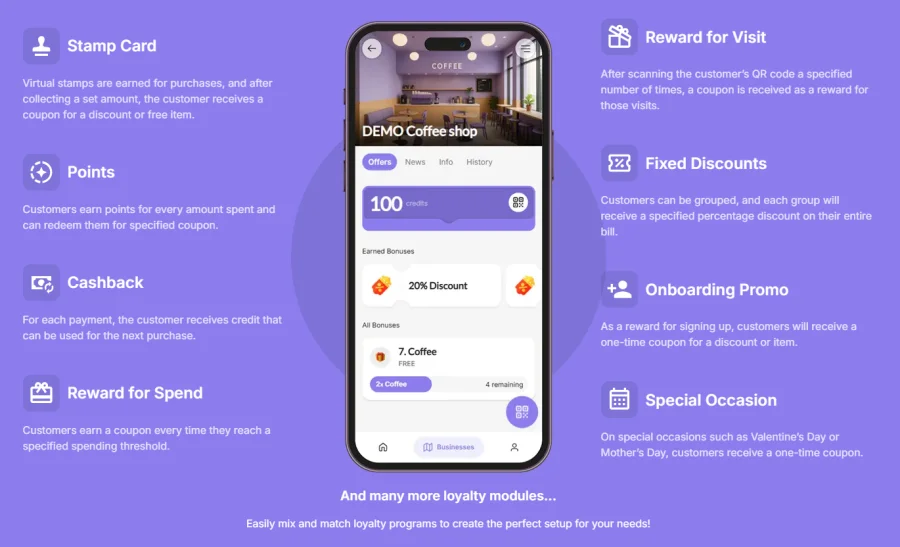
BonusQR gives small and medium businesses a fast, flexible way to build and manage loyalty programs without requiring a complex technical setup. From the full range of loyalty system features including stamp cards, cashback, and push notifications, to a purpose-built points system that automates reward tracking, BonusQR lets you focus on running your business while your retention workflow runs in the background. You can launch a program, segment your customers, set milestone triggers, and review real-time analytics all from one platform. Start with a free plan and scale as your program grows.
Frequently asked questions
What is a customer retention workflow?
A customer retention workflow is a step-by-step process for keeping existing customers engaged and encouraging repeat business through personal touches, rewards, and consistent communication. Research shows that retention improvements as small as 5% can generate profit growth of 25% to 95%.
How do loyalty programs fit into a customer retention workflow?
Loyalty programs provide rewards and recognition that give customers a concrete reason to return, making them one of the most effective components of any retention workflow. Since acquiring new customers costs more than keeping existing ones, loyalty programs deliver strong return on investment when designed well.
How do I measure the effectiveness of my retention workflow?
Track repeat purchase rate, customer lifetime value, and churn rate as your primary indicators of workflow effectiveness. Measurable profit increases become visible within a few months of consistent tracking and program optimization.
What is the most common mistake in customer retention workflows?
The most common mistake is building a program that is too complicated for customers to understand or use consistently. Monitoring and adapting your program based on real customer behavior is what keeps your workflow effective over time.