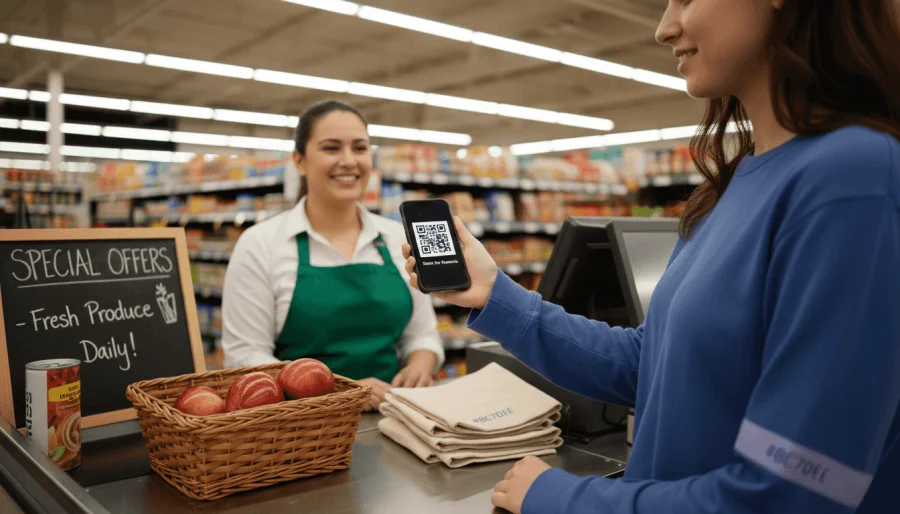
Customer loyalty is no longer just about paper punch cards. For North American grocery store managers tasked with staying competitive, loyalty apps can transform the shopping experience while encouraging customers to return. With a well-designed app, you deliver instant rewards, personalized offers, and real-time updates—right to your shoppers’ phones. In this article, discover how a digital tool streamlines loyalty programs and helps your store build lasting connections that drive measurable results.
Defining Grocery Store Loyalty Apps
A grocery store loyalty app is a digital tool that transforms how your store builds customer relationships and encourages repeat purchases. These apps deliver the same marketing principles as traditional loyalty programs, but with the power of mobile technology and real-time data behind them.
At their core, loyalty programs integrate marketing strategies designed to manage and deepen retailer-customer relationships. Your app automates this process, turning it into a seamless experience your customers access directly from their phones.
How They Work
A loyalty app sits between your point-of-sale system and your customers’ pockets. When a customer enrolls and makes a purchase, the app tracks their transactions and rewards them instantly—without fumbling through physical cards or receipts.
Here’s what happens behind the scenes:
- Customers download your branded app or access it through a digital platform
- They earn points, stamps, or rewards on every qualifying purchase
- The app displays real-time balances, exclusive offers, and personalized discounts
- You collect valuable customer data to understand shopping patterns and preferences
Unlike paper-based programs, digital loyalty apps create sustained engagement through push notifications, in-app messaging, and targeted promotions.
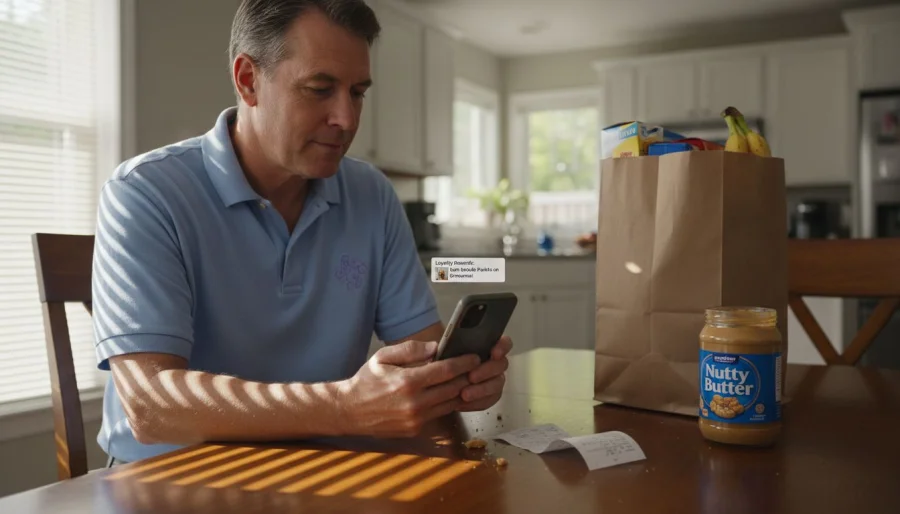
Key Functions Your App Provides
Modern grocery loyalty apps combine several core features to drive customer retention:
- Points collection systems that reward purchases automatically
- Digital coupon distribution targeted to individual customers
- Exclusive member-only discounts and early access to sales
- Tiered rewards that incentivize higher spending and frequency
- Real-time redemption tracking and balance visibility
- Mobile-first design for convenient shopping experiences
Loyalty programs offer strategic incentives like discounts and rewards points to encourage repeat business and build emotional customer connections.
Why This Matters for Your Store
A loyalty app isn’t just about giving discounts. It’s about building competitive advantage through customer data and personalization. When you understand what your customers buy, when they buy it, and how often they shop, you can tailor offers that actually resonate.
Your app becomes a direct communication channel. Instead of hoping customers see a store flyer, you send push notifications to their phones with deals they actually want. That’s infinitely more effective than traditional marketing.
The data flows both ways too. Your customers see instant gratification—points accumulating, rewards earned, exclusive member prices—while you gain insights into purchasing behavior that inform inventory, merchandising, and marketing decisions.
The Bottom Line
Grocery store loyalty apps are digital marketing engines that replace outdated punch cards with intelligent, mobile-first systems. They make your customers feel valued while giving you the data needed to compete in today’s retail environment.
Pro tip: Start with your core loyalty mechanics—points or stamp-based rewards work best—before adding complexity like tiered benefits or special occasion offers.
Types of Loyalty App Structures and Rewards
Your grocery store loyalty app needs a clear reward structure to drive purchases and keep customers engaged. The structure you choose determines how customers earn, what they get, and how often they come back.
There’s no one-size-fits-all answer. Different structures work better for different stores, customer bases, and business goals. The key is understanding what each structure offers and which aligns with your strategy.
Common Loyalty Program Structures
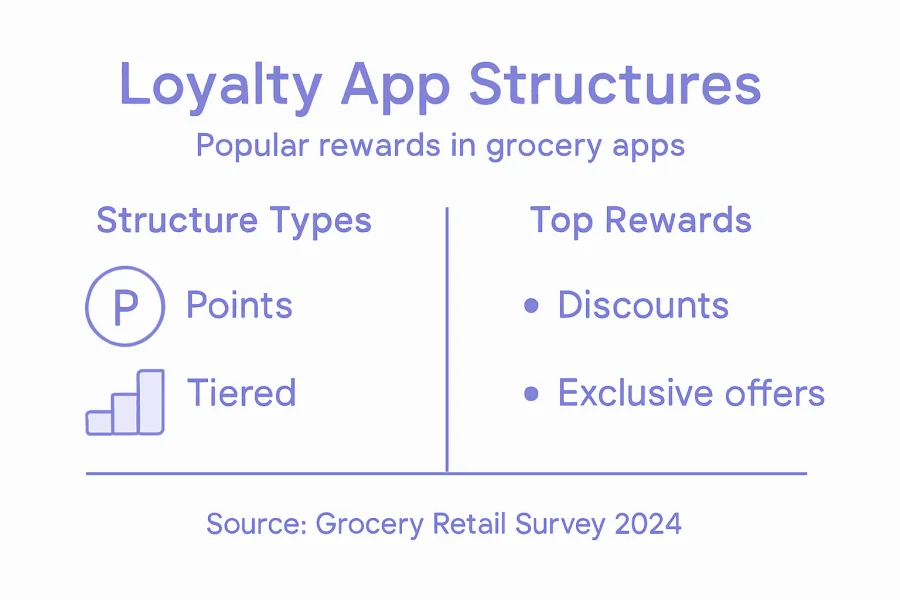
Loyalty programs vary widely in their reward content, delivery mechanisms, and customer engagement approaches. Your app can implement any of these core structures:
- Points-based systems: Customers earn points per dollar spent and redeem them for rewards
- Tiered programs: Rewards increase as customers reach higher spending levels or visit thresholds
- Cashback programs: Direct percentage returns on purchases deposited to accounts or applied at checkout
- Coalition programs: Multiple retailers share a single loyalty platform for cross-shopping benefits
- Stamp card systems: Digital versions of punch cards where customers collect stamps toward free items
Each structure influences purchase behavior differently. Points systems work well for frequent shoppers who enjoy seeing accumulation. Tiered programs motivate customers to spend more to reach the next level. Cashback appeals to price-conscious customers who want immediate value.
Below is a comparison of common grocery loyalty program structures and their typical business impact:
| Structure Type | Appeal for Customers | Business Benefit | Example Reward Mechanism |
|---|---|---|---|
| Points-Based | Frequent shoppers | Drives repeat visits | Redeem points for free groceries |
| Tiered | Status-oriented customers | Increases overall spend | Gold, Silver, Bronze reward levels |
| Cashback | Value-seekers | Boosts transaction frequency | % cashback per qualifying purchase |
| Coalition | Multi-store shoppers | Expands customer base | Earn points at all partners |
| Stamp Card | Occasional buyers | Promotes category loyalty | Free item after X purchases |
Reward Types That Actually Drive Sales
What you offer matters as much as how you structure it. Customers respond to both monetary and non-monetary rewards depending on your customer base.
Multi-level rewards and personalized offers keep customers engaged across multiple shopping trips. Consider combining several reward types:
- Points redeemable for discounts or free items
- Exclusive member-only pricing on specific products
- Birthday rewards or anniversary bonuses
- Double-points days on select items or times
- Free products after reaching point thresholds
- Early access to sales or new products
The most effective loyalty apps don’t just offer discounts—they create personalized experiences that adjust to each customer’s shopping patterns and preferences.
Hybrid Approaches Win
Many successful grocery stores combine structures to appeal to different customer segments. A hybrid approach might stack points with tiered benefits plus occasional cashback offers.
Your app can deliver innovative loyalty schemes that blend multiple reward types. This flexibility lets you test what resonates with your customers without completely overhauling your program.
You might offer base points earning on everything, bonus points on select categories, and exclusive member discounts on top. New customers see accessibility; loyal customers feel recognized with elevated benefits.
Gamification Drives Engagement
Adding game-like elements keeps your app top-of-mind. Challenges, streaks, and achievement badges turn shopping into something more engaging than a simple transaction.
Consider adding simple gamification:
- “Shop 10 times this month for a bonus reward”
- “Spend $50 in produce to unlock a special offer”
- “Complete your collection” of items for exclusive deals
Pro tip: Start with one simple reward structure—points or tiered benefits—and add complexity only after tracking what your customers actually use and respond to.
Must-Have Features for Grocery Retailers
Not all loyalty apps are created equal. Your grocery store needs specific features to actually drive sales, retain customers, and make your team’s lives easier. Without these core capabilities, your app becomes abandoned software instead of a revenue tool.
The features you choose directly impact adoption rates, customer engagement, and your ability to compete. A clunky app with missing features will sit unused on customers’ phones while a well-designed one becomes a shopping companion they check before every trip.
Core Features Every Grocery App Needs
Start with the non-negotiables. These features form the foundation of any effective loyalty system:
- Real-time point tracking: Customers see balances update instantly after purchases
- Easy enrollment: Quick signup without friction—QR code, email, or phone number only
- Mobile-first design: Fast loading, intuitive navigation, works on older phones
- Secure payment integration: Safe redemption and payment processing your customers trust
- Push notification capability: Send timely offers without overwhelming customers
- Barcode or QR code scanning: Quick point capture at checkout without POS integration
- Personalized offer display: Show relevant deals based on purchase history
These aren’t nice-to-haves. They’re the baseline your grocery store needs to compete.
Features That Drive Repeat Visits
Effective customer engagement strategies keep shoppers coming back consistently. Go beyond basic points with:
- Exclusive member pricing: Discounts visible only to app users
- Time-limited flash offers: Special deals that create urgency
- Category-specific bonuses: Double points on rotating departments
- Milestone rewards: Free items at 100 points, 250 points, 500 points
- Birthday and anniversary rewards: Personal recognition builds loyalty
- Referral incentives: Bonuses when members invite friends
These features transform casual shoppers into loyal regulars. When customers feel recognized and rewarded, they choose your store over competitors.
Backend Features Your Team Needs
A great app isn’t just customer-facing. Your staff and management need robust tools to run the program successfully:
- Real-time analytics dashboard: See sales, redemptions, and customer engagement instantly
- Segmentation capabilities: Target offers to specific customer groups
- Automated campaign scheduling: Set promotions and let them run without manual effort
- Inventory integration: Automatically adjust offers based on stock levels
- Staff management tools: Control permissions and access levels for team members
- Customer data security: Compliance with data protection regulations
The best loyalty apps balance customer experience with operational efficiency—they make shopping easier while making your job simpler.
Performance and Reliability Matters
Your app needs to work when customers need it most—during busy shopping hours when your store is packed. Slow apps frustrate customers and lose sales.
Look for apps with 99% uptime guarantees, fast load times under 2 seconds, and the ability to handle peak traffic without slowdowns. Your app should work offline too, so customers can still see their balances even with weak connectivity.
Test performance on older smartphones and slower connections. Your customer base probably includes people without the latest iPhone, and you need to serve them too.
Integration Flexibility
Your loyalty app should work with your existing systems, not force you to replace everything. Look for solutions that offer flexible integration—some work with your current point-of-sale system, while others operate independently with QR codes or barcodes.
This flexibility matters because ripping out existing technology is expensive and disruptive. A good app adapts to your infrastructure, not the other way around.
Pro tip: Prioritize the features your customers actually need first—real-time tracking and easy enrollment—before adding complexity like tiered rewards or gamification.
Setup Challenges and Pitfalls to Avoid
Launching a loyalty app without planning leads to wasted money and frustrated customers. Most grocery store managers don’t realize the common mistakes that sink loyalty programs before they gain traction. Learning what to avoid saves you time, budget, and customer trust.
The difference between a thriving program and a failed one often comes down to avoiding predictable pitfalls during setup. Your app won’t succeed on features alone—strategy matters just as much.
The Complexity Trap
Overly complex program rules are one of the biggest setup mistakes. When customers can’t understand how to earn or redeem rewards, they simply don’t participate. A program that’s too complicated becomes a dead feature on your app.
Simplicity wins. Customers should understand your program in under 30 seconds. If they need a flowchart or FAQ to figure out how points work, you’ve made it too complicated.
Common complexity mistakes include:
- Too many earning categories with different point values
- Rewards that expire or have hidden requirements
- Tier systems with unclear progression paths
- Redemption options that are confusing or limited
- Special rules for specific products or times
Start with one clear rule: “Earn 1 point per dollar spent.” Everything else is optional.
Ignoring Your Customer Base
You might love a feature that your actual customers don’t care about. Strategic planning requires understanding customer preferences before building your program. Skipping this step wastes development resources and customer attention.
Spend time learning what your customers actually want. Do surveys, ask staff what questions they get, check your sales data. Your gym-goer demographic likely has different needs than your weekend family shoppers.
Common mistakes from ignoring customer needs:
- Emphasizing mobile-only access when many customers prefer in-store
- Offering rewards customers don’t want
- Requiring too much personal data for enrollment
- Making the signup process too long or complicated
Data Security and Privacy Failures
Customers share personal information with your app. Weak security or poor privacy practices destroy trust instantly. A data breach doesn’t just hurt customers—it tanks your loyalty program’s credibility.
Make security non-negotiable from day one. Your app needs secure payment processing, encrypted customer data, and clear privacy policies. Don’t store payment information unnecessarily. Follow industry standards like PCI compliance.
Tell customers how their data gets used. Transparency builds trust. Hidden data practices breed suspicion.
The fastest way to kill a loyalty program is to mishandle customer data or make enrollment feel intrusive.
Poor Communication Strategy
You can’t launch and assume customers will flock to your app. Clear, consistent communication about how the program works is essential. Most managers underestimate how much education customers need.
Plan your rollout communication:
- In-store signage explaining the program
- Staff training so they can answer questions
- Email or text to existing customers with enrollment details
- Follow-up reminders at checkout for 2-3 months
- Ongoing app notifications about new rewards
Without communication, adoption stays low and you’ll question whether your program works.
Technical and Integration Problems
Choosing technology that doesn’t work with your existing systems creates friction for staff and customers. Integration failures slow checkout, frustrate employees, and damage the customer experience.
Test your app thoroughly before launch. Work with your point-of-sale system, test enrollment flows, verify point calculations. Don’t go live on a Friday—that’s when you need support most if something breaks.
Pro tip: Define clear program objectives and success metrics before building anything—knowing whether you’re optimizing for customer acquisition, spending increase, or frequency helps you avoid feature creep.
Maximizing Engagement and Measurable Results
Having a loyalty app isn’t enough. You need to actively drive engagement and track results to prove the program works. Without measurement, you’re spending money blind and can’t improve what isn’t working.
Engagement directly impacts sales. A dormant app generates zero revenue. An engaged customer base drives incremental purchases, higher frequency, and better margins. The difference comes down to intentional strategy and consistent optimization.
Design for Personalization
Sophisticated program design emphasizing personalization is essential for meaningful engagement. Generic offers don’t stick. Customers respond when your app shows deals tailored to what they actually buy.
Use purchase history to inform offer selection. If a customer consistently buys organic produce, show them organic promotions. When someone regularly buys frozen dinners, offer relevant deals there. Personalization increases redemption rates by 200-300% compared to generic offers.
Implement these personalization tactics:
- Show different home screens based on purchase patterns
- Recommend products purchased before at discounted prices
- Send category-specific offers to relevant customer segments
- Birthday rewards tied to favorite product categories
- Time-limited offers on items customers buy frequently
Keep Rewards Fresh and Relevant
Stale rewards kill engagement. If your app shows the same offers month after month, customers stop checking. Regular refresh keeps the program feeling alive and worth opening.
Rotate offers every 2-3 weeks. Change featured categories. Introduce limited-time deals that create urgency. New rewards give customers reasons to open the app and engage with your store instead of competitors.
Create excitement:
- Monthly featured categories with bonus points
- Weekly flash deals visible only in the app
- Seasonal promotions tied to holidays or events
- Customer appreciation weeks with increased rewards
- New product introductions with launch-week bonuses
Real engagement comes from customers feeling like your app offers genuine value, not just recycled discounts they see everywhere else.
Measure What Actually Matters
You need concrete metrics to evaluate success. Tracking retention, incremental sales, and customer lifetime value tells you whether the program drives profitability. Vanity metrics like downloads don’t tell you anything useful.
Focus on these core metrics:
- Enrollment rate: Percentage of customers actively using the app
- Monthly active users: How many customers engage at least monthly
- Redemption rate: What percentage of issued offers get redeemed
- Incremental sales: Sales attributable to loyalty program members versus non-members
- Customer retention: Whether members shop more frequently than non-members
- Lifetime value: Total spending per member over 12 months
- Cost per acquisition: What you spend acquiring each loyalty member
Track these numbers monthly. They show which tactics work and where to invest optimization efforts.
Here’s a quick reference for key metrics to gauge grocery loyalty app success:
| Metric | What It Measures | Why It Matters |
|---|---|---|
| Enrollment Rate | % of shoppers enrolled | Indicates program attractiveness |
| Monthly Active Users | Active app users per month | Reflects ongoing engagement |
| Redemption Rate | Offers used vs. offered | Shows relevance of rewards |
| Incremental Sales | Revenue from members | Tracks direct program impact |
| Customer Lifetime Value | Total annual spend per user | Guides ROI and retention strategy |
Use Data to Drive Improvements
Data without action is worthless. Review your metrics monthly and adjust accordingly. If redemption rates are low, offers are too complicated or irrelevant. If retention drops, engagement strategy needs refreshing.
Test changes systematically. Implement one change at a time so you know what actually impacts results. Maybe different offer timing works better. Maybe shorter expiration dates drive more redemptions. Data shows the answer.
Actually use customer engagement measurement to improve continuously. Small optimizations compound into major results over quarters and years.
Pro tip: Set baseline metrics before launching, then track them religiously—your first three months establish whether the program drives real incremental sales or just shifts existing sales around.
Unlock the Full Potential of Your Grocery Store Loyalty Program
Are you ready to turn the insights from “Role of Loyalty Apps in Grocery Stores Today” into real business growth? The article highlights challenges like program complexity, poor customer engagement, and lack of personalization that can hold your loyalty app back. BonusQR’s customizable platform addresses these pain points directly by offering flexible program modules such as points collection, digital stamp cards, cashback options, and tailored coupons. Our solutions help simplify your loyalty mechanics while delivering personalized rewards that keep your customers coming back.
Experience seamless onboarding with rapid setup and no POS integration required. Enjoy robust features like real-time analytics, push notifications, and branding customization that empower you to communicate effectively and optimize engagement. Start building an intelligent, mobile-first loyalty system designed to increase retention and sales by visiting bonusqr.com. Don’t wait—transform your grocery store’s customer loyalty strategy today with BonusQR’s loyalty program solutions. Your next loyal customer is just one click away.
Frequently Asked Questions
What are grocery store loyalty apps?
Grocery store loyalty apps are digital tools that help retailers build customer relationships and encourage repeat purchases. They automate traditional loyalty programs using mobile technology to track customer transactions and rewards in real-time.
How do grocery loyalty apps work?
When customers enroll in a loyalty app and make purchases, the app tracks their transactions automatically. They earn points, stamps, or rewards without the need for physical cards, and can view real-time balances and personalized offers directly from their smartphones.
What types of rewards can customers earn through loyalty apps?
Customers can earn various rewards, including points redeemable for discounts, exclusive member-only pricing, cashback on purchases, and tiered rewards based on spending. Loyalty apps may also offer personalized offers and special bonuses for birthdays or anniversaries.
What features should I look for in a grocery loyalty app?
Key features to consider include real-time point tracking, easy enrollment options, a mobile-friendly design, secure payment integration, and the ability to send push notifications for timely offers. It’s also important to have a user-friendly interface that keeps customers engaged.
Recommended
- Loyalty application for Grocery store | BonusQR
- Top Grocery Loyalty Programs to Boost Customer Retention | BonusQR
- 12 Best Retail Loyalty Programs to Watch in 2025 | BonusQR
- Loyalty application for Retail | BonusQR
- Boosting App Engagement with Rewards
- Loyalty Pass Directory: klantenkaarten gebruiken zonder gedoe test - AlexandervanDijl.nl - Bel 020 262 1789


