You pour your heart into your business-the friendly chat at the counter, the perfect cup of coffee, the haircut that makes someone’s day. You feel the connection with your regulars, but you can't put a number on it. This creates a huge problem: without knowing what truly keeps customers coming back, you're forced to make marketing decisions based on guesswork, not data.
The core challenge for small business owners isn't a lack of passion; it's the lack of a simple, affordable way to see which customers are truly loyal and why. You're left wondering: "Are my efforts actually working, or am I just spinning my wheels?"
This guide cuts through the noise. We'll show you exactly how to measure customer engagement using simple, actionable metrics that directly impact your bottom line-no data science degree required.
Your Customers Are Talking-Are You Listening?
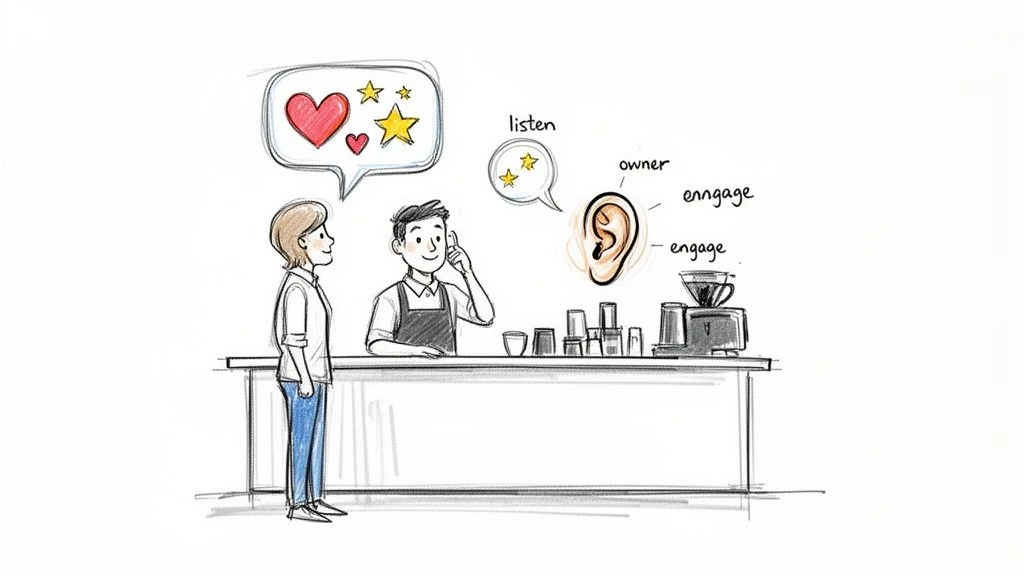
You know your business inside and out. Success is built on the daily relationships you forge-the personalized service that makes someone feel seen and the consistent quality that has them planning their next visit before they've even left. You create these moments every single day.
But here’s the tough part every passionate owner runs into: you know that connection is there, but you can’t measure it. Traditional methods seem too complex, too expensive, or just another task on a to-do list that's already a mile long. You're left wondering if your hard work is paying off or if you're just running on gut feelings.
The Challenge of Flying Blind
That feeling of uncertainty is more than just frustrating-it’s a genuine roadblock to growth. When you can’t clearly see who your most loyal customers are or what keeps them coming back, making confident decisions becomes a guessing game. How do you know which marketing efforts are working? How do you reward your best customers?
This guide is here to change that. We're going to show you how to measure customer engagement with simple, practical steps designed for businesses like yours-restaurants, coffee shops, and salons.
Your goal isn't to become a data analyst; it's to get clear answers to simple questions: "Who are my best customers?" and "What keeps them coming back?"
This isn't about getting lost in spreadsheets or expensive software. It's about using smart, cost-effective methods to listen to what your customers' actions are telling you. For a deeper dive, our complete growth guide on customer engagement is a great next step.
Picking the Engagement Metrics That Actually Matter
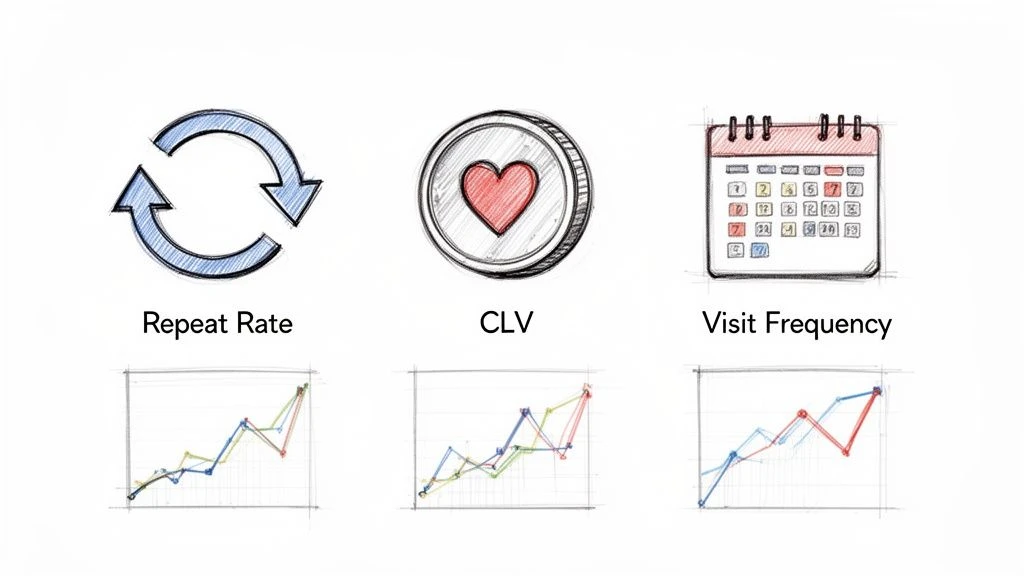
Before you can measure anything, you must decide what’s worth your attention. It’s easy to get lost in a sea of "vanity metrics" like social media likes. They might feel good, but they don't pay the bills or tell you if you're building a loyal community.
For a local business, the real story of your success is told through a few powerful numbers that directly reflect customer loyalty and business health. While you can explore what social media engagement entails, our focus here is on the metrics that directly impact your revenue.
The goal isn't to track everything; it's to track the right things. Let’s zero in on the key performance indicators (KPIs) that truly move the needle.
Key Engagement Metrics for Small Businesses
Here’s a scannable guide to the most important engagement KPIs for a brick-and-mortar business. These are the numbers that tell the real story.
| Metric | What It Measures | Why It's Critical for You |
|---|---|---|
| Repeat Purchase Rate | The percentage of customers who return for a second purchase. | This is the clearest sign of a great first impression and a happy customer. |
| Customer Lifetime Value (CLV) | The total profit you can expect from a single customer over time. | It shows you who your VIPs are and highlights the long-term health of your business. |
| Visit Frequency | How often a customer visits in a given period (e.g., weekly, monthly). | High frequency means your business is becoming a regular part of your customers' routine. |
Ultimately, these metrics paint a much clearer picture of your business's health than any social media dashboard ever could.
Focus on What Really Counts: Repeat Business
The ultimate sign of an engaged customer? They come back. It's that simple. Instead of getting bogged down in complex analytics, focus your energy on metrics that answer one crucial question: "Are my customers returning?"
Here’s what you should be watching:
- Repeat Purchase Rate: This is your most straightforward indicator of loyalty. If they loved their first experience, they'll be back. It's proof that you're doing something right.
- Customer Lifetime Value (CLV): This predicts the total revenue you can expect from a single customer. A high CLV means your customers aren't just returning-they're becoming more valuable over time.
- Visit Frequency: How often does someone pop into your shop? For a coffee joint, a customer who visits three times a week is infinitely more engaged than someone who stops by once a month.
Key Takeaway: Measuring these three core metrics gives you a direct line of sight into the health of your customer relationships. They tell a story of loyalty that social media likes simply can't.
A Coffee Shop Scenario in Action
Imagine you own a small coffee shop and launch a simple digital loyalty program like BonusQR. Instead of hoping it works, you focus on one thing: your Repeat Purchase Rate. You track how many new customers who signed up in the first week came back for a second coffee within 30 days.
That single measurement gives you powerful insight. You’re not just counting stamps on a card; you’re seeing tangible proof of loyalty.
And it works. Gamified loyalty programs can boost repeat purchases by up to 40%. For your coffee shop, this means every QR code scanned is an investment in turning a one-time visitor into a regular.
By focusing on these practical numbers, you can begin to understand your business on a much deeper level. In fact, learning how to calculate customer retention rate is a natural next step in this journey. This is how you start making decisions based on real customer behavior, not just guesswork.
Simple Tools for Tracking Engagement Without Breaking the Bank
Knowing what to measure is one thing, but how is the real question for a busy owner. The good news? You don't need a data science degree or a massive budget. The right tools can do the heavy lifting for you.
You probably already have one of the most powerful tools at your fingertips: your Point of Sale (POS) system. Most modern POS systems can track purchase histories. If you attach a name to each order, you can start to manually spot your regulars. It takes effort, but it's a solid first step.
Automate Your Insights with a Digital Loyalty App
Let’s be honest, manually digging through POS data is a grind. It’s slow, and it's easy to miss things. This is where a simple, effective digital loyalty app like BonusQR becomes your best friend. It’s built to automate the entire process for you.
- See Repeat Visits in Real-Time: The app logs every visit automatically. No more guesswork-you'll see precisely how often each person returns.
- Track Spending Habits: Finally understand what your most loyal customers love to buy.
- Instantly Identify Your VIPs: The system flags your top customers, so you can give them a little extra love.
With BonusQR, everything is on a clean, simple dashboard, giving you an at-a-glance view of customer engagement. No spreadsheets required. It's the most cost-effective way to get enterprise-level insights. When you're ready, you can explore the best loyalty apps for small businesses in 2025 to see how different platforms stack up.
Go Beyond Transactions with Direct Feedback
Transaction data tells you what your customers are doing, but hearing from them directly tells you why. Combining these gives you a 360-degree view of your business. Gathering feedback doesn't have to be complicated.
By combining sales data with customer sentiment, you stop just tracking numbers and start understanding the stories behind them. This is where truly actionable insights are born.
One of the easiest ways to do this is with QR-code surveys. Place a small sign at your counter or print a QR code on your receipts. Link it to a quick, one- or two-question survey. A salon, for instance, could ask, "How likely are you to recommend us to a friend?" This one question gives you your Net Promoter Score (NPS), a gold-standard metric for customer loyalty.
Putting Your Measurement Plan Into Action
This is your game plan for creating a simple, repeatable process to measure customer engagement-and turn those insights into your next big win.
Getting Started: Launch and Collect
Your first move is to flip the switch on your tracking tools. The best way to do this is to automate it. Setting up a digital loyalty program like BonusQR takes minutes and starts gathering crucial data for you immediately.
Once you’re live, be patient. Let the data roll in before you spot patterns.
- Pick a timeframe: Commit to collecting data for a set window, like 30 or 60 days. This gives you a solid baseline.
- Stay consistent: During this time, make it a habit to invite every customer to join your program. More data tells a clearer story.
Think of this as pure observation. Resist the urge to draw conclusions after just a few days.
This is where all your data streams-POS transactions, loyalty app scans, and direct feedback-start to merge and paint a complete picture.
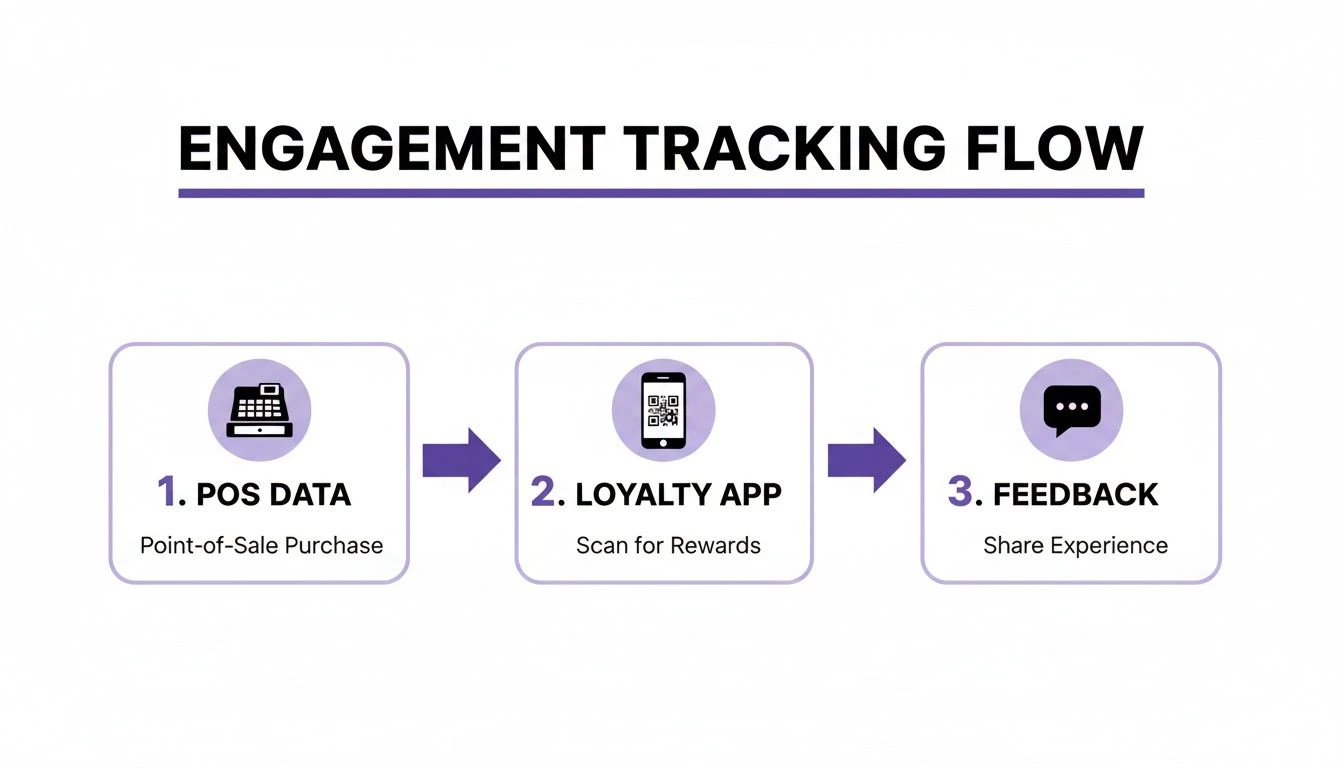
As you can see, when you combine what people buy with how they interact with your loyalty program, you unlock a powerful, unified view of your customer relationships.
Crunching the Numbers and Finding the Story
Once your collection period is over, it’s time to dive in. With a tool like BonusQR, the heavy lifting is already done. Your job is to interpret what these metrics mean for your business.
Let’s look at a couple of real-world examples:
Example 1: A Restaurant Owner's Experiment
A restaurant owner offers a "free appetizer on your 5th visit" reward. Before the launch, her Repeat Purchase Rate was around 22%. After 60 days, she logs into her BonusQR dashboard. The rate has jumped to 35%. Boom. Clear, undeniable proof the new reward is working.
Example 2: A Salon Owner's Lightbulb Moment
A salon owner uses automated SMS reminders for appointments. She tracks the Customer Lifetime Value (CLV) for clients who book through these reminders versus those who don't. The result is staggering: the CLV for the SMS group is 50% higher. This single insight proves she should invest even more into her reminder system.
By zeroing in on one or two key metrics tied to a specific initiative, you're running a simple experiment. The results give you a clear "yes" or "no" on whether your efforts are paying off.
This focused approach takes the guesswork out of the equation. You’re no longer just hoping your ideas are working; you’re proving it with data. If you’re ready to go deeper, our guide on mastering customer retention metrics is the perfect next step.
Turning Your Numbers Into Actionable Insights
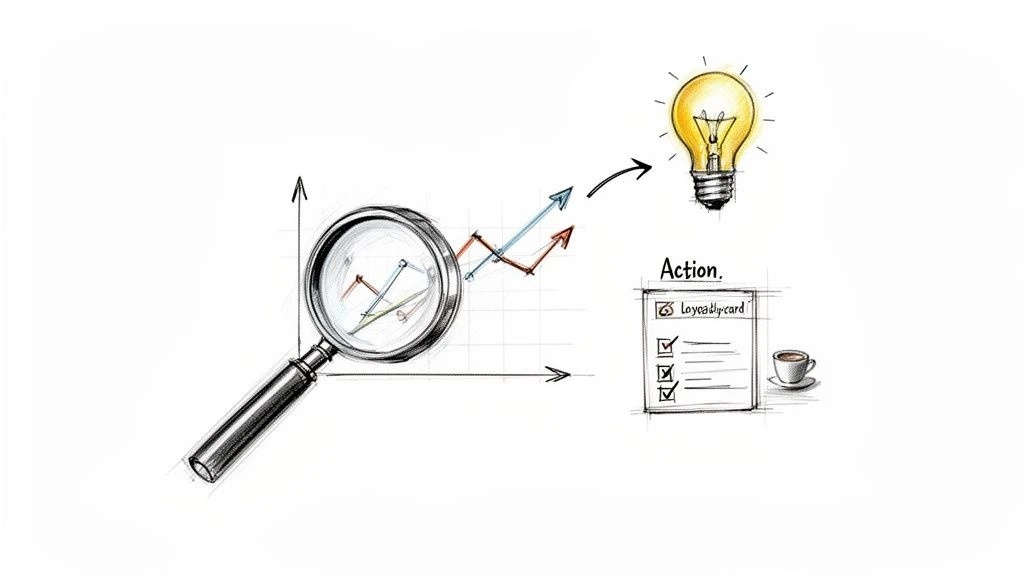
Data is one thing, but the magic happens when you understand the story it's telling. A 40% repeat purchase rate is great, but its true value is unlocked when you figure out why it's happening and how to lean into it.
This is the moment you shift from simply running your business to strategically growing it.
Look for Patterns in Your Data
Think of your engagement reports as a treasure map to what your customers really want. Ask deeper questions to find your next great idea.
- What are your most loyal customers consistently buying? If your top 20 regulars always grab your signature latte, that's a powerful loyalty driver.
- Does engagement dip after someone redeems their first reward? This could be a sign your welcome offer is great, but the next incentive isn't strong enough.
- Are certain days showing a spike in loyalty scans? Maybe that "double points Tuesday" promotion is a bigger hit than you thought.
True insight isn't about having more data; it's about asking better questions of the data you already have. This transforms raw numbers into a clear roadmap for growth.
Set Benchmarks That Make Sense for You
It’s easy to fall into the trap of comparing your business to the wrong standard. "Good" engagement looks different for every industry.
A busy downtown coffee shop will have a higher visit frequency than a premium hair salon. A caffeine lover might stop by several times a week, while a salon client who visits every six weeks is still incredibly loyal. Both are highly engaged, but their patterns are worlds apart.
Use your first few months of data to establish what's normal for you. That becomes your baseline. This process is tied directly to keeping customers happy. We dive deeper into this in our guide on how to measure customer satisfaction and stop losing your best customers.
From Insight to Action
Once you spot a pattern, do something with it. This is how you close the loop and turn hard work into results. A great place to start is by grouping customers based on their behavior; learning about email segmentation to boost engagement can show you how to send the perfect message to the right people.
Let’s see how this plays out:
Insight: You discover that customers who redeem a "free coffee" reward are 50% more likely to come back within that same week.
Action: You set up an automated campaign in your BonusQR app. The second a customer redeems that free coffee, they get a follow-up offer pushed to their phone: "Come back this week for 10% off any pastry!"
This simple, targeted action came directly from interpreting your data. You found a key customer behavior, created a smart incentive to encourage it, and built a powerful engine for repeat business.
Have Questions? Let's Get Them Answered
Even with the best game plan, you're bound to have questions. Let's walk through some common ones for small business owners.
How Often Should I Be Looking at These Numbers?
For most local businesses, a monthly check-in on your core engagement metrics is the sweet spot. This shows you real trends without getting overwhelmed by daily ups and downs.
If you've just rolled out a big new promotion, you'll probably want to peek at key stats like repeat visits on a weekly basis for a quicker pulse. The golden rule is consistency. Pick a rhythm and stick to it.
Isn't Engagement Just Another Word for Satisfaction?
That's a great question. Think of it this way:
Customer satisfaction is about a single moment. It's the "How was your coffee today?" survey. It tells you how a customer felt about one specific experience.
Customer engagement is the whole story-the ongoing relationship. It’s not just about one good coffee; it’s about whether they come back next week, bring a friend, and tell coworkers you're the best spot in town.
Satisfaction might get you a good review, but engagement gets you a customer for life. One is a snapshot; the other is the entire photo album.
I Only Have a Small Customer Base. Can I Still Do This?
Yes, and you absolutely should! When you're small, every customer relationship is gold. Measuring engagement might actually be more important for you.
You don't need complex spreadsheets. With a smaller base, you can focus on the real people behind the numbers. Simply knowing that Sarah has been to your salon five times in the last two months is a huge piece of engagement data. Tools built for businesses like yours make this easy, turning data back into the familiar faces you serve every day.
Ready to stop guessing and start seeing exactly who your best customers are? BonusQR gives you the simple, powerful tools you need to automatically track repeat visits, identify your VIPs, and grow your business with data-driven confidence. Start your free trial today and discover the loyalty you've been missing.


