
Customer loyalty in retail and restaurant businesses rarely happens by chance. Owners and managers often find themselves guessing which engagement channels and promotional offers actually inspire repeat visits. With so many ways customers interact online and offline, a systematic review of every touchpoint is essential for meaningful retention. This guide walks you through using digital engagement channel analysis and proven loyalty program strategies so you can build stronger connections and drive consistent sales growth.
Step 1: Assess current customer engagement channels
Assessing your current customer engagement channels helps small businesses understand how effectively they’re connecting with their audience. This strategic review will reveal valuable insights about your customer communication landscape.
To comprehensively evaluate your engagement channels, start by mapping out all touchpoints where customers interact with your business. Digital engagement landscape analysis reveals several critical channels to examine:
- Social media platforms
- Website interactions
- Email communications
- Mobile app engagement
- Physical store/location interactions
- Customer service touchpoints
Begin by collecting quantitative data from each channel. Track metrics like:
- Average response times
- Interaction frequencies
- Customer feedback volumes
- Conversion rates
- Engagement duration
Tracking these metrics allows you to identify which channels are performing well and which need improvement. Systematic customer engagement frameworks recommend considering cognitive, emotional, and behavioral dimensions of customer interactions.

Here’s a summary of key customer engagement channels and the types of data they commonly generate:
| Engagement Channel | Typical Data Collected | Business Impact |
|---|---|---|
| Social media platforms | Comments, shares, likes | Builds brand awareness |
| Website interactions | Page views, session duration | Increases conversion potential |
| Email communications | Open rates, click rates | Drives targeted outreach |
| Mobile app engagement | Session frequency, retention | Enhances loyalty and convenience |
| Physical store interactions | Foot traffic, purchase history | Direct sales and upsell chances |
| Customer service touchpoints | Satisfaction scores, resolution | Improves support experience |
Understanding your current engagement channels provides the foundation for developing more targeted retention strategies.
Pro tip: Create a visual dashboard that consolidates engagement metrics across all channels to simplify ongoing tracking and analysis.
Step 2: Select and configure loyalty program modules
Selecting and configuring the right loyalty program modules can transform how small businesses engage and retain customers. The goal is to create a customized system that resonates with your specific business needs and customer preferences.
Loyalty program configuration strategies emphasize the importance of tailoring modules to your unique business context. When selecting modules, consider these key components:
- Points collection systems
- Tiered reward structures
- Digital stamp cards
- Referral incentive modules
- Birthday and special occasion rewards
- Personalized coupon generation
Key steps for effective module selection include:
- Analyze your current customer base
- Identify most attractive reward types
- Evaluate technical integration capabilities
- Test module compatibility
- Consider scalability and future growth
Each module should align with your business goals and provide clear value to your customers. Some modules might offer more engagement for retail businesses, while others work better for service-based companies.
Below is a comparison of loyalty program modules and their suitability for different types of small businesses:
| Module Type | Retail Business Benefit | Service Business Benefit |
|---|---|---|
| Points collection | Encourages repeat purchase | Rewards frequent bookings |
| Tiered rewards | Incentivizes larger orders | Builds client loyalty tiers |
| Digital stamp cards | Promotes visits and buys | Highlights service usage |
| Referral incentives | Expands customer base | Attracts new clients |
| Personalized coupons | Drives specific product sales | Customizes offers per service |
The most successful loyalty programs are those that feel personalized and genuinely valuable to customers.
Your chosen modules should provide flexibility and allow for easy modifications as your business evolves.
Pro tip: Start with a minimum viable set of modules and gradually expand based on customer feedback and engagement metrics.
Step 3: Customize branding and promotional offers
Creating distinctive branding and targeted promotional offers is critical for small businesses looking to stand out in a competitive marketplace. Your loyalty program should reflect your unique brand identity and speak directly to your customer’s preferences.
Strategic branding and promotional customization reveals that successful small businesses align their marketing efforts with precise customer segmentation. When developing your promotional strategy, focus on these key customization elements:
- Color palette matching
- Logo integration
- Personalized messaging
- Customer segment targeting
- Visual design consistency
- Reward structure alignment
Key steps for effective customization include:
- Analyze customer demographic data
- Define unique brand personality
- Create targeted offer templates
- Implement dynamic personalization
- Test and refine promotional approaches
The goal is to create promotional offers that feel authentic and tailored to your specific customer base. Branding integration frameworks emphasize the importance of maintaining consistent brand messaging across all customer touchpoints.
Successful promotional offers feel like a natural extension of your brand, not generic marketing tactics.
Consider your brand’s unique value proposition when designing promotional strategies, ensuring each offer reinforces what makes your business special.
Pro tip: Develop a flexible promotional template that allows quick customization while maintaining consistent brand guidelines.
Step 4: Automate communication and rewards delivery
Automating communication and rewards delivery can dramatically improve your customer retention strategy, reducing manual work while maintaining personalized interactions. By implementing smart automation, you can create consistent and engaging customer experiences.
Customer communication automation strategies demonstrate significant benefits for small businesses seeking efficient engagement methods. Key automation elements to consider include:
- Triggered welcome messages
- Milestone reward notifications
- Birthday special offers
- Personalized point balance updates
- Automated tier progression alerts
- Redemption reminder communications
Effective automation requires strategic implementation:
- Map customer journey touchpoints
- Define clear communication triggers
- Create personalized message templates
- Set up segmentation rules
- Monitor and adjust automation workflows
Successful automation balances efficiency with personalization, ensuring each automated interaction feels genuine and valuable to your customers.
Automation should enhance customer experience, not replace human connection.
Consider your customers’ preferences and communication styles when designing automated workflows, keeping interactions helpful and relevant.
Pro tip: Test your automation sequences thoroughly and regularly review performance metrics to continuously refine your communication approach.
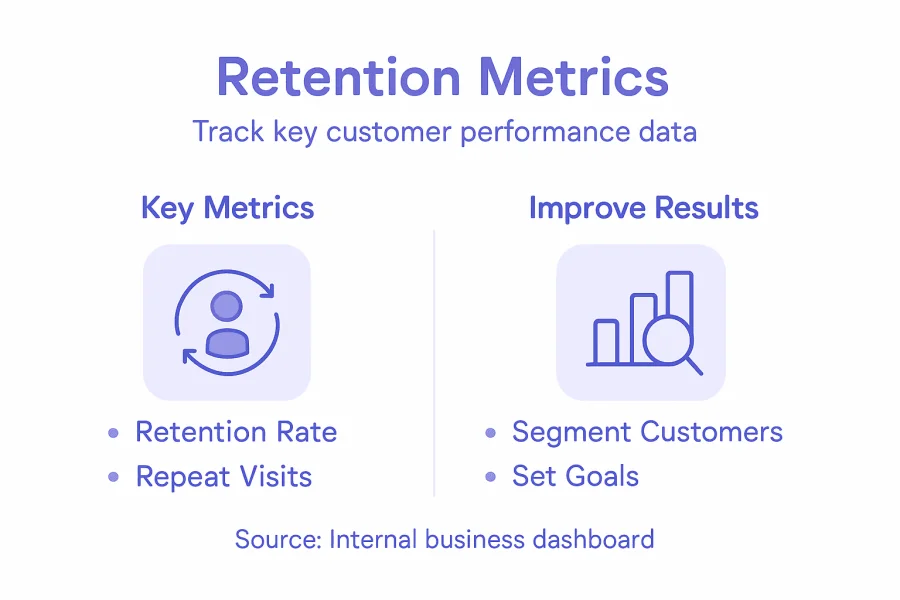
Step 5: Monitor retention metrics and optimize results
Monitoring retention metrics provides small businesses with critical insights into their customer loyalty strategies. Understanding and analyzing these metrics enables data-driven decisions that can significantly improve your customer engagement approach.
Predictive analytics for retention optimization reveals the importance of tracking key performance indicators systematically. Essential metrics to monitor include:
- Customer retention rate
- Churn rate
- Repeat purchase frequency
- Average customer lifetime value
- Engagement score
- Redemption rate for loyalty rewards
Comprehensive metric tracking involves:
- Establish baseline performance metrics
- Set specific improvement targets
- Implement regular measurement intervals
- Analyze trends and patterns
- Develop responsive optimization strategies
Tracking these metrics allows you to identify strengths and weaknesses in your customer retention approach, enabling continuous improvement and strategic adjustments.
Data-driven insights transform customer retention from guesswork into a precise, measurable science.
Regularly review and adjust your metrics tracking to ensure you’re capturing the most relevant and actionable information for your business.
Pro tip: Create a dashboard that visualizes key metrics, making it easier to quickly understand and communicate performance trends.
Unlock Powerful Customer Retention with Tailored Loyalty Solutions
Small businesses face critical challenges in building meaningful customer engagement and sustaining repeat business. This practical guide underlines the importance of personalized loyalty modules, automated communications, and thorough analytics—all vital components to reduce churn and increase customer lifetime value. If tracking engagement metrics and customizing branding feel overwhelming, there is a solution designed to simplify these steps without compromising flexibility.
bonusqr.com offers an intuitive loyalty program platform that empowers you to easily configure points collection, tiered rewards, personalized coupons, and targeted promotions aligned with your unique brand. With features like mobile and web app integration plus real-time analytics, our system supports automated reward delivery and detailed retention monitoring to keep you ahead in customer loyalty.
Ready to transform customer retention into measurable growth? Explore how easy it is to launch your own tailored loyalty program with bonusqr.com, and start optimizing your engagement strategies today. Discover the benefits of flexible loyalty modules by visiting our platform overview now and take the first step toward loyal customers who keep coming back.
Frequently Asked Questions
How can I assess my current customer engagement channels?
Assess your customer engagement channels by mapping all touchpoints where customers interact with your business, such as social media, website, email, and physical stores. Track metrics like average response times, interaction frequencies, and customer feedback to identify strengths and weaknesses in your communication strategy.
What loyalty program modules should I consider for my small business?
Consider modules like points collection systems, tiered reward structures, and personalized coupon generation. Analyze your customer base to determine which rewards resonate most with them and select the modules that best align with your business goals.
How do I customize branding and promotional offers for my loyalty program?
Customize your program by matching your brand’s color palette, integrating your logo, and crafting personalized messaging. Analyze your customer demographic data to create targeted offers that feel authentic and relevant to your specific audience.
What steps should I take to automate communication and reward delivery?
To automate communication and rewards, define clear customer journey touchpoints and set up communications based on specific triggers. Create personalized message templates to enhance customer experience and streamline the delivery process, ensuring each interaction remains valuable and engaging.
How can I monitor retention metrics effectively?
Effectively monitor retention metrics by establishing baseline performance indicators like customer retention rate and average customer lifetime value. Set specific improvement targets and regularly analyze the data to identify patterns, allowing you to continuously optimize your retention strategies.
What are some immediate actions I can take to enhance customer retention?
Begin by assessing the performance of your current customer engagement channels and implementing a loyalty program tailored to your business. Focus on gathering feedback from customers and use it to fine-tune your strategies within 30 days, leading to improved customer satisfaction and retention.
Recommended
- Top Strategies for Customer Retention to Grow Your Business | BonusQR
- Top Customer Retention Strategies for Small Business 2025 | BonusQR
- 7 strategies of customer retention that work | BonusQR
- Top Customer Service Retention Strategies to Boost Loyalty | BonusQR
- 5 B2B Prospecting Methods That Will Help You Land Customers - TechMoths


