
 Deutsch
 Español
 Français
 Italiano
 Magyar
 Polski
 Slovenčina
 Čeština
Being a branch manager for a small or medium-sized business (SMB) is more than just opening and closing the doors. Whether you run a bustling coffee shop, a chic salon, or a popular local restaurant, your success hinges on a manager who masters a diverse set of skills. The core branch manager duties and responsibilities have evolved from simple oversight to strategic growth drivers, with customer loyalty at the very heart of profitability.
This guide breaks down the 10 essential duties that define a high-performing branch manager. We'll move beyond generic advice to provide actionable checklists and unique strategies to not only manage but grow your business by turning repeat customers into your most valuable asset. Central to every one of these duties are effective supervisor communication skills, the foundation for leading a team and delighting customers.
Are you struggling with inconsistent performance, high staff turnover, or stagnant sales? Understanding and implementing these responsibilities is your first step toward a thriving, self-sufficient branch. This article provides a clear roadmap to empower your managers, streamline operations, and drive measurable results from day one.
1. Masterful Staff Performance Management and Training
At the heart of any successful branch is a motivated, well-trained team. A core duty of a branch manager is to transform a group of employees into a high-performing unit. This goes far beyond scheduling; it involves actively managing performance, providing continuous feedback, and identifying opportunities for growth.
A great manager doesn't wait for annual reviews. They build a culture of constant improvement through daily check-ins and weekly one-on-ones. The goal is to set clear expectations, monitor progress, and provide the coaching necessary to help each team member succeed.
How to Implement Effective Performance Management:
- Set SMART Goals: Work with each employee to set goals that are Specific, Measurable, Achievable, Relevant, and Time-bound. For a retail associate, this could be increasing customer loyalty sign-ups by 15% in a quarter.
- Conduct Regular Feedback Sessions: Schedule brief, informal weekly check-ins to discuss wins and challenges. This prevents small issues from becoming large problems and shows your team you are invested in their success.
- Create Individual Development Plans (IDPs): Identify skills gaps and career aspirations. An IDP could outline steps for a barista to become a shift supervisor, including training on inventory management and conflict resolution.
Key Insight: Consistent, constructive feedback is more impactful than a single annual review. It builds trust and allows for real-time adjustments, ensuring the entire team stays aligned with branch objectives.
A poorly trained team can't effectively enroll or engage customers in your loyalty program. Managers must ensure their staff can confidently explain the benefits and seamlessly handle sign-ups. With a simple tool like BonusQR, training focuses on a quick pitch that makes every customer feel valued, turning a routine transaction into a reason for them to return.
2. Customer Experience and Satisfaction
A branch manager's primary goal is to cultivate an environment where every customer feels valued. This part of the branch manager duties and responsibilities involves overseeing the entire customer journey, from the moment they walk in until long after they leave. It’s about proactively resolving complaints, seeking feedback, and driving continuous improvement.

The manager sets the standard for service. They must train staff not just on transactions, but on building genuine rapport. A welcoming space and positive interactions are non-negotiable.
How to Implement an Exceptional Customer Experience:
- Standardize Service Protocols: Create clear guidelines for greeting customers, handling inquiries, and managing difficult situations. For a salon, this could be a script for confirming appointments and explaining aftercare.
- Gather Actionable Feedback: Use simple surveys or direct conversations to understand what customers love and where improvements are needed. The key is to act on this feedback promptly.
- Integrate Loyalty Programs Seamlessly: Ensure the rewards program feels like a natural part of the service, not an awkward upsell. A coffee shop manager can train baristas to say, "Don't forget to scan for your free coffee!" at the end of every order.
Key Insight: A superior customer experience is the most powerful marketing tool a branch has. It directly fuels word-of-mouth referrals and transforms one-time visitors into loyal advocates.
For small businesses, integrating a loyalty program is a tangible way to show appreciation. A manager must make enrollment effortless. Using a tool like BonusQR allows staff to introduce the program with a simple QR code scan at checkout. This removes friction and makes joining an easy, positive step for every customer, encouraging repeat visits.
3. Financial Management and Budgeting
A core component of branch manager duties and responsibilities is fiscal stewardship. Branch managers are entrusted with the financial health of their location, from controlling operational costs to maximizing revenue and ensuring profitability.
This requires a keen eye for detail. A manager must create and adhere to a budget, track daily expenses, and make smart decisions that positively impact the bottom line. This includes managing inventory to prevent waste and allocating funds toward initiatives with strong ROI, like customer loyalty programs.
How to Implement Effective Financial Management:
- Develop a Detailed Budget: Break down your budget into key categories like payroll, inventory, marketing, and utilities. Regularly compare actual spending against your forecast to address variances quickly.
- Track Key Financial KPIs: Monitor metrics like cost of goods sold (COGS), labor cost percentage, and average transaction value. For a quick-service restaurant, tracking food cost percentage daily can prevent significant losses.
- Allocate for Growth Initiatives: Set aside a portion of your budget for revenue-driving activities. Dedicating just 2-5% of your marketing budget to loyalty program promotions can directly boost customer retention.
Key Insight: Proactive financial management isn't just about cutting costs; it's about strategic investment. Understanding the ROI of every dollar spent allows you to invest confidently in areas like customer loyalty that generate sustainable growth.
A boutique salon manager might allocate funds for a seasonal promotion, offering double loyalty points to drive traffic during a slow period. By tracking the cost of redeemed points against the revenue from returning customers, the manager can prove the initiative's success.
Tools with built-in analytics, like BonusQR, simplify this. They allow managers to see exactly how much their loyalty program costs versus the revenue it brings in, making it easy to justify the budget and optimize rewards for maximum profitability.
4. Sales and Revenue Growth Strategy
Beyond daily operations, a key part of branch manager duties and responsibilities is driving financial success. This means developing and executing a clear strategy to increase sales and consistently grow revenue. The manager acts as the commercial leader, setting ambitious targets and empowering the team to achieve them.
An effective manager doesn't just wait for customers. They proactively analyze sales data, identify local market opportunities, and implement targeted promotional campaigns. This ensures the branch not only meets but exceeds its financial goals.
How to Implement an Effective Sales Strategy:
- Set Data-Driven Sales Targets: Analyze historical performance to set realistic yet challenging weekly and monthly sales goals for the team and individual products.
- Identify Growth Opportunities: Notice your coffee shop's afternoons are slow? Create a "happy hour" loyalty promotion to boost traffic during off-peak hours.
- Launch Targeted Campaigns: Use customer data to create relevant offers. A pizza place could offer loyalty points on larger orders to increase the average transaction value on weekends.
Key Insight: Proactive sales management is about creating demand, not just fulfilling it. By understanding customer behavior and market trends, a manager can turn a good month into a record-breaking one.
A customer loyalty program is a powerful tool in any manager's arsenal. Driving repeat business is often more cost-effective than acquiring new customers. A well-managed program directly contributes to revenue growth by increasing customer lifetime value.
With a simple tool like BonusQR, a manager can easily implement this strategy. They can segment customers by purchase frequency and send targeted promotions to bring back lapsed visitors. By creating tiered rewards, they encourage higher spending, directly linking loyalty efforts to bottom-line results.
5. Inventory and Operational Management
Effective operational oversight is a cornerstone of a profitable branch, and managing inventory is a critical part of these branch manager duties and responsibilities. It requires a strategic approach to stock control to meet customer demand without tying up capital in excess goods.
A skilled manager ensures the right products are available at the right time, preventing both stockouts that disappoint customers and overstock that leads to waste. They analyze sales data and streamline processes to ensure the branch runs smoothly and cost-effectively.
How to Implement Effective Inventory Management:
- Leverage Sales Data for Forecasting: Use point-of-sale data to identify sales trends and predict future demand. A coffee shop manager might notice a spike in oat milk sales on weekends and adjust orders accordingly.
- Establish Par Levels: Set minimum inventory levels for all key products. When stock drops to this level, it triggers a reorder, simplifying the process and preventing shortages.
- Conduct Regular Stock Audits: Perform weekly or bi-weekly physical counts of key inventory to ensure accuracy and identify discrepancies caused by theft, waste, or errors.
Key Insight: Strategic inventory management is not just about having products on the shelf; it's about optimizing cash flow. Every dollar tied up in slow-moving stock is a dollar that can't be used for growth.
Poorly managed inventory can quickly derail a loyalty program. If a salon consistently runs out of the exclusive hair serum offered as a reward, it erodes member trust.
Managers must ensure their inventory strategy supports loyalty initiatives. Using a tool like BonusQR, which provides clear data on reward redemptions, a manager can forecast demand for popular promotional items. This turns a simple operational task into a powerful customer retention tool.
6. Marketing and Loyalty Program Promotion
A branch manager’s role extends beyond the four walls of their establishment; they are also the primary drivers of local marketing. One of the most critical branch manager duties and responsibilities is executing strategies that build brand awareness, attract new customers, and foster loyalty.
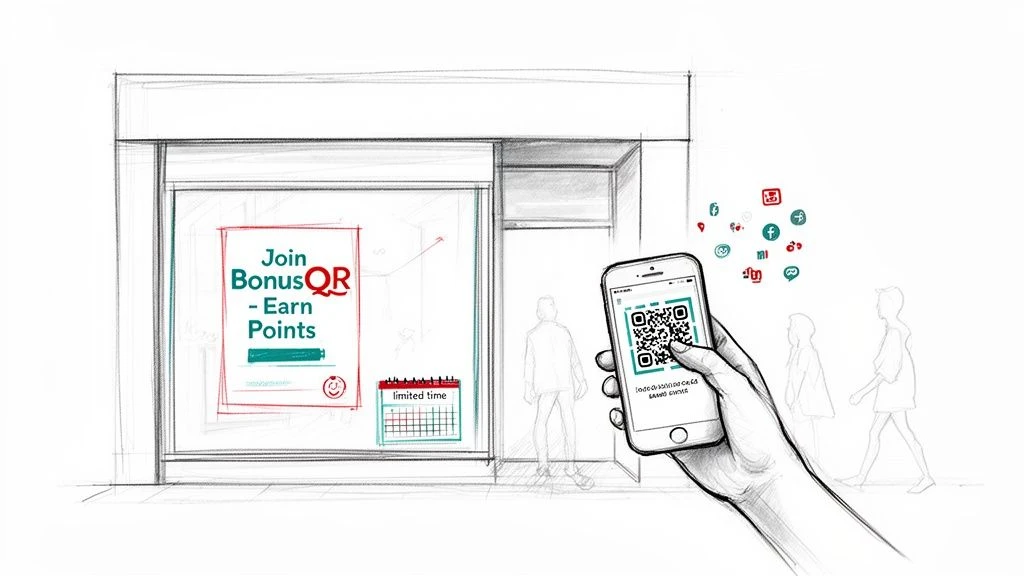
For a local business, the manager is the chief marketer. They must create in-store campaigns and ensure every customer interaction reinforces the brand’s value. This is especially true for loyalty programs, which rely on enthusiastic promotion to succeed.
How to Implement Effective Local Marketing and Promotion:
- Create Compelling In-Store Signage: Display clear, attractive signs near the point of sale that highlight the benefits of joining the loyalty program. A simple countertop sign with a QR code saying, "Scan to Join, Get Your 5th Coffee Free!" works wonders.
- Leverage Social Media for Local Reach: Run targeted social media campaigns for the local community. A restaurant could promote a "Loyalty Sunday" with double points, using geotagged posts and local hashtags to attract nearby diners.
- Develop Targeted Email Campaigns: Segment your customer list and send personalized offers. A salon manager could email a "friends and family" referral bonus to their top loyalty members.
Key Insight: Local marketing isn't about a massive budget; it's about authentic connection. A manager who actively promotes a simple, valuable loyalty program turns everyday transactions into lasting customer relationships.
For tools like BonusQR, the manager's role is to make enrollment irresistible and effortless. They can train staff to highlight the ease of scanning a QR code to join and immediately earn points. This simple, manager-led initiative ensures the program gains traction, builds a loyal customer base, and drives measurable growth.
7. Compliance, Safety, and Risk Management
A core part of branch manager duties and responsibilities is serving as the branch's primary guardian of safety and compliance. This means ensuring the business operates within all legal, regulatory, and company policy frameworks, from health and safety standards to labor laws and data privacy.
Managers must proactively identify and mitigate potential risks before they become costly problems. They must also master the intersection of operations with regulatory mandates; a comprehensive approach to understanding risk and compliance is paramount.
How to Implement Effective Compliance and Risk Management:
- Conduct Regular Audits: Routinely check your branch against a compliance checklist covering health codes, OSHA standards, labor law postings, and data privacy policies.
- Prioritize Data Security: Train all staff on the secure handling of customer information. Ensure all point-of-sale and loyalty program transactions are processed through secure, encrypted systems.
- Maintain Clear Documentation: Keep meticulous records of all training sessions, safety inspections, and compliance reports. A salon manager should document that all stylists' licenses are current.
Key Insight: Proactive risk management is always more effective and less expensive than reactive crisis control. A culture of compliance protects the business, its employees, and its customers.
This responsibility is critical when managing loyalty programs, where data privacy is a major concern. Managers must ensure any platform used handles customer information securely and complies with regulations like GDPR or CCPA.
With a tool like BonusQR, managers can be confident that customer data is handled safely. Training can then focus on simple, secure procedures for staff, like never writing down customer phone numbers and ensuring all transactions are completed within the secure digital system.
8. Analytics and Data-Driven Decision Making
In today's market, intuition isn't enough. A core component of modern branch manager duties and responsibilities involves leveraging analytics to make informed, strategic decisions. This means using concrete data to understand sales trends, customer behavior, and operational efficiency.
A data-savvy manager uses business intelligence to pinpoint what's working and what isn't. They analyze key metrics to understand customer preferences, optimize promotions, and drive growth. For a small business, this data-driven approach is the difference between thriving and stagnating.
How to Implement Data-Driven Decision Making:
- Track Key Performance Indicators (KPIs): Monitor metrics like customer enrollment rates, reward redemption rates, and repeat purchase frequency. A coffee shop manager might track which loyalty rewards drive the highest repeat purchases.
- Analyze Customer Segments: Use data to identify your most valuable customers. A retail store could discover that loyalty members who buy a specific brand spend 30% more annually.
- Connect Promotions to Performance: Correlate specific offers with sales spikes. A salon can use its data to see if a "10% off for loyalty members on Tuesdays" promotion successfully boosts traffic on slow days.
Key Insight: Data transforms abstract goals into measurable actions. By tracking the right metrics, you can directly connect your team's daily efforts to tangible outcomes like increased customer lifetime value.
Understanding the numbers helps you refine your strategy and allocate resources effectively. To learn what to measure, check out this guide on mastering customer retention metrics.
A simple tool like BonusQR provides a dashboard that makes this easy. A manager can quickly see which customers are most engaged, which rewards are most popular, and how the program is impacting sales. Sharing these insights with staff can be a powerful motivator, showing them how their efforts directly contribute to the branch's success.
9. Customer Relationship Management and Retention
Long-term success is built on repeat business. A critical part of branch manager duties and responsibilities is to create an environment where customers feel valued and want to return. This involves building genuine relationships, actively managing feedback, and implementing strategies that foster loyalty.
Effective customer relationship management turns one-time visitors into loyal advocates. The manager spearheads this effort by ensuring every interaction is positive and by using tools to personalize the customer experience.
How to Implement Effective Customer Retention:
- Use Segments for Targeted Campaigns: Group customers based on behavior. A salon can use a loyalty system like BonusQR to send exclusive birthday offers to its members, making them feel personally recognized.
- Identify and Re-engage At-Risk Customers: Monitor visit frequency to spot customers who haven't returned. A coffee shop manager can create a "We Miss You" campaign with a special discount to entice them back.
- Personalize Every Interaction: Leverage purchase history to make relevant recommendations. A boutique can use its loyalty data to notify specific customers when new inventory arrives that matches their past purchases.
Key Insight: Customer retention is far more cost-effective than customer acquisition. A well-executed loyalty program is the most direct tool for systematically building relationships and driving repeat visits.
A manager who understands how to stop losing customers transforms the branch into a go-to destination. By celebrating a customer's 10th visit with a surprise reward, you create memorable moments that build an unbreakable bond.
Tools like BonusQR make this simple, allowing managers to automate personalized communications and rewards. This ensures that even during busy shifts, the branch is consistently strengthening customer relationships. For more, explore this small business owner's guide to loyalty and retention on bonusqr.com.
10. Strategic Planning and Branch Growth
Beyond day-to-day operations, a branch manager’s duties and responsibilities include steering the branch toward long-term success. This involves collaborating with leadership to set strategic goals, developing actionable growth plans, and thinking like a business owner, not just an operator.
Effective strategic planning means identifying new opportunities and making decisions that ensure future profitability. Instead of relying solely on acquiring new customers, savvy managers focus on sustainable growth by increasing the value of their current ones.
How to Implement Strategic Growth Planning:
- Integrate Loyalty into Your Core Plan: Make customer loyalty a central pillar of your branch's strategic plan. For a restaurant, this could mean aiming to have 40% of weekly revenue come from loyalty members within two years.
- Set Data-Driven Loyalty Targets: Establish clear KPIs for your loyalty program. Focus on metrics like enrollment rate, repeat purchase frequency, and customer lifetime value (CLV).
- Use Data for Expansion Insights: Leverage loyalty data to identify opportunities for growth. If a significant number of your salon’s loyalty members live in a neighboring town, it could signal a prime location for a new branch.
Key Insight: True strategic growth comes from building a loyal customer base that consistently chooses your business over competitors. This creates a stable revenue foundation that makes expansion far less risky.
A loyalty program is a tool for community building and referrals, directly fueling strategic growth without a massive marketing spend.
By making loyalty a strategic priority, managers can ensure every decision supports long-term goals. Tools like BonusQR make this easier by providing the data needed to track repeat business and customer behavior, turning abstract goals into measurable outcomes.
10-Point Comparison of Branch Manager Responsibilities
| Function / Area | Implementation complexity | Resource requirements | Expected outcomes | Ideal use cases | Key advantages |
|---|---|---|---|---|---|
| Staff Performance Management and Training | Moderate - ongoing coaching & evaluation | Time for reviews, training materials, small incentive budget | Consistent service, higher program participation | High-turnover outlets; new loyalty rollouts | Improved competence, morale, accurate redemptions |
| Customer Experience and Satisfaction | Moderate - cross-touchpoint coordination | Staff time, feedback tools, QR signage | Increased retention and positive word-of-mouth | Customer-facing retail, restaurants, salons | Higher loyalty sign-ups, stronger NPS |
| Financial Management and Budgeting | High - detailed forecasting and ROI tracking | Financial tools, reporting time, analytics | Improved profitability, balanced loyalty spend | Tight-margin branches; promotional-heavy periods | Clear ROI, optimized resource allocation |
| Sales and Revenue Growth Strategy | Moderate-High - campaign design & segmentation | Marketing budget, analytics, promotional inventory | Increased sales, higher repeat purchase rates | Growth-focused branches, seasonal campaigns | Higher CLV, targeted revenue uplift |
| Inventory and Operational Management | Moderate - forecasting and stock coordination | Inventory systems, supplier coordination, staff time | Fewer stockouts, smoother promotions | Businesses offering physical rewards or limited stock | Better availability, reduced waste/carrying costs |
| Marketing and Loyalty Program Promotion | Low-Moderate - local campaign execution | Content creation time, signage, small ad spend | Higher enrollment and local engagement | Small businesses, community-oriented stores | Cost-effective acquisition, measurable via BonusQR |
| Compliance, Safety, and Risk Management | High - regulatory and privacy controls | Training, security tools, documentation effort | Reduced legal risk, stronger customer trust | Regulated industries; businesses handling personal data | Protected data, improved reputation, lower liability |
| Analytics and Data-Driven Decision Making | High - data collection, analysis, dashboards | BI tools, data quality processes, analyst time | Better strategic decisions, optimized offers | Multi-location operations; data-driven teams | Insight into high-value segments, improved ROI |
| Customer Relationship Management and Retention | Moderate-High - segmentation & personalization | CRM tools, content workflows, data management | Higher CLV, lower acquisition costs | Membership models, repeat-purchase businesses | Personalized retention, effective re-engagement |
| Strategic Planning and Branch Growth | High - long-term goal setting & alignment | Leadership time, cross-functional data, planning tools | Sustainable growth, aligned investments | Franchises, branches planning expansion | Focused growth, loyalty-driven scalability |
Empower Your Manager, Grow Your Business
The role of a branch manager is the central pivot upon which your business’s success turns. We’ve explored the intricate web of branch manager duties and responsibilities, from orchestrating daily operations to spearheading growth. These aren't just items on a checklist. They are the interconnected gears that drive the engine of your branch.
True success lies in the holistic integration of all ten pillars. The common thread weaving these duties together is the relentless pursuit of customer loyalty.
From Duties to Outcomes: The Loyalty Connection
Understanding the list of branch manager duties and responsibilities is the first step. The next is connecting each duty to a tangible business outcome: sustainable growth fueled by repeat customers.
Consider these connections:
- Effective Staff Training creates confident employees who deliver memorable experiences, which directly builds loyalty.
- Meticulous Financial Management isn't just about cutting costs; it's about investing in a simple, high-ROI loyalty program that pays for itself.
- Strategic Marketing Promotion gives customers compelling reasons to return, transforming casual visitors into devoted fans.
When your branch manager sees their role through this lens, their daily tasks gain a powerful new meaning. They are no longer just managing a branch; they are actively building a loyal community around your brand.
Your Actionable Next Step
To translate this knowledge into action, empower your manager with the right focus and the right tools.
- Conduct a Skills Audit: Review the ten core responsibilities with your manager. Where are their strengths? Where are the opportunities for development? Use this to set clear performance goals.
- Prioritize Customer Retention: Make customer loyalty the primary KPI. Shift the focus from purely transactional metrics (daily sales) to relationship-building metrics (customer return rate, loyalty engagement).
- Equip Them with Simple, Effective Tools: A manager's greatest challenge is often a lack of time. Provide them with streamlined solutions. A tool like BonusQR, for instance, simplifies the entire loyalty process. It empowers managers to sign up customers in seconds, track engagement effortlessly, and demonstrate clear ROI without needing a marketing degree or hours of administrative work.
Ultimately, mastering branch manager duties and responsibilities is the key to unlocking consistent growth. By empowering your manager to focus on customer loyalty, you are not just improving one branch. You are building a scalable model for success, one happy, returning customer at a time.