
 Deutsch
 Español
 Français
 Italiano
 Magyar
 Polski
 Slovenčina
 Čeština
Tired of the endless, expensive cycle of finding new customers? Here's a secret the smartest small businesses know: your most reliable path to growth is sitting right in front of you. It's the people who already love what you do.
A well-designed customer loyalty program isn't just another marketing tactic. For a small business, it's a powerful engine for turning casual shoppers into loyal fans who return again and again, spend more, and tell their friends. This guide will show you how to build one simply and affordably.
Why Loyalty Programs Are a Small Business Superpower
Let's be honest. Constantly chasing new leads is exhausting and expensive. The most successful small businesses focus on a simpler, more powerful strategy: building real relationships with their existing customers. A loyalty program is your framework for doing just that, consistently and at scale.
At its core, a good program taps into a basic human need: people want to feel appreciated and valued. When you reward them for their business, you're not just offering a discount; you're creating an emotional connection that transforms a simple transaction into a lasting relationship.
Turn Repeat Visits into Predictable Revenue
The numbers don't lie. Fostering loyalty has a direct, measurable impact on your bottom line and solves the pain of unpredictable cash flow.
Studies show that repeat customers spend 67% more by their third year with a business than they did in their first six months. Even better, a loyal customer can be worth up to 10 times the value of their very first purchase.
Let's make that real. You run a small café with an average ticket of $20. A simple loyalty program nudges a regular to visit 12 times a year instead of 10. That’s an extra $40 from one person. Now multiply that by 500 members. You’re looking at an extra $20,000 in annual revenue. That's a huge return for the small cost of a few free coffees.
This infographic drives home the financial upside of investing in loyalty.
As you can see, the benefits stack up quickly, leading to more frequent sales, higher spending per visit, and a much stronger return on your investment.
Build a Community, Not Just a Customer List
The best loyalty programs do more than just offer discounts. They make customers feel like insiders, building a genuine community around your brand.
When a customer feels truly valued, they become your most powerful advocate. They'll tell their friends, leave glowing online reviews, and defend your brand. That kind of word-of-mouth marketing is pure gold for a small business on a tight budget.
To get these results, you need to improve customer loyalty with a modern tool that is dead simple to use. Forget asking customers to download yet another app they'll ignore.
Solutions like BonusQR make it effortless. Customers join and track rewards with a quick scan of a QR code using their phone's camera. By removing that friction, you get people signed up and engaged from day one, so your program can start delivering value immediately.
Choosing the Right Loyalty Program for Your Business
The perfect loyalty program isn't the most complex one-it's the one that fits your business and customers seamlessly. The right model encourages repeat business without creating a headache for you or your staff.
One size does not fit all. A bustling pizzeria has different needs than a high-end salon. The goal is to find a structure that feels natural for your customers and is effortless to manage day-to-day.
Let's break down the most popular and effective models for small businesses.
Simple and Effective Program Models
For small businesses, simplicity is the secret weapon. Customers are far more likely to join a program they can understand in seconds.
Here are the proven models that just work:
- Points-Based Systems: A classic for a reason. Customers earn points for every dollar spent, which they redeem for rewards. It's flexible and directly encourages them to spend more to reach the next reward.
- Digital Punch Cards: The modern version of the "buy 10, get one free" card. It’s incredibly effective for businesses with frequent, repeatable purchases-think coffee shops, car washes, or sandwich spots.
- Tiered Programs: This model rewards your best customers with perks that improve over time. As they spend more, they unlock new "tiers" with better benefits, making them feel like true VIPs.
A tiered program can be a game-changer for a salon. The first tier might offer a simple product discount, while a higher "VIP" tier could grant exclusive access to last-minute booking slots-a reward that costs you nothing but delivers huge value.
Matching the Program to Your Business
The real magic happens when you align the program with your business goals and customer behavior. What works for a quick-service cafe will likely fall flat for a boutique clothing store.
The most successful loyalty programs feel like a natural extension of the customer experience, not a tacked-on gimmick. The easier it is for customers to join and see value, the faster your program will deliver a return.
Consider these real-world scenarios:
- A Local Pizzeria: Thrives on repeat family orders. A digital punch card like "Buy 9 Pizzas, Get the 10th Free" is simple and highly motivating. It’s a clear goal that keeps them coming back for Friday pizza night.
- A Hardware Store: Gets more value from a points system. A customer making a large one-time purchase feels rewarded, while smaller, frequent trips for odds and ends also build up toward a future discount.
How to Make Implementation Painless
The biggest hurdle for small business owners is the perceived complexity and cost. Juggling messy paper cards gives you zero data, while custom apps are expensive and often ignored. This is where modern, simple tools change the game.
BonusQR cuts through this complexity by using what everyone already has: a smartphone camera. Customers join and collect rewards with a quick QR code scan at the counter.
This solves several major pain points instantly:
- No Clunky Apps: Customers don't have to download anything, removing the single biggest barrier to sign-up.
- No Lost Paper Cards: Everything is digital, so there are no more "I forgot my card" moments holding up the line.
- Affordable and Simple: You get the power of a digital system without the high price tag or complicated setup.
By choosing a QR-code-based system, you can launch a points program or digital punch card without the operational drag. For a deeper dive, explore our guide on choosing your first customer loyalty software. This simplicity ensures your team can easily manage it and, more importantly, your customers will actually use it.
Designing Rewards Your Customers Actually Want
A loyalty program lives or dies by its rewards. If the perks are boring, uninspired, or feel impossible to earn, your program will fall flat.
The secret is balancing what delights your customers with what makes financial sense for your business. It's about moving beyond generic discounts to craft rewards that feel thoughtful and tied to the unique experience only you can offer. A reward is a "thank you," and the best thank-you is always personal.
Go Beyond Free Products with Experiential Perks
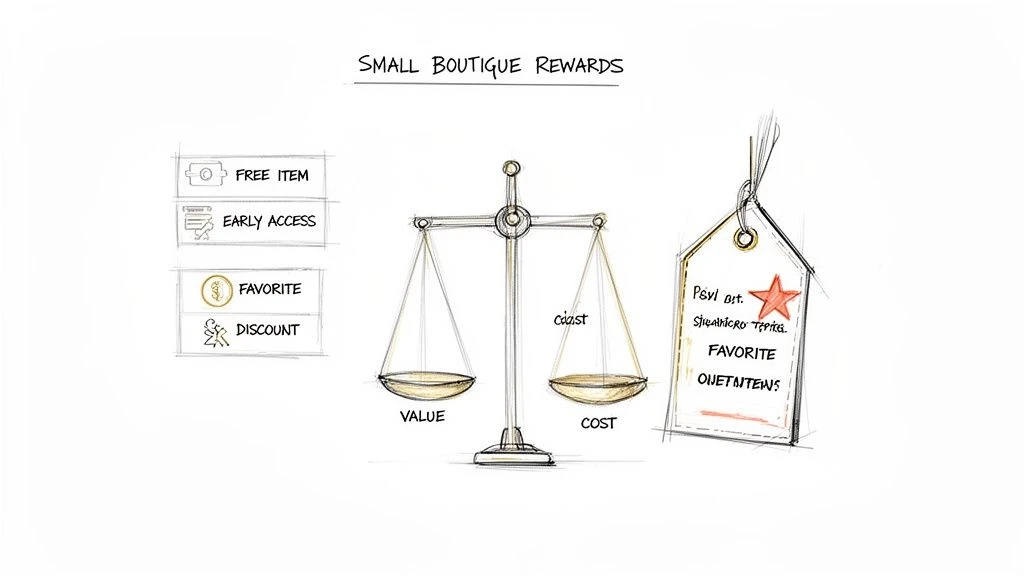
While transactional rewards like a free coffee or a 10% discount work, don't underestimate the power of unique experiences. These non-monetary perks often feel more exclusive and forge a much stronger emotional connection.
Think about what you can offer that costs you little to nothing but provides huge perceived value.
- Early Access: Let loyal members be the first to try a new menu item, shop a new collection, or book a seasonal service.
- VIP Treatment: Offer a "skip the line" pass during busy hours or provide priority booking for appointments. It’s a small gesture that feels like a big deal.
- Exclusive Events: Host a small, members-only tasting event, a behind-the-scenes tour, or a Q&A with you, the owner.
A local brewery, for example, could offer loyal members first dibs on a limited-edition beer release. This creates a sense of community that a simple dollar-off coupon can't replicate.
Make Rewards Feel Personal
Personalization is no longer a buzzword; it's an expectation. Your customers want to feel seen, not like another number in a database. You can use what you know about their habits to offer rewards that feel uniquely tailored to them.
The payoff is huge: members who redeem personalized rewards spend 4.3 times more than those using generic offers.
- A bookstore could offer a loyal reader a discount on their favorite author's next book.
- A pet supply shop could send a birthday treat for a customer's dog.
- These small, thoughtful gestures show you’re paying attention and build real relationships.
Ensure Your Rewards Are Profitable
Finally, your program must be sustainable. A reward that drains your profit isn't a reward-it's a liability. Before committing to your perks, do some simple math to understand the real cost versus the value it creates.
The most profitable rewards are often low-cost, high-perceived-value items. A free appetizer that costs you $2 to make might feel more valuable to a customer than a $2 discount on a $50 bill.
Follow this simple formula:
- Calculate the Reward Cost: Determine the actual cost of goods sold (COGS) for the reward. For a free coffee, this is just the cost of beans, milk, and a cup-not its retail price.
- Estimate the Customer Lifetime Value (CLV): How much revenue does a loyal customer typically generate?
- Compare: Does the small cost of the reward encourage enough repeat business to significantly boost that customer's lifetime value?
If the answer is "yes," you've found a winner. For more guidance, check out our article on how to create a rewards program that boosts loyalty.
How to Launch Your Loyalty Program for Maximum Impact
You've designed a fantastic loyalty program. The rewards are dialed in, and you know customers will love it. Now for the launch. A great launch isn't about an expensive marketing blitz; it’s about smart, consistent promotion that builds momentum from day one.
The goal is to make your program impossible to miss. Your strategy should focus on two key areas: turning your team into champions and using simple, effective tactics to spread the word.
Turn Your Team into Your Best Promoters
Your employees are on the front lines, interacting with every customer. They are your most powerful promotional asset. If they're excited, that energy is infectious.
Hold a quick, engaging training session before you go live.
- Explain the "Why": Tell them how the program helps the business and makes their job easier (happier, repeat customers are great to serve).
- Show, Don't Just Tell: Let them try the sign-up process themselves. For a system like BonusQR, this is as simple as showing them the fast scan-and-go process.
- Give Them Easy Talking Points: Arm them with natural, benefit-driven lines to use at checkout.
Scrap the generic "Want to join our rewards program?" Instead, try these:
Your team's genuine enthusiasm is your most effective marketing tool. A simple, confident offer from a trusted cashier is far more powerful than any poster.
- "Before you go, you're just one scan away from earning a free [Your Reward]. Just point your camera here to join."
- "I saw you bought a [Popular Product]. If you join our free rewards program, your next one could be on us. It takes ten seconds."
Keep it simple, fast, and focused on what's in it for the customer right now.
Low-Cost In-Store Promotional Tactics
With your team ready, make the program impossible to ignore inside your store.
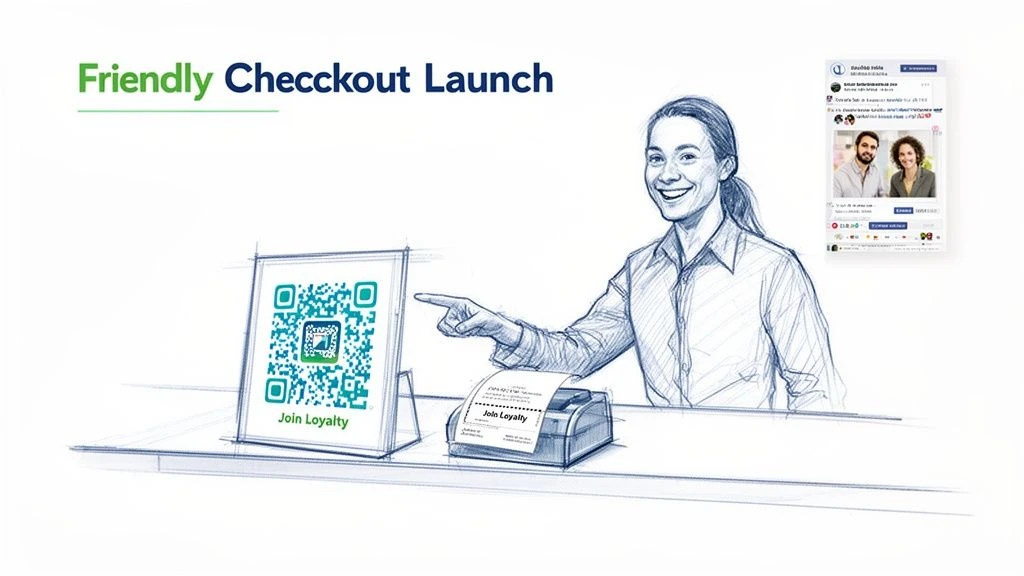
- QR Code Displays at Checkout: A non-negotiable. A small, clean sign with your sign-up QR code by the payment terminal is a must. This is where a tool like BonusQR shines-it makes joining completely frictionless.
- Receipt Reminders: Add a bold message to every receipt: "You could have earned 5 points today! Scan here to join for free: [QR Code]."
- Flyers in Bags: A simple postcard-sized flyer in every shopping bag is a great take-home reminder.
- Mirror Clings & Table Tents: Running a salon? A sticker on the mirror is perfect. For a café, a table tent works while customers wait.
These consistent touchpoints ensure every customer knows about the value you're offering.
Simple Digital Promotion Strategies
The push doesn't stop at your front door.
- Announce on Social Media: Create eye-catching posts for Instagram or Facebook announcing the launch and highlighting the best perks.
- Add a Website Banner: Place a banner at the top of your homepage linking to a simple sign-up page.
- Email Your List: Send a dedicated email blast explaining how the program works and why they should be the first to join.
A successful launch combines an enthusiastic team with smart, multi-channel promotion. By making your program easy to find and join, you’ll build the momentum it needs to become a real growth engine.
Measuring Success and Optimizing for Growth
Launching your program is a huge step, but the work doesn't stop there. A great program isn't "set it and forget it"; it's a living part of your business that evolves. You need to know what's working and where you can make small tweaks for big results.
The key is tracking a few simple metrics that tell a clear story about your customers' behavior. This isn't about getting lost in spreadsheets; it's about understanding the health of your program at a glance.
Key Metrics You Can Actually Use
Forget overwhelming dashboards. For small businesses, focusing on a handful of core numbers provides all the insight you need. Modern tools like BonusQR track these automatically and present the information in a simple format.
Here’s what to watch:
- Participation Rate: The percentage of your customers who have signed up. This is your first health check. If it's low, your promotion or sign-up process needs a boost.
- Redemption Rate: How many issued rewards are being claimed. A high rate is a fantastic sign-it means your rewards are compelling. If it’s low, it might be time to rethink your perks.
A low redemption rate isn't a failure; it's a signal. It tells you that your rewards might be too hard to earn or simply not exciting enough. This feedback is your opportunity to offer something your customers truly value.
Key Metrics to Track for Your Loyalty Program
| Metric | What It Measures | Why It Matters for Your Business |
|---|---|---|
| Participation Rate | The % of total customers enrolled in your program. | Shows how well you're promoting the program and how easy it is to join. |
| Redemption Rate | The % of earned rewards that are actually claimed. | A direct measure of how desirable your rewards are. High redemption = engaged customers. |
| Repeat Purchase Rate | The % of customers who make more than one purchase. | The ultimate goal. Tells you if the program is successfully turning one-time buyers into regulars. |
| Customer Lifetime Value (CLV) | The total revenue a customer is expected to generate. | A rising CLV for members proves the program is increasing the value of your best customers. |
| Average Order Value (AOV) | The average amount spent per transaction. | See if loyalty members spend more per visit than non-members. |
Optimizing Your Program for Better Results
Once you have this data, you can start asking the right questions.
- If sign-ups are low, ask: Is the program visible enough? Is my team consistently mentioning it? Is the sign-up offer compelling?
- If redemption is weak, ask: Are the rewards truly desirable? Does it take too long to earn the first reward? Are the rules simple?
Imagine a coffee shop owner sees many sign-ups but few redemptions for their "free specialty latte" reward. After chatting with regulars, they realize most just want a simple black coffee. By changing the reward to "any free drink," they could see redemption rates-and customer satisfaction-soar.
The Clear ROI of a Well-Tuned Program
Continuously improving your program drives real financial results. A staggering 90% of companies report a positive ROI from loyalty initiatives, with an average return of 4.8 times their initial investment. This proves that investing in a simple digital loyalty solution pays for itself many times over.
Even better, research shows that improving customer retention by just 5% can increase profits by 25% to 95%. Why the huge jump? Because keeping an existing customer is far more profitable than acquiring a new one. You can find more insights in this 2025 local business analysis.
By measuring and optimizing, you ensure your customer loyalty program for your small business isn’t just an expense-it’s one of your most valuable assets.
Your Top Loyalty Program Questions, Answered
Starting a loyalty program brings up questions. Let's tackle the most common ones small business owners have, with straight-to-the-point answers to help you move forward with confidence.
How Much Does a Loyalty Program Cost to Start?
The cost can range from nearly free to thousands of dollars. Paper punch cards are cheap to print but give you zero data and are easily lost. A custom-built app will set you back tens of thousands-unrealistic for most small businesses.
The smart middle ground is a modern digital solution like BonusQR, which runs on a simple, affordable monthly subscription. For a small monthly fee, you get a powerful system with customer insights that paper cards could never provide, without the scary upfront investment.
Will My Customers Actually Use a Digital Program?
Yes-if you make it ridiculously simple. No one wants to download another app or fill out long forms at the counter. The secret is to eliminate all friction.
This is why QR code-based programs are so effective. With a platform like BonusQR, a customer joins in seconds with just their phone's camera. No apps, no passwords, no hassle. They just scan, join, and start earning.
People want to be rewarded. Your job isn’t to convince them; it’s to make it as easy as possible for them to participate. The simpler the process, the higher your sign-up rate.
What Are the Biggest Mistakes to Avoid?
Well-meaning loyalty programs often fizzle out due to simple, avoidable mistakes.
- Making It Too Complicated: If your program requires a manual, you've already lost. It should be explainable in one sentence.
- Offering Boring or Unattainable Rewards: The first reward needs to feel within reach to create an early win and keep people engaged.
- Forgetting to Promote It: Your team is your best marketing asset. Train them to mention it to every customer. A simple program you promote will always outperform a "perfect" program nobody knows exists.
How Soon Will I See Results from a Loyalty Program?
While loyalty is a long-term strategy, you can see positive signs quickly.
- First Few Weeks: You should see a steady flow of new sign-ups. This confirms your promotion and sign-up process are working.
- 1-3 Months: You'll start to see changes in behavior, like increased visit frequency and spending from loyalty members compared to non-members.
- 6-12 Months: The biggest financial payoff becomes clear. The compounding effect of repeat business kicks in, leading to a measurable lift in overall revenue and customer lifetime value.