In a crowded digital marketplace, launching a mobile app is just the first step. The real challenge is getting it discovered, downloaded, and used consistently. Many small business owners ask the same questions: How do I get more app downloads without a huge budget? How can I stop users from deleting my app after one use? What's the best way to turn app users into loyal, repeat customers?
This guide cuts through the noise. We've compiled 10 proven mobile app marketing strategies specifically for businesses like yours. These are actionable steps you can implement today to acquire new users, boost engagement, and create a powerful loyalty program that drives real revenue growth. While you can explore more Top Mobile App Marketing Strategies, our focus is on tactics that deliver maximum impact for small businesses.
Whether you run a coffee shop, a salon, or a local retail store, this list provides a clear roadmap. You'll learn how to turn your app from a simple digital tool into your most valuable marketing asset, building a direct connection with your customers and encouraging them to come back again and again.
1. App Store Optimization (ASO)
App Store Optimization (ASO) is how you improve your app’s visibility in the Apple App Store and Google Play Store. Think of it as SEO for apps. When a potential customer searches for "customer loyalty app" or "rewards program for cafes," a strong ASO strategy ensures your app appears at the top, leading to more downloads.
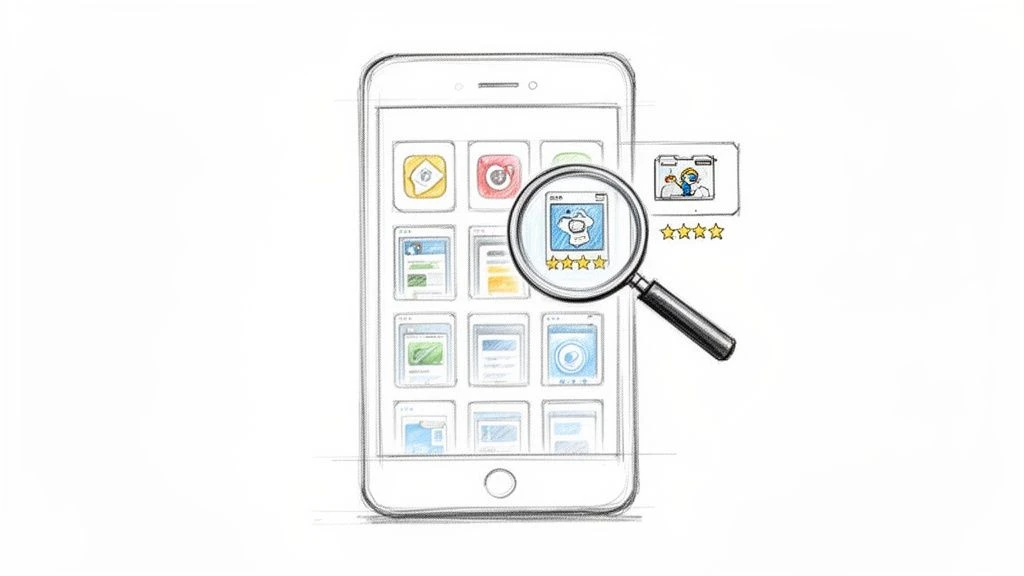
This is a critical first step because most users discover new apps by searching in the app store. Ignoring ASO is like hiding your business on a back street with no sign. By optimizing your app’s title, keywords, and description, you connect with potential users at the exact moment they need a solution like yours.
Why ASO is a Must-Have Strategy
Effective ASO drives high-quality, relevant users to your app. Someone searching for a "loyalty app for salons" is a much better lead than someone who sees a random ad. This is one of the most cost-effective mobile app marketing strategies because it targets users with clear intent, reducing your customer acquisition cost. A loyalty app can achieve a top 10 ranking for "loyalty program," attracting thousands of qualified business owners monthly without a huge ad budget.
Actionable ASO Tips for Your Loyalty App
- Solve a Problem with Keywords: Use tools like data.ai or Sensor Tower to find what your audience searches for. Target pain-point keywords like “restaurant rewards app,” “coffee shop loyalty card,” or “retail customer retention.”
- Optimize Your App Title: Include your main keyword in your app’s title. Instead of just “BonusQR,” use “BonusQR: Loyalty Rewards App.”
- Write a Benefit-Driven Description: Clearly explain the benefits. Describe how your app helps an SMB track customer visits, issue rewards, and increase sales.
- Refresh Your Visuals: Update screenshots and videos to showcase your app's core features in action. Highlight the ease of use, like how simple it is to set up a digital punch card.
- Encourage and Manage Reviews: Positive ratings significantly boost your ranking. Prompt satisfied users for a review and always respond to feedback to show you are engaged.
2. Influencer and Micro-Influencer Marketing
Influencer marketing involves partnering with people who have a dedicated following to promote your app. For a loyalty app like BonusQR, this means collaborating with local restaurant bloggers, salon industry experts, or small business consultants who can authentically showcase your app's value to their engaged community.
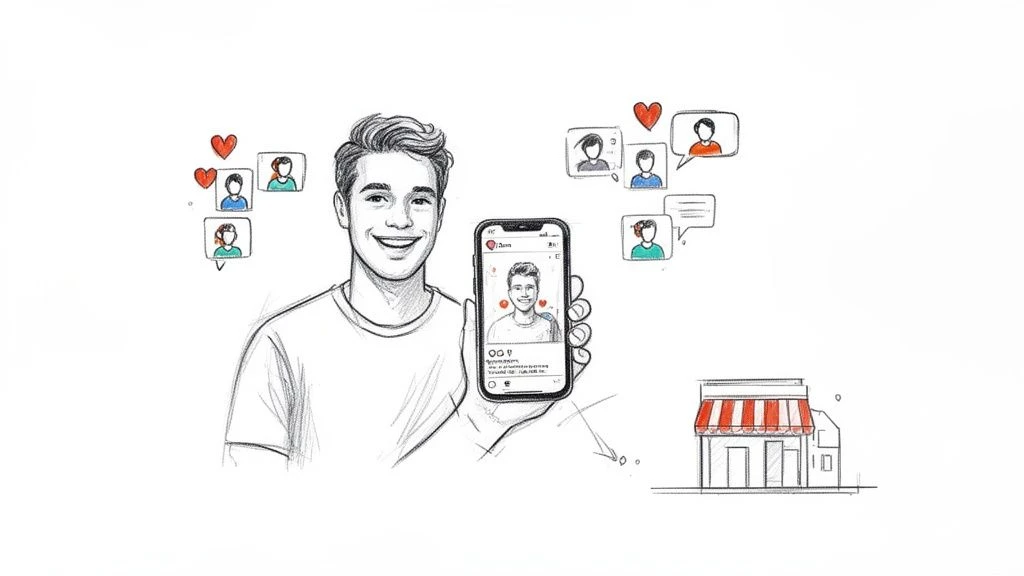
This strategy leverages the trust influencers have built. When a respected food blogger shows how BonusQR helped a local cafe double its repeat customers, their recommendation acts as a powerful, third-party endorsement that feels more like a trusted suggestion than a sales pitch.
Why Influencer Marketing is a Must-Have Strategy
This approach lets you tap into a pre-built, niche audience of your ideal customers. Instead of casting a wide net, you reach a concentrated group of salon owners or restaurant managers already looking for growth solutions. This is one of the most effective mobile app marketing strategies for building brand trust and driving qualified downloads. A partnership with a micro-influencer focused on retail business tips can generate more high-quality leads than a broad ad campaign.
Actionable Influencer Marketing Tips for Your Loyalty App
- Focus on Niche Micro-Influencers: Prioritize partners in specific verticals like restaurants or beauty salons. Their smaller, more engaged audiences often deliver a higher ROI.
- Create Clear Partnership Agreements: Define deliverables, compensation, and key performance indicators (KPIs) upfront. Track metrics like app downloads and sign-ups.
- Provide Unique Promo Codes: Give each influencer a unique discount code or referral link. This offers value to their audience and allows you to track conversions accurately.
- Encourage Authentic Content: Ask influencers to show behind-the-scenes content of them setting up the app or interviewing a business owner who uses it. This resonates far more than a scripted ad.
- Establish Long-Term Partnerships: Consider working with key influencers for 3-6 months. Sustained visibility builds deeper trust and keeps your app top-of-mind.
3. Email Marketing and In-App Push Notifications
Email and push notifications are your direct lines of communication to keep users engaged long after they download your app. For a loyalty app aimed at small business owners, this means sending strategic messages that guide them on setup, share success stories, and announce new features.
These channels bring users back into your app and reinforce its benefits. A well-timed push notification about a new customer signing up for their loyalty program can be incredibly motivating for a salon owner, while a weekly email digest with usage stats helps a cafe manager see tangible ROI.
Why Direct Communication is a Must-Have Strategy
Strategic messaging transforms your app from a passive tool into an active business partner. This is one of the most effective mobile app marketing strategies because it builds a relationship, reduces churn, and drives feature adoption. For instance, an email sequence guiding a new restaurant owner through setting up their first digital punch card dramatically increases their chance of becoming a long-term user.
Actionable Communication Tips for Your Loyalty App
- Segment Your Audience: Group users by business type, such as “coffee shops” or “salons.” Send tailored tips relevant to their industry.
- Create Onboarding Email Sequences: Welcome new business owners with a series of emails. Guide them through setup, share case studies, and highlight key features.
- Use Behavioral Triggers: Send automated messages based on user actions. If a user hasn't finished setup after three days, send a helpful reminder. When they hit 100 loyalty customers, send a congratulatory push notification.
- Keep Notifications Valuable: Limit push notifications to 2-3 times per week. Focus on high-value alerts, such as new feature announcements or weekly performance summaries.
- Personalize and Be Direct: Use the business owner’s name in subject lines. Include clear calls-to-action (CTAs) that link directly to a specific screen in your app. Explore more ideas on automated marketing for small business to see how these tactics fit into a larger strategy.
4. Content Marketing and Educational Resources (includes Webinars & Live Demos)
Content marketing is creating and sharing valuable, free content to attract and convert prospects into customers. For a loyalty app like BonusQR, this means teaching small business owners how to build customer loyalty, positioning your brand as a helpful expert.
This approach builds trust and authority. Instead of directly selling your app, you provide solutions to a business owner’s biggest challenges, like customer churn. When they are ready to invest in a tool, your app will be the first one they think of.
Why Content is a Must-Have Strategy
This is one of the most effective mobile app marketing strategies for long-term growth. By addressing the questions your target audience is already searching for on Google, you attract highly qualified leads organically. A cafe owner searching for “how to get more repeat customers” is an ideal user, and your helpful blog post can be their first interaction with your brand.
Actionable Content & Webinar Tips for Your Loyalty App
- Solve Specific Pain Points: Create blog posts that answer real questions, like “How to Reduce Customer Churn in a Coffee Shop” or “5 Low-Cost Ways to Increase Salon Client Visits.”
- Host Educational Webinars: Host a monthly live demo on a topic like “Turning First-Time Customers into Regulars.” Require an email signup to attend and offer a special discount to attendees.
- Create Downloadable Resources: Develop checklists or ebooks like “The Ultimate Guide to Launching a Restaurant Rewards Program.” Gate this content behind an email signup form to capture leads.
- Showcase Success Stories: Write detailed case studies featuring real merchants who increased their revenue using your app. Concrete numbers and testimonials are incredibly persuasive.
- Repurpose Everything: Turn a successful blog post into a short video for social media, an infographic, and a topic for your next webinar.
5. Social Media Marketing and Community Building
Social media marketing involves using platforms like Instagram, Facebook, and LinkedIn to connect with potential users and build a loyal community. It’s about creating a space where small business owners can learn, share success stories, and see how your loyalty app solves their specific problems.
This strategy transforms marketing from a one-way broadcast into a two-way conversation. By building an engaged community, you create brand advocates who will promote your app through word-of-mouth.
Why Social Media is a Must-Have Strategy
A strong social media presence puts your loyalty app directly in front of your target audience. Mastering effective Social Media & Community Management is paramount for building a loyal user base. This approach fosters trust and provides invaluable social proof, showing other business owners that your app delivers real results.
Actionable Social Media Tips for Your Loyalty App
- Focus Your Platforms: Concentrate on platforms where business owners are most active, like LinkedIn for B2B articles and Facebook or Instagram for visual success stories.
- Showcase Merchant Success: Post short video testimonials or graphics showing how a local salon increased repeat business by 20% with your digital punch card system.
- Create Valuable, Native Content: Produce short, engaging videos (like Instagram Reels) demonstrating how easy it is to set up a new reward.
- Build a Community Hub: Create a private Facebook Group for your users to ask questions, share tips, and feel part of an exclusive community.
- Engage Authentically: Respond to every comment and message. Run a monthly challenge to encourage interaction and user-generated content.
6. Referral Programs and Word-of-Mouth Marketing
Referral programs turn your existing, happy users into your most effective sales team. This strategy incentivizes your current merchants to recommend your loyalty app to other business owners. For a small business owner, a recommendation from a trusted peer is far more persuasive than any advertisement.
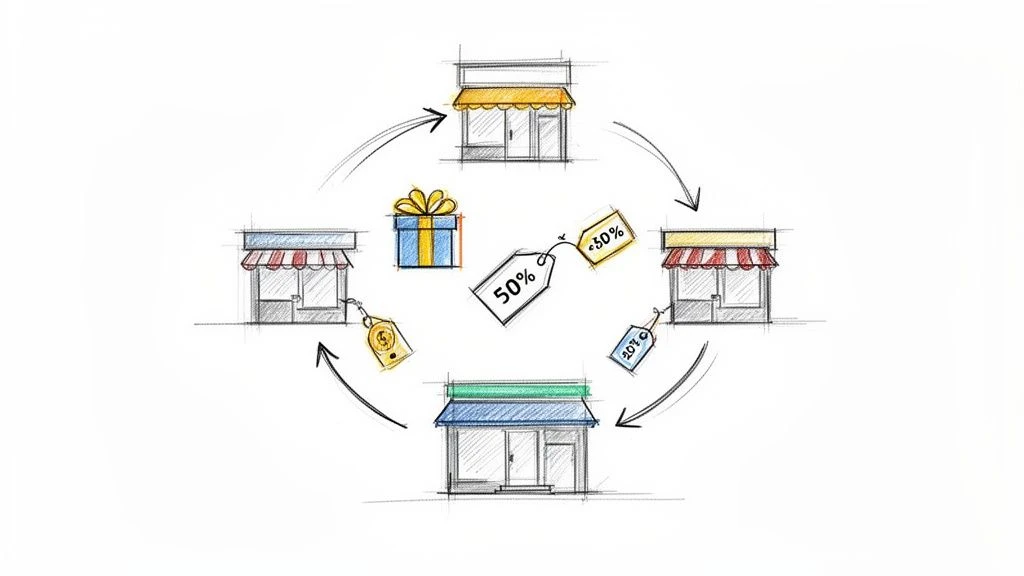
This approach creates a powerful growth loop. When a coffee shop owner successfully uses your app to boost sales, they are perfectly positioned to refer it to the salon owner next door. By rewarding both the referrer and the new user, you create a win-win scenario that fuels organic, cost-effective growth.
Why Referral Programs are a Must-Have Strategy
Word-of-mouth is one of the most trusted forms of marketing. Referral programs formalize this process, creating a scalable engine for user acquisition. This is one of the mobile app marketing strategies that relies on genuine satisfaction, leading to higher-quality sign-ups and better long-term retention. Dropbox famously used a dual-sided referral program to grow from 100,000 users to 4 million in just 15 months.
Actionable Referral Tips for Your Loyalty App
- Offer Dual-Sided Rewards: Give both the referrer and the new business owner a compelling incentive, like a free month of premium features.
- Keep It Simple: Make the referral process effortless. Integrate a "Refer a Friend" button directly into your app’s dashboard that allows sharing with a single click.
- Provide Referral Templates: Equip your users with pre-written messages and promotional materials they can easily share.
- Track and Celebrate Success: Create a leaderboard or recognition program for your top referrers. Celebrating their success can motivate others. If you're wondering how to foster that initial loyalty, discover how loyalty program apps help increase customer retention.
7. Paid Advertising (Facebook, Google, LinkedIn)
Paid advertising runs targeted ad campaigns on platforms like Facebook, Google, and LinkedIn to accelerate user acquisition. While organic methods build a foundation, paid ads put your loyalty app directly in front of small business owners actively searching for customer retention solutions.
This strategy allows you to bypass the slow build of organic growth and instantly tap into massive user bases. You can target a cafe owner on Facebook, a restaurant manager searching on Google, or a retail decision-maker on LinkedIn with specific messaging.
Why Paid Advertising is a Must-Have Strategy
Paid advertising delivers speed, scale, and precision. It is one of the most effective mobile app marketing strategies because you can precisely define your audience by job title, business type, location, and interests. This ensures your marketing budget is spent reaching high-intent prospects. For example, a campaign can target salon owners within a 10-mile radius who have shown interest in point-of-sale systems.
Actionable Paid Advertising Tips for Your Loyalty App
- Segment Your Audiences: Create separate campaigns for different industries. An ad showing a digital coffee punch card will resonate with cafe owners.
- Start with LinkedIn for B2B: Use LinkedIn Ads to target users by job title ("Restaurant Manager," "Small Business Owner") and company size.
- Use Facebook for Niche Targeting: Leverage Facebook’s detailed targeting to find owners of "coffee shops" or "boutique stores." Use retargeting to show ads to people who have visited your website.
- Dominate Google Search: Bid on keywords like “customer loyalty software for retail” and “best rewards app for cafes” to capture users actively looking for a solution.
- Create Industry-Specific Creative: Use video ads to demonstrate how your app solves a specific problem, like how easy it is for a barista to scan a customer’s QR code.
- Track Your Cost Per Acquisition (CPA): Set up conversion tracking to monitor how much it costs to get one app install or free trial sign-up.
8. Strategic Partnerships and Integrations
Strategic partnerships involve connecting your loyalty app with other business tools your target audience already uses, like Point of Sale (POS) systems, payment platforms, or email marketing software. When your app works seamlessly with a coffee shop’s Square POS, you provide immense value and create a natural marketing channel.
This approach taps into established trust and user bases. A small business owner is far more likely to adopt a new tool if it integrates with their existing, essential systems. It transforms your app from a standalone product into an indispensable part of their business ecosystem.
Why Partnerships are a Must-Have Strategy
Integrations create a "sticky" product while opening powerful co-marketing opportunities. When your app integrates with a popular POS like Toast or Clover, you can be featured in their app marketplace, instantly reaching thousands of qualified business owners. This is one of the most effective mobile app marketing strategies for B2B apps, leveraging a partner's credibility and distribution channel.
Actionable Partnership Tips for Your Loyalty App
- Identify Key Integration Partners: Research the top POS systems, booking platforms, and payment processors used in your target industries.
- Develop Seamless Integrations: Focus on integrations that eliminate manual work, like automatically awarding loyalty points based on transaction data from the POS system.
- Create Co-Marketing Content: Work with partners to create co-branded case studies, blog posts, or webinars.
- Establish a Referral Program: Create mutual referral agreements with local business consultants or marketing agencies who advise small businesses.
- Build a Presence in App Marketplaces: Get your app listed on major platforms like the Shopify App Store or HubSpot App Marketplace.
9. Free Trial and Freemium Model
A free trial or freemium model lowers the barrier to entry. It allows small business owners to experience your app's value firsthand, risk-free, before committing to a paid subscription. For a loyalty app like BonusQR, this means letting a cafe owner set up a digital punch card and see customers use it, proving its ROI directly.
This approach builds trust and demonstrates tangible benefits. Instead of just telling a salon owner that your app can increase customer retention, you let them see it happen. Successful platforms like Shopify and Canva grew by letting users experience their core features for free.
Why a Risk-Free Model is a Must-Have Strategy
Offering a free trial is one of the most persuasive mobile app marketing strategies because it shifts the focus from cost to value. When a business owner can track customer visits during a 14-day trial without providing credit card details, they are far more likely to convert. This model lets the quality of your product do the selling for you.
Actionable Tips for Your Loyalty App Trial
- Keep it Simple and Short: Offer a 14 to 30-day free trial. Require only an email to sign up, removing friction.
- Guide Users to “Aha!” Moments: During the trial, use automated emails and in-app messages to guide users toward key actions, like creating their first reward.
- Showcase the ROI: Provide a simple dashboard that visualizes success metrics, such as "new customers added" or "repeat visits tracked."
- Create a Smooth Upgrade Path: Send reminders a few days before the trial ends. Offer a small incentive, like a first-month discount, to encourage them to upgrade.
- Gather Feedback: Ask users who don't convert for feedback to identify and fix friction points in your onboarding process.
10. SEO and Organic Search Marketing
Search Engine Optimization (SEO) is optimizing your website and content to rank higher in search results on Google. While ASO focuses on app stores, SEO targets the web, where small business owners often start their research for solutions like a "digital punch card app" or "simple loyalty program for my cafe."
This strategy is about attracting business owners to your website. When a salon owner searches for "how to increase customer visits," your blog post on that topic can introduce them to your loyalty app as the perfect solution, generating highly qualified and cost-effective leads.
Why SEO is a Must-Have Strategy
SEO positions your app as an authoritative solution. Unlike paid ads, which stop when you stop paying, a high-ranking blog post can generate consistent, free traffic for years. This is one of the most powerful mobile app marketing strategies for long-term growth. HubSpot built a multi-billion dollar company by creating helpful content that ranks for terms their target customers search for.
Actionable SEO Tips for Your Loyalty App
- Target Long-Tail Keywords: Focus on specific phrases business owners use, like "best loyalty app for restaurants" or "customer retention app for salons."
- Create Comprehensive Guides: Write detailed blog posts that solve your audience's problems, like "5 Ways to Boost Repeat Business in a Coffee Shop."
- Optimize for Local Search: Create pages targeting specific locations, such as "loyalty app for businesses in New York," and build citations in local directories.
- Build Quality Backlinks: Earn links from reputable websites in the restaurant, retail, or salon industries by guest posting on industry blogs or getting featured in local business publications.
- Monitor and Improve: Use free tools like Google Search Console to track which keywords drive traffic to your site and identify new opportunities.
Mobile App Marketing: 10-Point Strategy Comparison
| Strategy | Implementation complexity | Resource requirements | Expected outcomes (timeline) | Ideal use cases | Key advantages |
|---|---|---|---|---|---|
| App Store Optimization (ASO) | Moderate - ongoing optimization & A/B testing | ASO tools, designers for assets, analytics | Improved app visibility and organic installs (3-6 months) | App discovery, localized markets, targeting app shoppers | Cost-effective long-term growth; builds credibility |
| Influencer & Micro-Influencer Marketing | Low-Moderate - campaign setup and vetting | Budget for creators, outreach, tracking codes | Short-term awareness and trust; potential viral bursts (weeks-months) | Local niches (restaurants, salons), authentic demos | High credibility and targeted engagement |
| Email Marketing & In-App Push Notifications | Moderate - segmentation & automation required | Email/push platform, copywriters, analytics | Fast re-engagement and measurable conversions (immediate-weeks) | Onboarding, retention, promotions, churn reduction | Direct, highly measurable, very high ROI |
| Content Marketing & Educational Resources (Webinars & Demos) | High - consistent production and event management | Writers, video/webinar tools, SEO, presenters | Organic leads and authority; steady pipeline (3-12 months) | Thought leadership, education, qualified lead generation | Builds trust, supports SEO, attracts high-quality leads |
| Social Media Marketing & Community Building | Moderate-High - frequent content and moderation | Community manager, creatives, platform tools | Increased brand awareness and engagement (weeks-months) | Community support, social proof, local engagement | Low-cost awareness, user-generated content, advocacy |
| Referral Programs & Word-of-Mouth | Moderate - tracking, incentives, fraud controls | Referral software, incentive budget, tracking | Very high conversion and low CAC as network grows (months) | Viral merchant acquisition, peer recommendations | Highest conversion rates; scalable with low CAC |
| Paid Advertising (Facebook, Google, LinkedIn) | Moderate-High - targeting & optimization skills | Ad spend, creative assets, ad management tools | Immediate visibility and traffic; measurable CPA (instant-weeks) | Fast acquisition, targeted B2B campaigns, retargeting | Scalable, highly targeted, quickly testable |
| Strategic Partnerships & Integrations | High - technical integration and partner ops | Dev resources, partner managers, co-marketing budget | Expanded reach and product stickiness (months-year) | POS/payment integrations, co-marketing, enterprise channels | Access to partner customer bases; increases retention |
| Free Trial & Freemium Model | Moderate - onboarding and support processes | Product readiness, support team, analytics | High self-service conversions and product-led growth (immediate-weeks) | SMB self-service adoption, demo-to-paid conversion | Low friction adoption; generates usage data for upsell |
| SEO & Organic Search Marketing | High - technical SEO and sustained content | SEO specialists, content team, tools | High-intent organic traffic and conversions (3-6+ months) | Capture merchants actively searching for loyalty solutions | Sustainable, cost-effective, attracts qualified prospects |
Ready to Launch Your Loyalty Program? Start Simply and Effectively.
Navigating the world of mobile app marketing can feel overwhelming. We've covered a wide array of powerful mobile app marketing strategies, from ASO and SEO to social media and referral programs. You've learned about push notifications, partnerships, and paid ads. It’s a lot to take in.
But here’s the most important takeaway: You don’t need to do everything at once. The most successful small businesses start with a solid, manageable foundation and build from there. The goal is progress, not perfection.
Your Actionable Blueprint for Success
Feeling overwhelmed is normal. To cut through the noise, focus on the core principle: delivering undeniable value to your customers. A loyalty program is the most direct way to do this, turning one-time visitors into repeat regulars.
Here are your immediate next steps:
- Choose Your "Big Three": Review the list. Which three feel most achievable right now? Perhaps it’s local SEO, a simple referral program, and engaging social media content. Write them down.
- Set One Simple Goal for Each: Define one clear, measurable goal for the next 30 days. For example:
- Local SEO: "Get 10 new positive Google reviews."
- Referral Program: "Have 20 customers successfully refer a friend."
- Social Media: "Post three times a week featuring our loyalty program."
- Implement a Simple, Effective Loyalty Tool: This is the foundation. Many loyalty platforms are too complex, expensive, and time-consuming for a busy small business owner. This is where a tool designed specifically for your needs becomes critical.
Key Insight: The best marketing tool is the one you and your team will actually use. Simplicity beats complexity every time when it comes to long-term results.
The Smartest, Simplest First Step
For most small businesses, the challenge isn’t a lack of ambition; it’s a lack of time and resources. You need a solution that works for you. BonusQR was designed to solve this exact problem. It’s the simplest way to launch a digital loyalty program using the QR code technology your customers already understand.
Forget convincing customers to download another app. Forget clunky hardware or lengthy training. With a simple QR code scan, customers can join your program and start earning rewards, creating a frictionless experience that encourages participation.
By combining an intuitive tool like BonusQR with a few of the high-impact mobile app marketing strategies from this guide, you can create a powerful engine for customer retention. You can build a thriving community of loyal fans without the high cost or operational headaches. The path to growing your loyal customer base is clearer than ever.
Ready to see just how easy customer loyalty can be?
Start your free trial of BonusQR today and create your first digital punch card in under five minutes.


